Subatomic Particles Isotopes And Ions
Learn and apply Subatomic Particles Isotopes And Ions in the published Chemistry course sequence.
Continue where you stopped
The core idea
On this page
Subatomic Particles, Isotopes and Ions: Orientation
This lesson builds the “atoms questions” reflexes: extract protons, neutrons and electrons quickly, then write one precise sentence about isotopes, ions or deflection.
Begin with the Atomic Structure hub if you need the full learning sequence. The particle model developed here is used again when explaining trends in the Periodic Table.
Definitions (Must Know)
Proton number, Z
The proton number Z is the number of protons in the nucleus.
Nucleon number, A
The nucleon number A is the total number of protons and neutrons in the nucleus.
Isotope
Isotopes are atoms of the same element with the same number of protons but different numbers of neutrons.
Ion
An ion is an atom or group of atoms with a net charge because electrons have been gained or lost. A cation is positive because electrons were lost; an anion is negative because electrons were gained.
Detailed Explanations
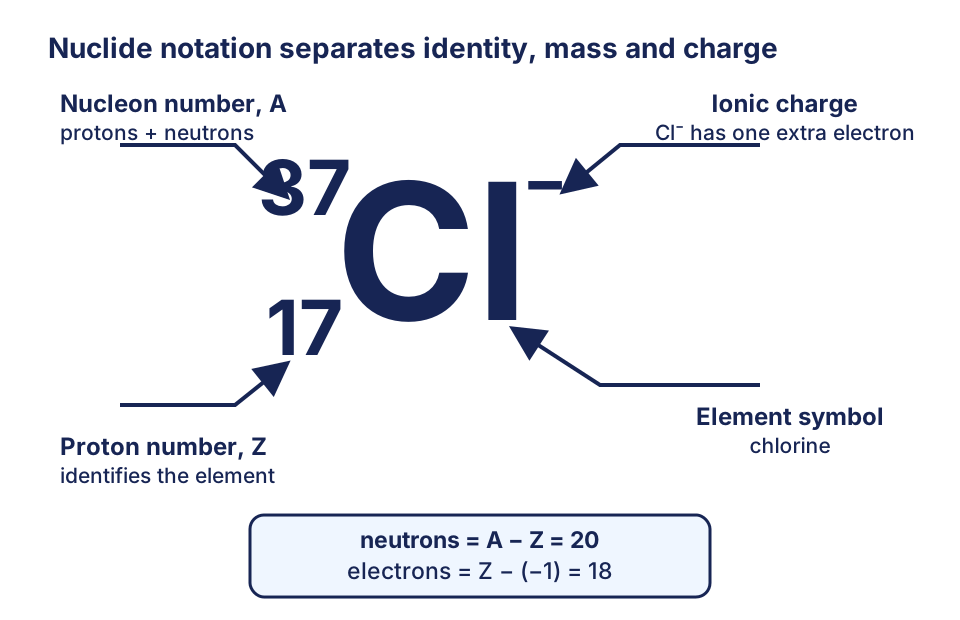
Reading a nuclide symbol
For ²³₁₁Na⁺:
- protons = 11;
- neutrons = 23-11 = 12;
- electrons = 11-1 = 10.
The + charge affects only the electron count. It does not change the proton or neutron count.
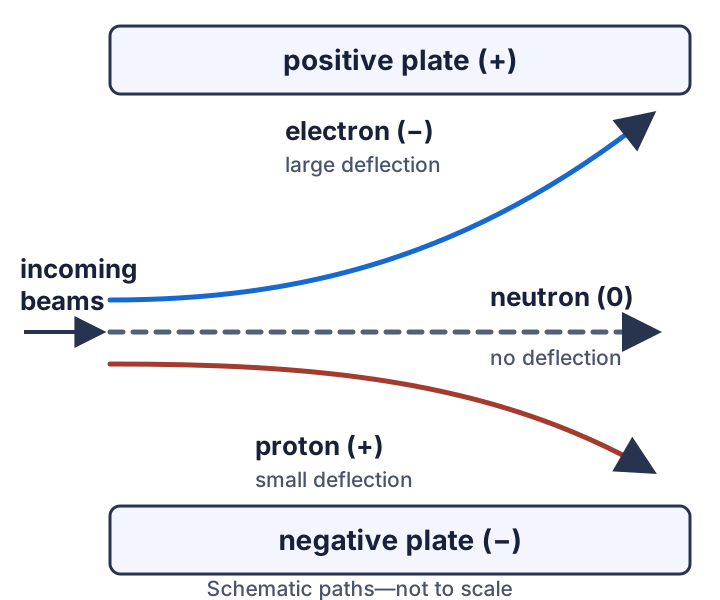
Deflection in an electric field
An electric field exerts a force on a charged particle:
- a positive particle accelerates towards the negative plate;
- a negative particle accelerates towards the positive plate;
- a neutral particle is not deflected.
For particles entering at the same speed, the size of the deflection depends on the magnitude of the charge-to-mass ratio, |q|/m. An electron and proton have equal charge magnitude, but an electron has far less mass. The electron therefore undergoes a much greater acceleration and bends more strongly.
Where mass and charge are found
Almost all atomic mass is concentrated in the nucleus because protons and neutrons each have relative mass 1. The nucleus also contains all the positive charge. The electron cloud occupies most of the atom’s volume and carries negative charge. A neutral atom has equal proton and electron counts, so its overall charge is zero.
Relative atomic mass and isotope-abundance calculations belong in The Mole Concept and Stoichiometry. In Atomic Structure, first establish what makes two atoms isotopes.
Worked Examples
Modelled example 1
Counting particles in an ion
Problem
State the numbers of protons, neutrons and electrons in ³⁷₁₇Cl⁻.
Study the worked solution
Read the proton number
Method
Use the lower-left number, Z.Reason
The proton number defines the element.Working
Protons = Z = 17.Calculate the neutron number
Method
Subtract proton number from nucleon number.Reason
The nucleon number counts protons and neutrons together.Working
Neutrons = A-Z = 37-17 = 20.Account for the ionic charge
Method
Add one electron to the neutral-atom count.Reason
A 1- ion has gained one negatively charged electron while its nucleus is unchanged.Working
Electrons = 17 + 1 = 18.
Guided practice 2
Writing an isotope explanation
Problem
Explain why ³⁵Cl and ³⁷Cl are isotopes.
Try this before viewing the solution
Hints
Hint 1: establish the same element
Hint 2: establish the difference
View solution step by step
Establish the element identity
Method
State that both have proton number 17.Reason
Atoms with the same proton number are the same element, chlorine.Working
Both nuclides contain 17 protons.Establish the isotopic difference
Method
State that their neutron numbers differ.Reason
The nucleon numbers are 35 and 37 while the proton number remains 17.Working
³⁵Cl has 18 neutrons and ³⁷Cl has 20 neutrons.
Common misconception 3
Separate Mass from Charge
Learner claim
A learner says, “A neutral atom should be positively charged because each proton is much heavier than each electron.” Identify the misconception and correct the claim.
Identify what determines net charge
View solution step by step
Separate the two properties
Method
Use particle charge, not particle mass, to determine net charge.Reason
A proton has charge + 1 and an electron has charge -1 in relative-charge units despite their very different masses.Working
Mass affects the atom’s mass; it does not change either particle’s charge magnitude.Correct the claim
Method
Compare the numbers of protons and electrons.Reason
Equal numbers give equal and opposite total charges.Working
A neutral atom has the same number of protons and electrons, so its net charge is zero.
Examiner practice 4
Comparing electric-field paths
Problem
Electron and proton beams enter the same electric field at the same speed. State the direction in which each beam bends and explain which bends more. [3 marks]
Try this before viewing the solution
View solution step by step
State the proton direction
1 markMethod
The proton beam bends towards the negative plate.Reason
Positive and negative charges attract.Working
p⁺ → negative plateState the electron direction
1 markMethod
The electron beam bends towards the positive plate.Reason
The electron is negatively charged.Working
e⁻ → positive plateCompare the deflections
1 markMethod
The electron beam bends more.Reason
Both particles have the same charge magnitude, but the electron has much smaller mass and therefore much larger |q|/m.Working
(|q|/m)_electron > (|q|/m)ₚᵣₒₜₒₙ
Self-mark with the mark scheme
Compare your response with each mark point. Select a point only when your response contains that evidence.
Credit both directions and the charge-to-mass comparison separately.
Challenge 5
Reconstruct Two Related Ion Nuclides
Problem
Species P contains 12 protons, 12 neutrons and 10 electrons. Species Q contains 12 protons, 13 neutrons and 10 electrons. Proton number 12 is magnesium. Write the full nuclide symbol for each species, including charge, and explain how P and Q are related.
Try this before viewing the solution
Hints
Hint 1: build each nucleon number
Hint 2: deduce each charge
View solution step by step
Construct species P
Method
Add its 12 protons and 12 neutrons, then compare protons with electrons.Reason
Nucleon number is p + n, while charge is set by the proton-electron imbalance.Working
A = 24 and charge = 12-10 = 2 +, so P is ²⁴₁₂Mg²⁺.Construct species Q
Method
Repeat the two deductions using 13 neutrons.Reason
The different neutron count changes nucleon number but not element identity or charge.Working
A = 25 and charge = 2 +, so Q is ²⁵₁₂Mg²⁺.State the relationship
Method
Identify P and Q as isotopes of the same element.Reason
They have the same proton number but different neutron numbers; both have also formed 2 + ions.Working
P and Q are magnesium isotopes with the same ionic charge.
Mind Stretchers
Attempt each unfamiliar situation before opening the hint.
Mind stretcher 1: Reconstructing an unknown nuclideExtension
An ion has 18 electrons and 20 neutrons. It has a 1- charge. Identify the element and write the nuclide symbol.
Show Hint
A 1- ion has one more electron than proton. Work backwards from the electron count, then add protons and neutrons to obtain A.
Show Answer
The ion has 18-1 = 17 protons, so it is chlorine. Its nucleon number is 17 + 20 = 37. The nuclide symbol is ³⁷₁₇Cl⁻.
Mind stretcher 2: Deducing three unknown particle beamsExtension
Three beams enter the same electric field at the same speed. Beam A bends slightly towards the negative plate, beam B travels straight, and beam C bends strongly towards the positive plate. Identify the three beams and explain all three paths.
Show Hint
Use direction to establish the sign of charge. Then use relative curvature to distinguish the two charged particles.
Show Answer
Beam A is protons: its positive particles bend towards the negative plate. Beam B is neutrons: neutral particles experience no electric force. Beam C is electrons: its negative particles bend towards the positive plate. Electrons bend more strongly than protons because their charge magnitudes are equal but electron mass is far smaller, giving a much larger |q|/m.
Mind stretcher 3: Testing charge-to-mass reasoningExtension
An alpha-particle beam and a proton beam enter the same electric field at the same speed. An alpha particle has charge + 2e and mass approximately four times the proton mass. Predict which beam bends more and justify your answer without using memorised paths.
Show Hint
Compare the two values of |q|/m relative to the proton value e/mₚ.
Show Answer
For a proton, |q|/m = e/mₚ. For an alpha particle, |q|/m ≈ 2e/(4mₚ) = 0.5e/mₚ. Both beams bend towards the negative plate, but the proton beam bends more because its charge-to-mass ratio is about twice as large.