Dynamic Equilibrium And Le Chatelier
Learn and apply Dynamic Equilibrium And Le Chatelier in the published Chemistry course sequence.
Continue where you stopped
The core idea
On this page
Dynamic Equilibrium and Le Chatelier’s Principle: Orientation
Equilibrium questions are mostly “language + logic”: define equilibrium correctly, then apply Le Chatelier with one clean chain (disturbance → shift → effect on named species → whether K changes).
Use the course selector and topic navigator on this page to move between this equilibrium concept lesson, the equilibrium-constant lesson for your course, and the Chemical Equilibria hub.
Definitions (Must Know)
A. Reversible reaction
A reversible reaction can proceed in both the forward and reverse directions under the same conditions.
B. Dynamic equilibrium
A system is at dynamic equilibrium when the forward and reverse reaction rates are equal, so macroscopic quantities (e.g. concentration, pressure) remain constant.
C. Le Chatelier’s principle
Le Chatelier’s principle: when a system at equilibrium is disturbed, the position of equilibrium shifts to oppose the disturbance.
D. Position of equilibrium
The position of equilibrium describes which side has a higher proportion of products/reactants at equilibrium (not “equal amounts”).
Key Ideas (What Earns Marks)
- Equilibrium must be in a closed system (no loss of reactants/products).
- At equilibrium, rates are equal, but concentrations are not necessarily equal.
- A catalyst does not change the position of equilibrium; it increases both forward and reverse rates.
- Concentration/pressure changes shift equilibrium to reduce the change; temperature changes shift based on endothermic/exothermic direction.
- Changing conditions does not change K unless temperature changes.
Fast decision table:
| Change | Equilibrium position | K value |
|---|---|---|
| concentration | may shift | unchanged |
| pressure (gases) | may shift | unchanged |
| catalyst | no shift | unchanged |
| temperature | shifts depending on Δ H | changes |
- State the disturbance. 2) State the shift direction. 3) State the effect on a named species. 4) State whether K changes.
Quick visuals (equilibrium reached + disturbance):
Reaching Dynamic Equilibrium in a Closed System (Example)
Reaching Dynamic Equilibrium in a Closed System (Example). A (reactant), B (product) plotted as Concentration against Time.
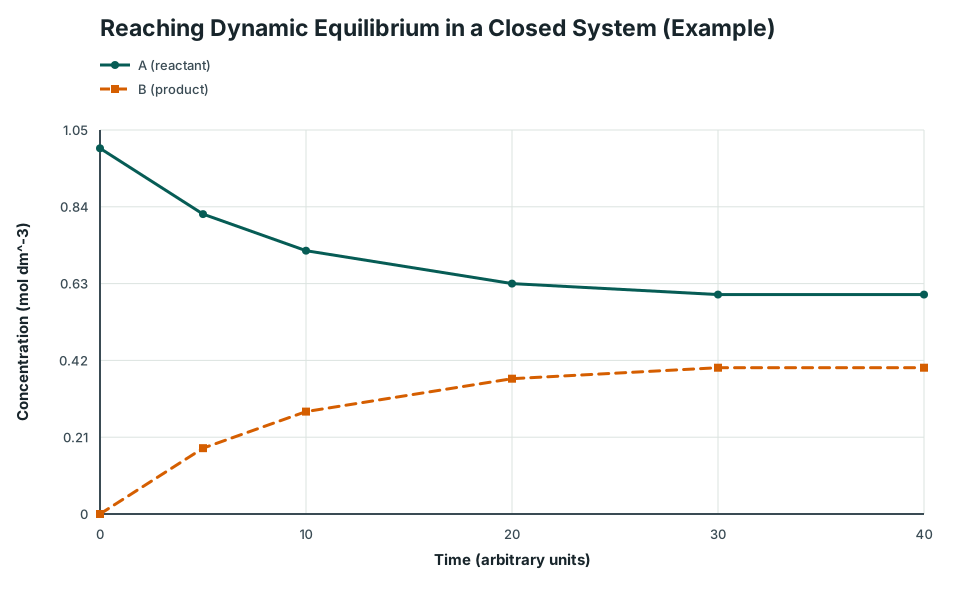
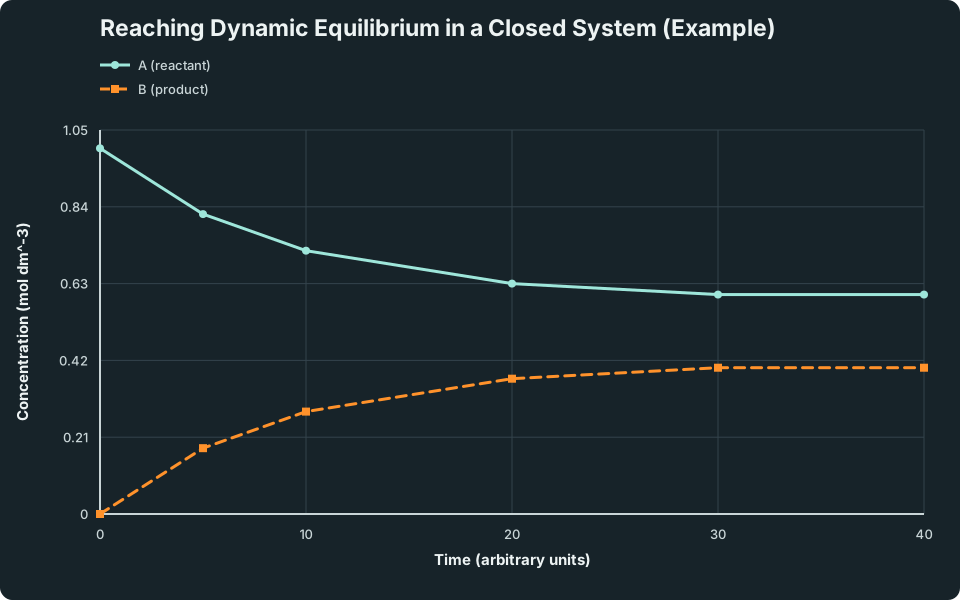
Explore the graph to compare how the reactant falls while the product rises towards constant equilibrium concentrations.
Optional interaction loads only after you choose Explore graph.
View figure data
| Time (arbitrary units) | A (reactant) | B (product) |
|---|---|---|
| 0 | 1 | 0 |
| 5 | 0.82 | 0.18 |
| 10 | 0.72 | 0.28 |
| 20 | 0.63 | 0.37 |
| 30 | 0.6 | 0.4 |
| 40 | 0.6 | 0.4 |
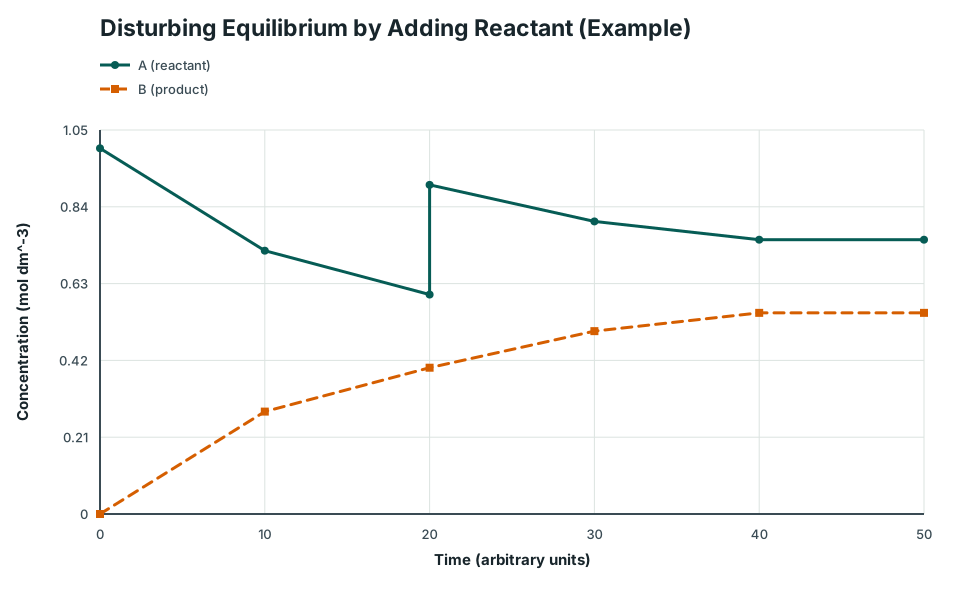
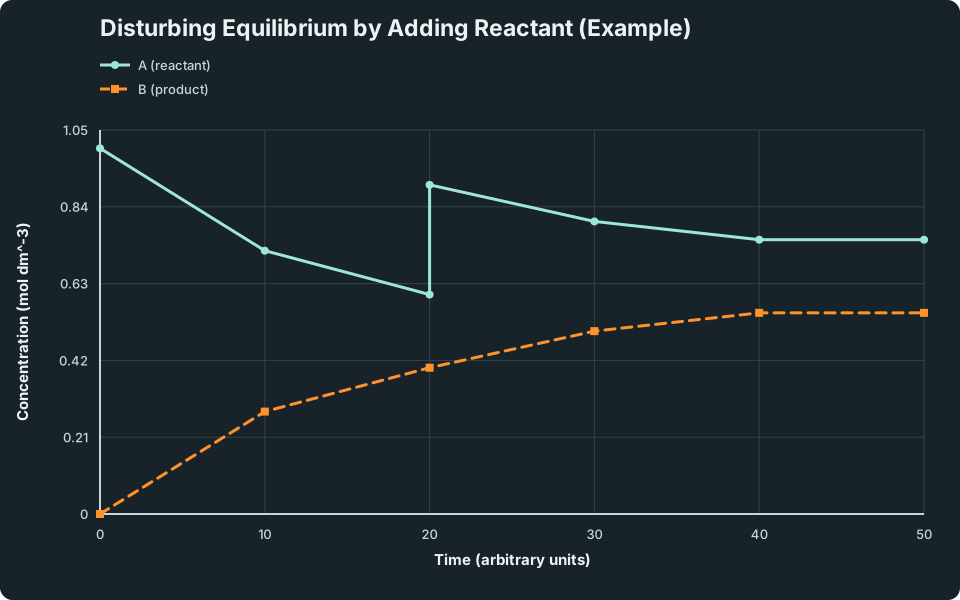
Disturbing Equilibrium by Adding Reactant (Example)
Disturbing Equilibrium by Adding Reactant (Example). A (reactant), B (product) plotted as Concentration against Time.
Scroll across the graph to read all labels.
View figure data
| Series | Time (arbitrary units) | Time uncertainty | Concentration (mol dm^-3) | Concentration uncertainty |
|---|---|---|---|---|
| A (reactant) | 0 | 1 | ||
| A (reactant) | 10 | 0.72 | ||
| A (reactant) | 20 | 0.6 | ||
| A (reactant) | 20 | 0.9 | ||
| A (reactant) | 30 | 0.8 | ||
| A (reactant) | 40 | 0.75 | ||
| A (reactant) | 50 | 0.75 | ||
| B (product) | 0 | 0 | ||
| B (product) | 10 | 0.28 | ||
| B (product) | 20 | 0.4 | ||
| B (product) | 30 | 0.5 | ||
| B (product) | 40 | 0.55 | ||
| B (product) | 50 | 0.55 |
Detailed Explanations
A. A repeatable workflow (Le Chatelier questions)
- Write the balanced equilibrium equation (with states).
- Identify the disturbance (what changed?).
- Decide which side opposes it (uses up what was added, replaces what was removed).
- Conclude: “shifts left/right”, then state “more/less of X”.
Mini example: N₂(g) + 3H₂(g) ⇌ 2NH₃(g) If H₂ is added, the system removes added reactant by forming more NH₃ → shifts right.
B. Concentration changes
For: aA + bB ⇌ cC + dD
- Increasing a reactant concentration shifts equilibrium right (to use it up).
- Removing a product shifts equilibrium right (to replace it).
Because concentration changes do not change the reaction’s temperature, they do not change K; therefore the system shifts position until the new equilibrium concentrations satisfy the same K value.
C. Pressure changes (gases only)
Pressure effects matter when there are different total moles of gas on each side.
- Increasing pressure shifts to the side with fewer moles of gas.
- Decreasing pressure shifts to the side with more moles of gas.
Mini example: N₂(g) + 3H₂(g) ⇌ 2NH₃(g) Left: 4 mol gas, right: 2 mol gas, so increasing pressure shifts right (more NH₃).
D. Temperature changes
Treat heat as a reagent:
- If forward reaction is exothermic, heat is like a product. Increasing temperature shifts left.
- If forward reaction is endothermic, heat is like a reactant. Increasing temperature shifts right.
Because temperature changes change the relative favourability of products vs reactants, temperature is the only factor here that changes K.
E. Catalysts
A catalyst speeds up reaching equilibrium but does not change K or the final equilibrium composition.
Worked Examples
Modelled example 1
Model a pressure disturbance in ammonia formation
Problem
Study the worked solution
Count gaseous amounts
Method
Add the stoichiometric coefficients of gaseous species on each side.Reason
At constant temperature, increasing pressure favours the side occupying fewer gaseous moles.Working
Left: 1 + 3 = 4 mol gas; right: 2 mol gas.Oppose the disturbance
Method
Select the side with fewer gaseous moles.Reason
A shift to that side reduces the pressure increase.Working
The equilibrium shifts right.Name the composition effect
Method
State which product becomes more abundant at the new equilibrium.Reason
A rightward shift consumes nitrogen and hydrogen and forms ammonia.Working
The equilibrium yield of NH₃ increases.
Guided practice 2
Guide a temperature prediction
Problem
Try this before viewing the solution
Hints
Hint 1: place heat
Hint 2: oppose added heat
View solution step by step
Represent the thermal change
Method
Place heat on the product side of the exothermic forward reaction.Reason
That makes the reverse direction endothermic and able to absorb added heat.Working
reactants ⇌ products + heat.Predict the shift and yield
Method
Shift left to oppose the temperature increase.Reason
The endothermic reverse reaction consumes some of the added heat.Working
The equilibrium yield of forward products decreases.State the constant effect
Method
State that the equilibrium constant changes.Reason
Temperature changes the relative favourability of the forward and reverse reactions.Working
For this exothermic forward reaction, increasing temperature decreases K.
Common misconception 3
Correct an automatic pressure-shift claim
Learner claim
Compare gaseous counts
View solution step by step
Test the pressure condition
Method
Count gaseous coefficients on both sides.Reason
Pressure favours a side only when the total gaseous mole counts differ.Working
Left: 1 + 1 = 2 mol gas; right: 2 mol gas.Correct the prediction
Method
State that neither side is favoured.Reason
Shifting either way would not reduce the total gaseous mole count.Working
There is no shift in equilibrium position, and K is unchanged because temperature is constant.
Examiner practice 4
Explain a concentration disturbance
Problem
Try this before viewing the solution
View solution step by step
Predict the response
1 markMethod
State that equilibrium shifts right.Reason
The forward reaction consumes some of the added hydrogen.Working
Added reactant H₂ → rightward shift.Name the composition effect
1 markMethod
State that more hydrogen iodide is formed.Reason
A rightward shift favours the product side.Working
The amount of HI at the new equilibrium increases.Treat the constant
1 markMethod
State that K is unchanged.Reason
The temperature has not changed.Working
Concentration changes the equilibrium position, not K at fixed temperature.
Self-mark with the mark scheme
Compare your response with each mark point. Select a point only when your response contains that evidence.
Credit the direction, the named product effect and the fixed-temperature K statement separately.
Challenge 5
Separate competing equilibrium effects
Problem
Try this before viewing the solution
Hints
Hint 1: analyse separately
Hint 2: do not force a net direction
View solution step by step
Analyse pressure
Method
Compare the gaseous coefficients.Reason
Higher pressure favours the side with fewer gaseous moles.Working
Left: 3 mol gas; right: 2 mol gas, so pressure favours the right.Analyse temperature
Method
Treat heat as a product of the exothermic forward reaction.Reason
Higher temperature favours the endothermic reverse direction.Working
Temperature favours the left.Judge the combined outcome
Method
Keep the two qualitative effects separate.Reason
They favour opposite directions, and Le Chatelier’s principle does not quantify their relative sizes.Working
The net change in equilibrium SO₃ yield cannot be determined from this information alone.State the K effect
Method
Apply the temperature-only rule for the equilibrium constant.Reason
Increasing temperature disfavors products for an exothermic forward reaction.Working
K decreases; the pressure change itself does not alter K.
Mind Stretchers
Mind stretcher 1Extension
Explain why adding a catalyst does not change the equilibrium composition.
Show Hint
Separate the immediate disturbance from the subsequent shift, then decide independently whether temperature changed.
Show Answer
Mark scheme:
- A catalyst lowers activation energy for both forward and reverse reactions.
- Both rates increase, so equilibrium is reached faster.
- At equilibrium, rates are equal; the ratio of forward/reverse rate constants at a given temperature (related to K) is unchanged.
Mind stretcher 2: Disturbance, response and KExtension
Question. For 2SO₂(g) + O₂(g) ⇌ 2SO₃(g), oxygen is added at constant temperature and volume. Predict the shift, the eventual change in [SO₂], and whether K_c changes.
Show Hint
The system consumes some added oxygen by favouring the forward reaction; concentration changes alone do not change Kc.
Show Answer
The equilibrium shifts right, consuming SO₂ and producing more SO₃, so the eventual SO₂ concentration is lower than immediately before the disturbance. K_c is unchanged because temperature is unchanged.