Matter and Bonding Foundations
Key idea: Complete G2 lesson on particles, atoms, ions and simple ionic and covalent bonding.
Matter questions are strongest when an observation is connected to a particle, atomic or bonding model. State what the particles are, how they are arranged or interact, and why that produces the property.
1. Definition
Matter has mass and occupies space. A particle model describes matter using moving particles. An atom contains protons and neutrons in a nucleus with electrons in shells. A chemical bond is an attraction that holds atoms or ions together.
2. Key Ideas
- Solids have closely packed particles vibrating about fixed positions; liquid particles remain close but move past one another; gas particles are far apart and move rapidly.
- Heating increases particle kinetic energy. Melting and boiling absorb energy; freezing and condensation release energy.
- Proton number identifies an element. Isotopes have the same proton number but different neutron numbers.
- Electrons occupy shells. Atoms form ions by losing or gaining electrons.
- Ionic bonding follows electron transfer and attraction between oppositely charged ions.
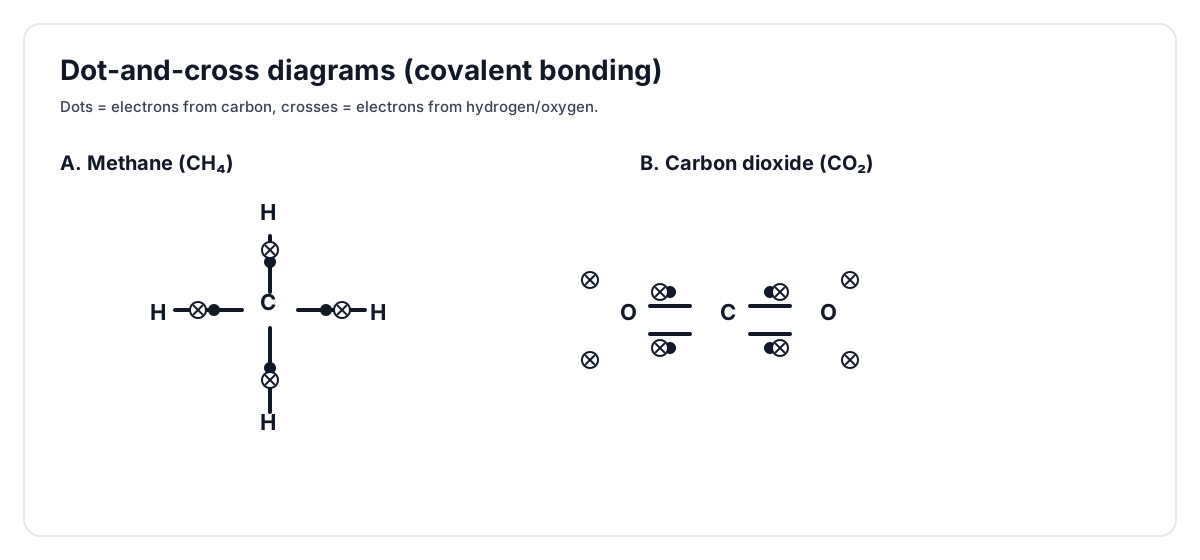
- Covalent bonding is the sharing of electron pairs between non-metal atoms.
- Simple molecular substances often have low melting and boiling points because intermolecular forces are weak.
3. Detailed Explanations
Particle evidence
A gas is easily compressed because its particles have large spaces between them. A liquid flows because its close particles can change neighbours. During a change of state, the substance remains the same substance: energy changes particle motion or attractions, not chemical identity.
Atomic bookkeeping
For a nuclide written as AZX:
A neutral atom has Z electrons. An ion’s charge records electrons lost or gained.
Bonding and properties
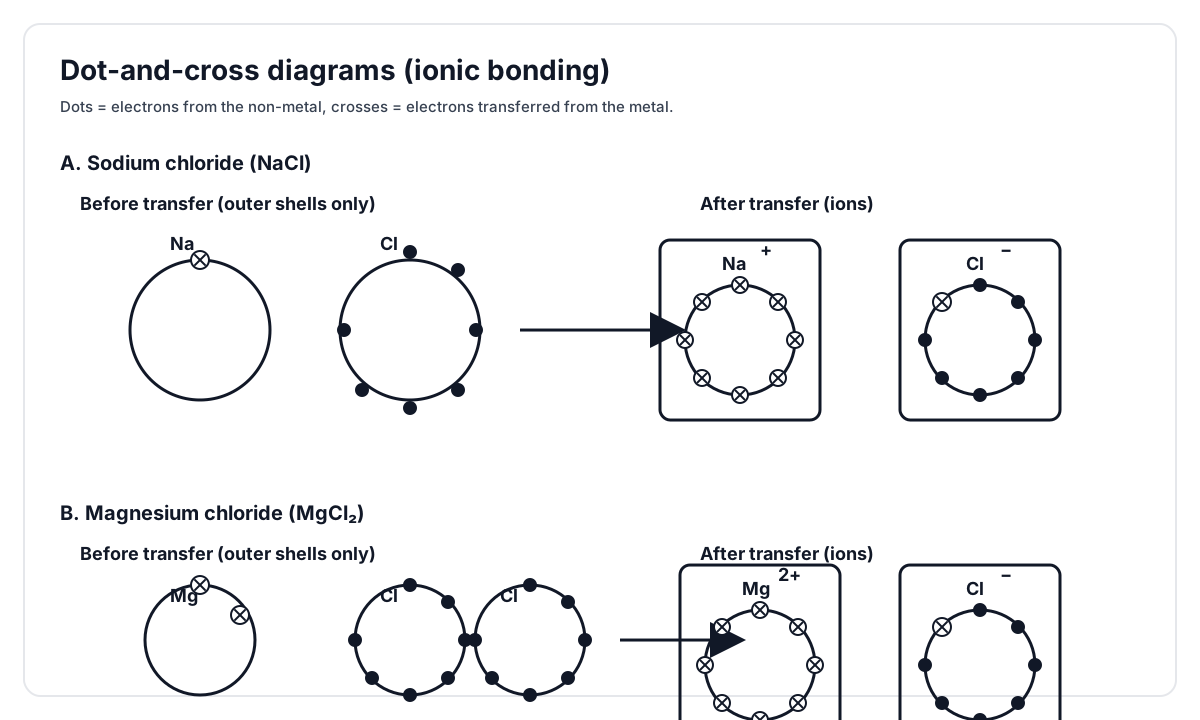
Sodium transfers one electron to chlorine:
The resulting ions form a giant ionic lattice. Strong electrostatic attractions give high melting points. Solid ionic compounds do not conduct because their ions are fixed; molten or aqueous ionic compounds conduct because ions can move.
In a simple covalent molecule, strong covalent bonds hold atoms together inside each molecule, but weaker intermolecular forces act between molecules. Melting or boiling overcomes the intermolecular forces.
4. Common Mistakes
- Particles do not swell when heated.
- Isotopes do not have different proton numbers.
- Ionic bonding is not electron sharing.
- Melting a simple molecular substance does not break its covalent bonds.
- Solid ionic compounds contain charged ions but cannot conduct because those ions are not mobile.
5. Exam Tips
Exam question 1: Explain conductivity by stateCore
Explain why solid sodium chloride does not conduct electricity but molten sodium chloride does.
Show Answer
Both contain ions. In the solid, the ions are fixed in a lattice and cannot carry charge through the substance. When molten, the ions are mobile and carry charge.
Use a three-part property explanation: name the structure, identify the particles and attraction, then explain what can or cannot move or be overcome.
6. Worked Examples
Example 1: Count particles in an ionCore
State the numbers of protons, neutrons and electrons in ²³₁₁Na⁺.
Show Answer
There are 11 protons, 23-11 = 12 neutrons, and 10 electrons because the atom has lost one electron to form a 1 + ion.
Example 2: Use evidence to deduce structureCore
A substance has a high melting point and conducts only when molten. Deduce its likely structure.
Show Answer
It is likely a giant ionic lattice: strong attractions require much energy to overcome, and charge is carried only when the ions become mobile.
7. Mind Stretchers
Mind stretcher 1: Distinguish two fluidsExtension
A gas and a liquid both flow. Which particle-model observation distinguishes them most directly?
Show Answer
A gas is readily compressed and fills its container because its particles are widely separated; a liquid has closely packed particles and a fixed volume.
Mind stretcher 2: Compare isotope behaviourExtension
Why can isotopes have the same chemical behaviour but slightly different mass-dependent physical properties?
Show Answer
They have the same electron configuration, which controls chemical behaviour, but different neutron numbers and therefore different masses.
Mind stretcher 3: Separate bonds from intermolecular forcesExtension
A molecular substance contains strong covalent bonds. Why can it still have a low boiling point?
Show Answer
Boiling separates molecules and overcomes the weaker forces between them; it does not break the strong covalent bonds within each molecule.
8. Quiz
Before attempting the assessment, check that you can:
- compare particle arrangement, motion and spacing in three states;
- determine protons, neutrons and electrons in atoms and ions;
- distinguish elements, compounds and mixtures;
- draw or describe electron transfer and electron sharing;
- explain melting point and conductivity using structure and particle mobility.