Acids, bases, alkalis and indicators
Use aqueous ions and raw indicator observations to distinguish acidic, neutral and alkaline solutions.
Continue where you stopped
The core idea
On this page
Two colourless liquids may look alike but behave differently with an indicator. This lesson connects that visible evidence to the ions in their solutions. By the end, you should be able to distinguish an acid, a base and an alkali, compare pH readings, and separate an observation from the conclusion it supports.
You will use the idea of an ion: a charged particle. The state symbol (aq) means dissolved in water; it does not mean that a substance is a liquid on its own.
What is in the solution?
An acid produces hydrogen ions, H + (aq), in water. An alkali is a soluble base that produces hydroxide ions, OH-(aq), in water. For example, aqueous sodium hydroxide contains Na + (aq) and OH-(aq); it is the hydroxide ion that gives the solution its alkaline behaviour.
A base is a substance that reacts with an acid to form a salt and water. A base need not dissolve in water. Copper(II) oxide, CuO, is an insoluble base: it reacts with acid, but it is not an alkali. Sodium hydroxide dissolves in water, so it is both a base and an alkali. To justify the word alkali, you need the solubility and aqueous-ion ideas, not merely a reaction with acid.
A formula containing hydrogen does not, by itself, identify an acid. The definition concerns the ions produced in water. Do not infer acidity from the letter H in a formula or test an unfamiliar substance by taste or touch.
Both hydrogen and hydroxide ions are present in aqueous solutions. Their relative concentrations distinguish three cases:
| Solution | Relative ion concentrations | pH at room temperature |
|---|---|---|
| Acidic | More H + (aq) than OH-(aq) | Below 7 |
| Neutral | Equal concentrations of H + (aq) and OH-(aq) | 7 |
| Alkaline | More OH-(aq) than H + (aq) | Above 7 |
Neutral therefore does not mean “contains no ions”. It describes the balance between these two ion concentrations. A neutral solution may also contain other ions.
From colour to a justified conclusion
An indicator changes colour over a pH range. Blue litmus turns red in an acid; red litmus turns blue in an alkali. Litmus distinguishes these conditions but cannot give an exact pH. Blue litmus staying blue is insufficient to distinguish an alkaline solution from a neutral one.
Universal indicator has several colours, which can be compared with its supplied chart. Red, orange and yellow indicate acidic conditions, green indicates neutral conditions, and blue or purple indicates alkaline conditions. Use the particular chart supplied with the indicator to estimate pH; a colour name alone does not justify decimal places.
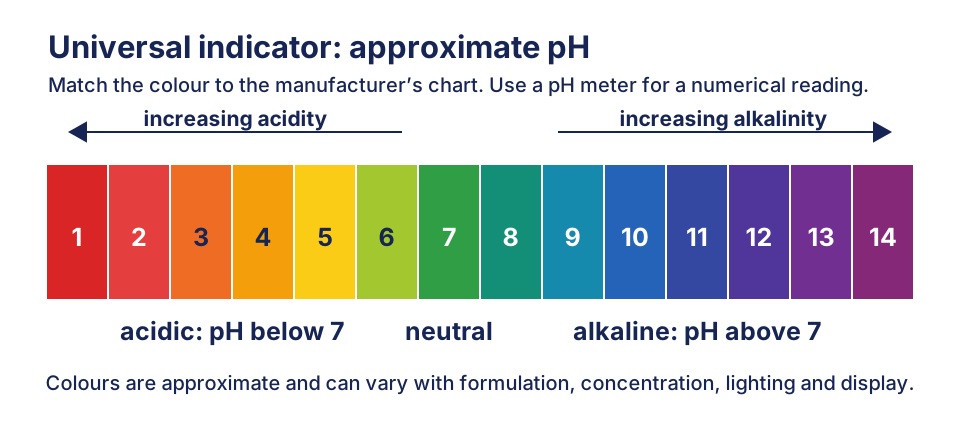
A calibrated pH meter gives a numerical reading. At the same temperature, pH 3 is more acidic than pH 5, and pH 11 is more alkaline than pH 9. These comparisons do not require calculating an ion concentration or describing strong and weak acids.
Modelled example 1
What does an orange colour tell us?
Problem
Universal indicator changes from green to orange in solution P. On the supplied chart, orange covers pH 3–4. State the observation, the classification and the ion relationship.
Study the worked solution
Record what was seen
Method
Universal indicator changes from green to orange.
Reason
This is an observation. “P is acidic” is the interpretation of that observation.
Working
Observation: green → orange.Interpret the chart
Method
P is acidic, with an estimated pH of 3–4.Reason
The chart puts orange below pH 7. It does not distinguish pH 3.1 from 3.8.
Working
Chart range: pH 3–4 → below 7 → acidic.Connect to the ions
Method
The concentration of H + (aq) is greater than that of OH-(aq).
Reason
This is the particle-level meaning of an acidic solution. It does not mean hydroxide ions are absent.
Working
Hydrogen-ion concentration > hydroxide-ion concentration.
Guided practice 2
Read the evidence before naming the solution
Problem
A calibrated meter measures Q at pH 9 and R at pH 12 at room temperature. Classify Q and decide which solution is more alkaline.
Use the readings
Hints
Hint 1: Two comparisons
First compare each reading with 7. Then compare Q with R.
View solution step by step
Classify before ranking
Method
Both solutions are alkaline; R is more alkaline.
Reason
Both readings are above 7, and 12 is higher than 9.
Working
In each solution, the hydroxide-ion concentration exceeds the hydrogen-ion concentration.
Check a claim against its evidence
A learner writes: “Blue litmus stayed blue, so the liquid is pH 14.” The first clause records an observation. The conclusion goes beyond it: a neutral liquid would also leave blue litmus blue, and litmus does not measure a pH number. Use red litmus to distinguish neutral from alkaline conditions, or use universal indicator with its chart to estimate pH.
Try these without the worked examples:
- Blue litmus turns red in S. What can you conclude, and what can you not conclude about its pH?
- T gives a meter reading of pH 7. A learner says it contains no hydrogen ions. Correct the explanation.
- Solid U is insoluble in water but reacts with an acid to form a salt and water. Is “base” or “alkali” justified?
Compare your explanations
S is acidic, with pH below 7; litmus does not give an exact value. T is neutral: hydrogen and hydroxide ions have equal concentrations, rather than both being absent. U is a base, but its insolubility means it is not an alkali.
Next, use the acid and base models to predict reactions and explain which observations distinguish their products.