Covalent bonding and molecular structures
Construct shared pairs and lone pairs while conserving every outer electron.
Continue where you stopped
The core idea
On this page
Learning objectives
- describe the formation of a covalent bond by the sharing of a pair of electrons and that the atoms in the molecules usually have the electronic configuration of a noble gas
- describe, using ‘dot-and-cross’ diagrams, the formation of covalent bonds between non-metallic elements, e.g. H2; O2; H2O; CH4; CO2
- deduce the arrangement of electrons in other covalent molecules
Hydrogen gas consists of H₂ molecules. The atoms do not become a positive and a negative ion: each supplies one electron to a shared pair. A covalent bond is a pair of electrons shared between two atoms. Each hydrogen counts that pair in its first shell, which is full with two electrons.
Construct the pairs, not just the outline
For the simple non-metal molecules here, start with the outer electrons of each atom. Hydrogen contributes one, carbon four and oxygen six. Use a key to track the original atom of each electron. Dots and crosses are bookkeeping symbols for identical electrons.
- Add the outer electrons to find the total available.
- Put a shared pair between each pair of bonded atoms: one electron from each atom for the ordinary covalent bonds studied here.
- Keep the remaining electrons on their original atoms for now. Count each atom’s shared and unshared electrons: hydrogen needs two; the other atoms in these molecules need eight. If two bonded atoms are both short of eight, add another shared pair using one remaining electron from each atom. Recount and repeat if needed. Hydrogen never needs a second shared pair.
- Group the remaining unshared electrons into lone pairs on their original atoms. Check every shell and the total again, counting each drawn electron only once in the total.
The shared electrons count towards both atoms’ shells, but this does not create extra electrons. Moving a lone pair to another side of the same atom or rotating a drawing changes its layout, not its bonding.
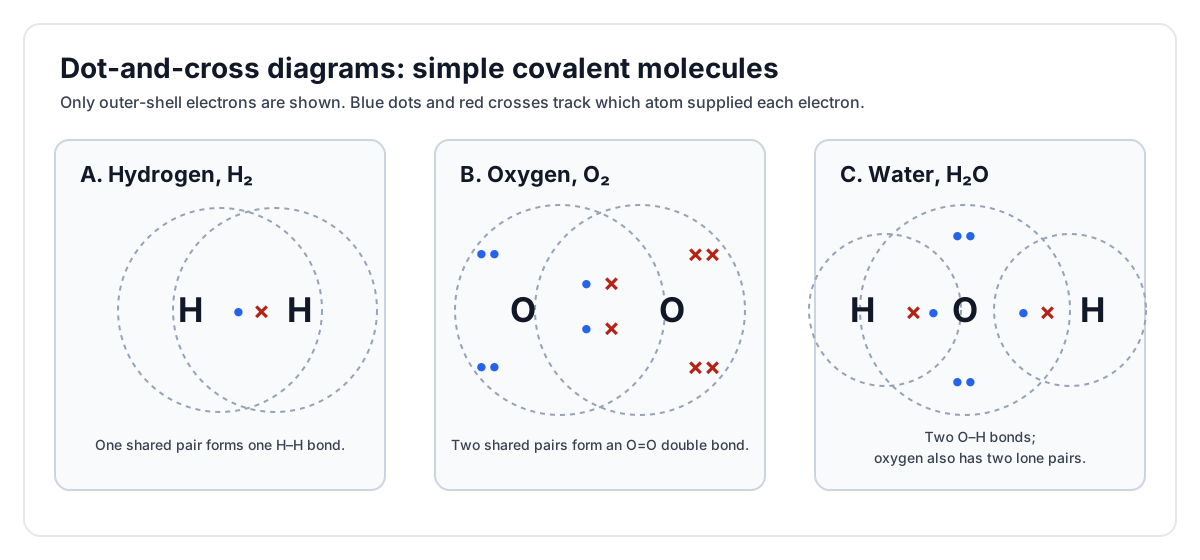
In O₂ the two atoms supply twelve outer electrons. Two shared pairs use four of them; the other eight form two lone pairs on each oxygen. With only one shared pair, each oxygen would have an incomplete outer shell.
Guided practice 1
Build a water molecule
Problem
Oxygen has six outer-shell electrons and each hydrogen has one. Deduce the number of O–H covalent bonds and the number of lone pairs on oxygen in water.
Complete each outer shell
Hints
Hint 1: hydrogen shell
Each hydrogen needs one shared electron to reach a full first shell.
Hint 2: oxygen count
Account for all six of oxygen’s original outer electrons.
View solution step by step
Form the bonds
Method
Share one pair between oxygen and each hydrogen.
Reason
Each shared pair gives hydrogen two electrons and contributes to oxygen’s full outer shell.
Working
Two O–H single covalent bonds.Account for the remaining electrons
Method
Place four unshared electrons on oxygen as two pairs.
Reason
A dot-and-cross diagram must show every outer electron.
Working
Two lone pairs on oxygen.
After the count check, draw the actual water arrangement. Put one oxygen electron and one hydrogen electron in each O–H shared region, then four oxygen electrons in two lone pairs. Check eight electrons in the whole diagram, eight around oxygen and two around each hydrogen.
Apply the same accounting to methane and carbon dioxide
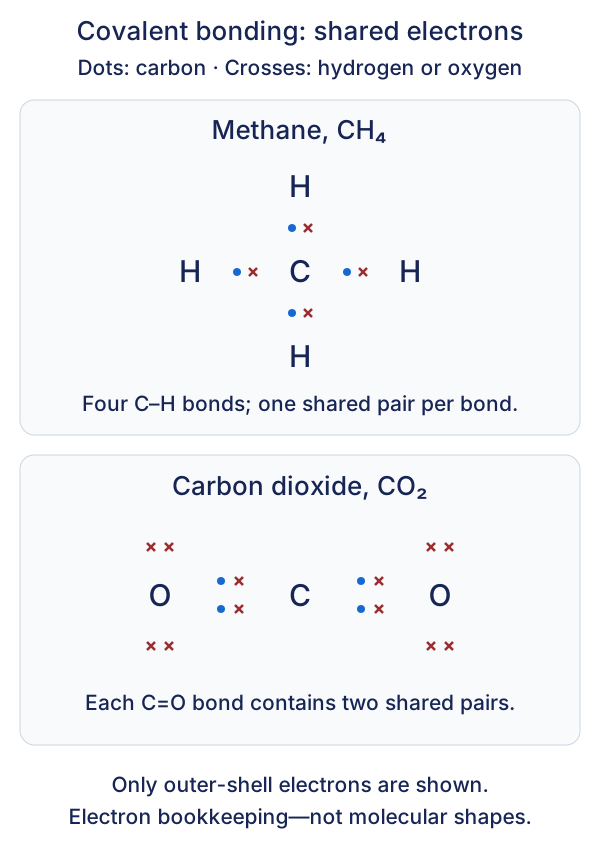
For CH₄, carbon supplies four electrons and the four hydrogens supply four more. All eight go into four shared pairs; none remain as lone pairs. For CO₂, there are sixteen outer electrons. Four shared pairs use eight; the remaining eight stay on the two oxygens as lone pairs. Each C=O double bond contains two shared pairs, not two electrons.
These neutral molecules need no ionic charges or brackets. A molecular formula counts atoms in one molecule; an ionic formula gives the simplest ratio in an extended lattice.
Find and repair a near miss
A water diagram puts two of oxygen’s electrons in one O–H shared pair and both hydrogen electrons in the other. It has the correct total and fills each shell. Why is it still wrong under the stated dot-and-cross convention? Redraw the two shared regions before revealing the correction.
Check the electron ownership
Each hydrogen must contribute its own electron to its bond with oxygen. Each O–H shared region contains one electron from that hydrogen and one from oxygen. Keep four oxygen electrons as two lone pairs. Correct totals alone do not establish the correct bonding arrangement.
Deduce an unfamiliar molecule
Nitrogen has five outer electrons. Using three hydrogen atoms, construct a neutral molecule in which each hydrogen has two electrons and nitrogen has eight around it. Label the shared and unshared regions and check the total.
Check the construction
There are eight outer electrons in total. Three N–H shared pairs use six; the remaining two form one lone pair on nitrogen. Each shared pair has one electron from nitrogen and one from its bonded hydrogen. The formula is NH₃. You do not need a bond angle or three-dimensional shape to establish this electron arrangement.
Use these molecular and ionic models in the next lesson to explain melting, boiling and conductivity. The strength of a bond within a molecule is not the same as the attraction between separate molecules.