Introduction to Acids
Acids: aqueous hydrogen ions, complete versus partial ionisation, and the distinction between acid strength and concentration.
Continue where you stopped
The core idea
On this page
Learning objectives
- describe the meanings of the terms acid and alkali in terms of the ions they produce in aqueous solution and their effects on Universal Indicator
- describe qualitatively the difference between strong and weak acids in terms of the extent of ionisation
Acid questions are mostly definition plus precise keywords. The most important distinction is that acid strength and concentration are different ideas.
Revise this together with the Acids, Bases and Salts hub and pH Scale and Indicators so definitions and practical observations stay linked.
1. Definition
A. Acid (aqueous definition)
An acid is a substance that produces hydrogen ions, H + (aq), when dissolved in water (or, equivalently, it is a proton donor in water).
2. Key Ideas
- Acids show acidic behaviour only in aqueous solution because the key particles are H + (aq) ions.
- A substance containing hydrogen is not automatically an acid (example: ammonia, NH₃).
- Strong/weak is about extent of ionisation. Concentrated/dilute is about amount per volume.
| Acid | Formula | Ionisation in water (what you write) |
|---|---|---|
| hydrochloric acid | HCl | HCl(aq) → H + (aq) + Cl⁻(aq) |
| nitric acid | HNO₃ | HNO₃(aq) → H + (aq) + NO₃⁻(aq) |
| sulphuric acid | H₂SO₄ | H₂SO₄(aq) → 2H + (aq) + SO₄²⁻(aq) |
| ethanoic acid | CH₃COOH | CH₃COOH(aq) ⇌ CH₃COO⁻(aq) + H + (aq) |
At O-Level, HCl, HNO₃ and H₂SO₄ are treated as strong acids (fully ionised in water). CH₃COOH is a common weak acid.
3. Detailed Explanations
- Acids show acidic behaviour in water because they produce H + (aq).
- Strong vs weak = degree of ionisation (complete vs partial). Concentrated vs dilute = amount per volume.
- Strong acids use → in ionisation equations; weak acids use ⇌.
A. Strong vs weak acids (ionisation)
Strong acids ionise completely in water (almost all molecules become ions). Weak acids ionise partially (many molecules remain as molecules).
Strong vs weak acid (same concentration): H₂ volume vs time
Example curves showing hydrogen volume increases faster for a strong acid than a weak acid at the same concentration, while final volume can be similar.
Scroll across the graph to read all labels.
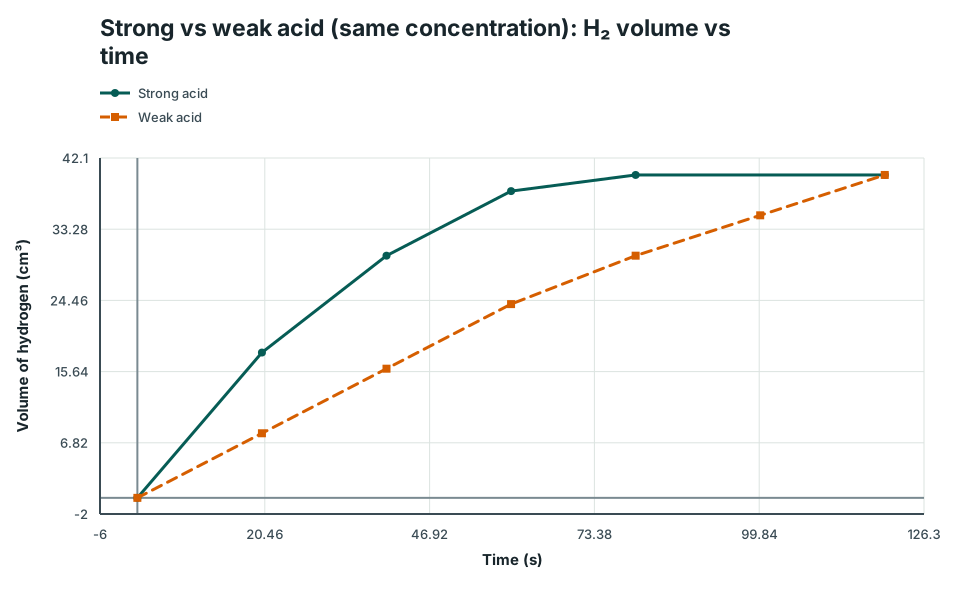
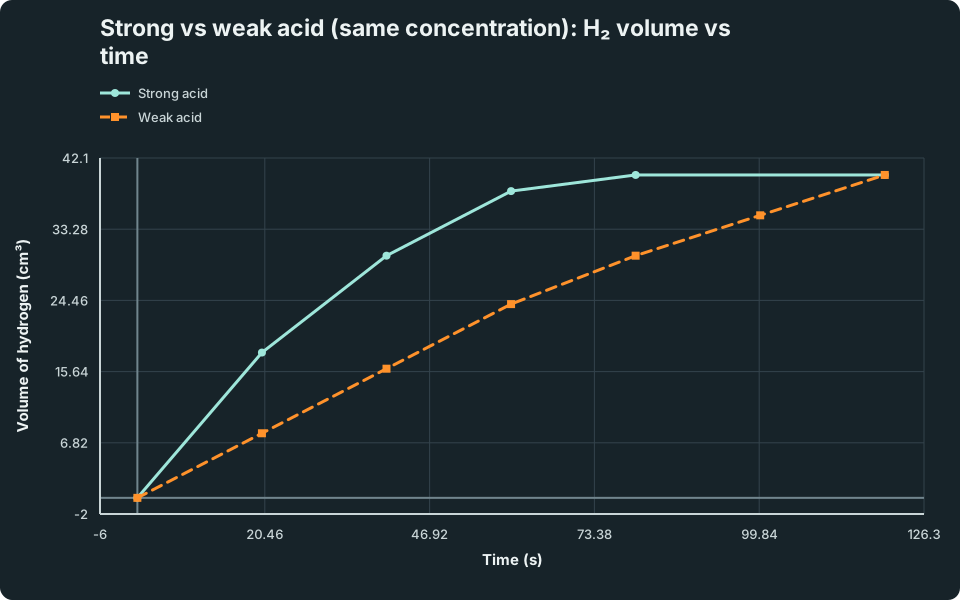
View figure data
| Series | Time (s) | Time uncertainty | Volume of hydrogen (cm³) | Volume of hydrogen uncertainty |
|---|---|---|---|---|
| Strong acid | 0 | 0 | ||
| Strong acid | 20 | 18 | ||
| Strong acid | 40 | 30 | ||
| Strong acid | 60 | 38 | ||
| Strong acid | 80 | 40 | ||
| Strong acid | 120 | 40 | ||
| Weak acid | 0 | 0 | ||
| Weak acid | 20 | 8 | ||
| Weak acid | 40 | 16 | ||
| Weak acid | 60 | 24 | ||
| Weak acid | 80 | 30 | ||
| Weak acid | 100 | 35 | ||
| Weak acid | 120 | 40 |
B. Strong vs concentrated (different ideas)
- Concentration (e.g. mol/dm³) is “how many particles per unit volume”.
- Strength is “what fraction of acid molecules ionise”.
So you can have:
- a concentrated weak acid (lots of acid molecules per volume, but few ionise), and
- a dilute strong acid (not many acid molecules per volume, but almost all ionise).
“Strong/weak refers to degree of ionisation. Concentrated/dilute refers to concentration.”
C. Why aqueous acids conduct electricity
Pure acids are covalent molecules and have few mobile ions. When dissolved in water, acids form ions (especially H + (aq)), which carry charge, so aqueous acids conduct electricity.
4. Common Mistakes
- Saying “strong acid = concentrated acid” (wrong comparison).
- Writing “equilibrium means equal amounts” (irrelevant here): weak acid ionisation is partial, not “half and half”.
- Writing formulas without state symbols when the question expects them (use (aq) for acids in water).
- Thinking any compound with hydrogen is an acid (e.g. NH₃ is not an acid in water).
After this lesson, test recall with the Acids quiz and then broaden revision through Exam Skills.
5. Exam Tips
- “produces H + (aq) ions in water”
- strong acid: “ionises completely”
- weak acid: “ionises partially”
- strength vs concentration: “degree of ionisation” vs “amount per volume”
- If asked to list particles in dilute hydrochloric acid, write H + (aq) and Cl⁻(aq) (not HCl molecules for a strong acid).
- If asked to compare strong vs weak acids fairly, keep concentration the same and compare ionisation.
6. Worked Examples
Modelled example 1
Choose the correct arrow
Problem
Study the worked solution
Classify hydrochloric acid
Method
Use a one-way arrow for aqueous HCl.Reason
HCl is a strong acid and ionises completely in water.Working
HCl(aq) → H + (aq) + Cl⁻(aq).Classify ethanoic acid
Method
Use a reversible arrow for aqueous ethanoic acid.Reason
Ethanoic acid is weak and ionises only partially.Working
CH₃COOH(aq) ⇌ CH₃COO⁻(aq) + H + (aq).State what the arrows encode
Method
Connect arrow choice to degree of ionisation.Reason
The distinction is strength, not the concentration of either solution.Working
→: complete; ⇌: partial.
Guided practice 2
Strong vs concentrated (spot the trap)
Problem
Classify two independent properties
Hints
Hint 1: strength criterion
Hint 2: concentration criterion
View solution step by step
Judge strength
Method
Classify HCl as strong and ethanoic acid as weak.Reason
Strength depends on complete versus partial ionisation.Working
Acid A: strong HCl; Acid B: weak CH₃COOH.Judge concentration
Method
Compare 0.10 with 1.0 mol dm⁻³.Reason
Concentration is amount per volume and is independent of strength.Working
Acid B is more concentrated; Acid A is relatively dilute.
Common misconception 3
“Contains hydrogen” is not enough
Learner claim
Use the aqueous-ion definition
View solution step by step
Reject the formula shortcut
Method
Do not classify a substance by merely spotting H in its formula.Reason
Acid behaviour depends on producing H + (aq) in water.Working
NH₃ does not ionise to release H + (aq).Classify ammonia
Method
Describe ammonia as a base.Reason
It accepts a proton to form the ammonium ion.Working
NH₃ + H⁺ → NH₄ +.
Challenge 4
List the main particles in solution
Particle-level transfer
Translate strength into particle populations
Hints
Hint 1: connect strength to extent
Hint 2: picture complete versus partial
View solution step by step
Represent strong nitric acid
Method
List mainly H + (aq) and NO₃⁻(aq).Reason
Strong nitric acid ionises completely in dilute aqueous solution.Working
HNO₃(aq) → H + (aq) + NO₃⁻(aq).Represent weak ethanoic acid
Method
List mainly CH₃COOH molecules plus small amounts of both ions.Reason
Partial ionisation leaves most weak-acid molecules intact.Working
Mainly CH₃COOH(aq); some H + (aq) and CH₃COO⁻(aq).
7. Mind Stretchers
Mind stretcher 1: Fix the student’s sentenceExtension
Question: A student writes: “A strong acid has a high concentration of acid.” Rewrite this correctly.
Show Answer
“A strong acid ionises completely in water (high degree of ionisation). Concentration is a separate idea (moles per unit volume).”
Mind stretcher 2: Conductivity logicExtension
Question: Why does ethanoic acid solution conduct electricity, even though it is a weak acid?
Show Answer
Even weak acids ionise partially, so ethanoic acid solution still contains mobile ions (H + (aq) and CH₃COO⁻(aq)) that carry charge. There are fewer ions than in a strong acid of the same concentration, so conductivity is weaker but not zero.
8. Quiz
Test yourself on aqueous ions, strong versus weak acids, and strength versus concentration.