Factors Affecting Rate of Reaction
Factors affecting rate: concentration, pressure, surface area, temperature and catalysts—explained using collision-theory keywords for full marks.
Continue where you stopped
The core idea
On this page
Learning objectives
- describe the effect of concentration, pressure, particle size and temperature on the rates of reactions and explain these effects in terms of collisions between reacting particles
- define the term catalyst and describe the effect of catalysts (including enzymes) on the rates of reactions
- explain how pathways with lower activation energies account for the increase in rates of reactions (see also 9(b))
- state that some compounds act as catalysts in a range of industrial processes and that enzymes are biological catalysts (see also 8.3(b), 9(b), 10(c) and 12(d))
This lesson builds on effective collisions and activation energy. Revise Collision Theory first if those ideas are unfamiliar.
1. Definition
Factors affecting rate of reaction are conditions that change how fast reactants are used up or products are formed by changing the number of effective collisions per unit time.
2. Key Ideas
- Factors that increase rate do one (or both) of these:
- increase collision frequency (more collisions per unit time), and/or
- increase the proportion of collisions that are effective (energy ≥ Eₐ).
- These are the syllabus factors:
- Concentration (solutions) and pressure (gases): more particles per unit volume → more collisions per unit time.
- Particle size (solids): smaller particles give a larger total surface area → more collisions at the surface per unit time.
- Temperature: particles move faster and more particles have energy ≥ Eₐ.
- Catalyst: lowers Eₐ (alternative pathway) → more collisions are effective.
| Factor increased | Applies to | What changes? | Explanation to include |
|---|---|---|---|
| Concentration | solutions | particles per unit volume ↑ | “more frequent collisions per unit time” → “more frequent effective collisions per unit time” |
| Pressure (at constant T) | gases | particles per unit volume ↑ | “particles closer together” → “more collisions per unit time” |
| Smaller particle size | solids | total surface area and exposed particles ↑ | “larger total surface area” → “more collisions at the surface per unit time” |
| Temperature | most reactions | speed ↑; fraction with energy ≥ Eₐ ↑ | “move faster”, “more collisions per unit time”, “larger proportion have energy ≥ Eₐ” |
| Catalyst | reactions with catalyst | Eₐ ↓ | “alternative pathway”, “lower Eₐ”, “higher proportion of effective collisions” |
3. Detailed Explanations
- Rate increases when there are more frequent effective collisions per unit time.
- Effective collision needs energy ≥ Eₐ (and correct orientation for molecules).
- Concentration/pressure/surface area mainly increase collision frequency.
- Temperature increases collision frequency and increases the fraction with energy ≥ Eₐ.
- A catalyst provides an alternative pathway with lower Eₐ (and is not used up).
A. Concentration (solutions)
Increasing concentration (more solute particles in the same volume of solution) increases rate because:
- there are more reactant particles per unit volume,
- particles are closer together,
- so there are more frequent collisions per unit time,
- so there are more frequent effective collisions per unit time (faster rate).
“More concentrated” is not the explanation. The explanation is “more reactant particles per unit volume → more collisions per unit time.”
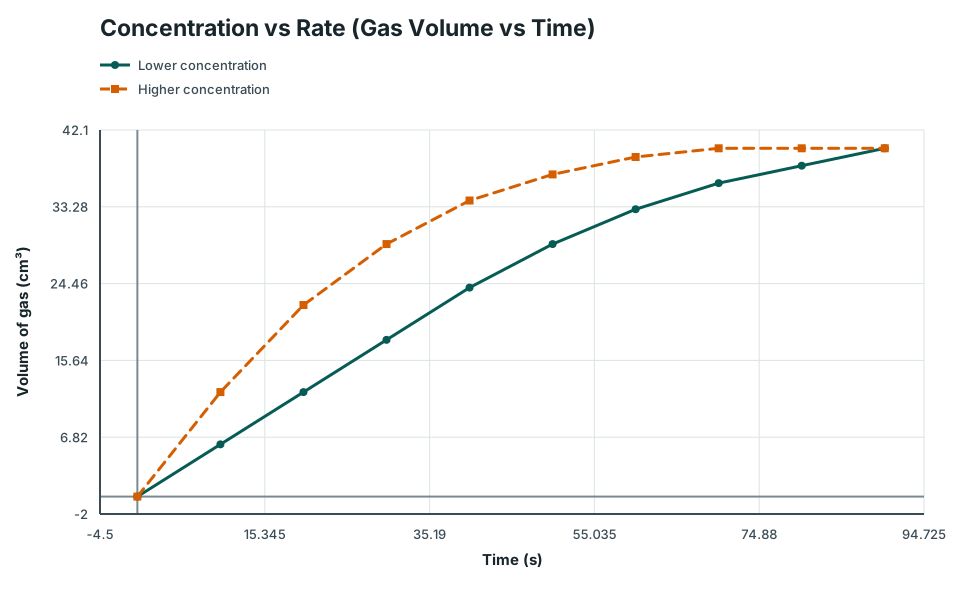
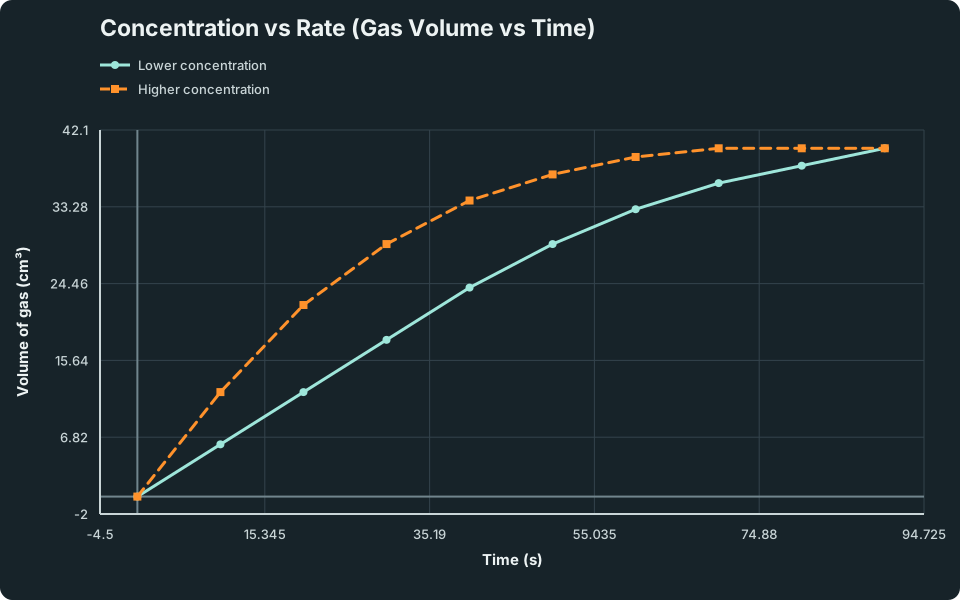
Concentration vs Rate (Gas Volume vs Time)
Two volume-of-gas vs time curves showing higher concentration gives a steeper initial gradient and finishes sooner while reaching the same final volume.
Scroll across the graph to read all labels.
View figure data
| Time (s) | Lower concentration | Higher concentration |
|---|---|---|
| 0 | 0 | 0 |
| 10 | 6 | 12 |
| 20 | 12 | 22 |
| 30 | 18 | 29 |
| 40 | 24 | 34 |
| 50 | 29 | 37 |
| 60 | 33 | 39 |
| 70 | 36 | 40 |
| 80 | 38 | 40 |
| 90 | 40 | 40 |
B. Pressure (gases)
A change in pressure only affects rate if the reacting particles are gases.
Increasing gas pressure (at constant temperature) increases rate because:
- gas particles are forced closer together (same number of particles in a smaller volume),
- so there are more collisions per unit time,
- so there are more frequent effective collisions per unit time.
In the Haber process, higher pressure increases rate because gas collisions become more frequent. If supplied data also show a yield change, describe that as a separate trend rather than treating rate and yield as the same quantity. See: Haber Process and Reversible Reactions.
C. Surface area (solids)
For reactions involving a solid, the syllabus factor is particle size; the collision-theory explanation uses the resulting change in total surface area.
Decreasing particle size (e.g., powdering a solid) increases rate because:
- total surface area increases,
- more solid particles are exposed to the other reactant,
- so there are more collisions at the surface per unit time,
- so there are more frequent effective collisions per unit time.
Write “larger surface area” and “more collisions at the surface per unit time”. Writing only “smaller particles” is a half-answer.
D. Temperature
For most reactions, increasing temperature increases rate because:
- particles have more kinetic energy (energy of motion) and move faster,
- so there are more collisions per unit time, and
- a larger proportion of particles have energy ≥ Eₐ, so a larger proportion of collisions are effective,
- so there are more frequent effective collisions per unit time.
Full marks needs both:
- collision frequency increases, and
- a larger fraction has energy ≥ Eₐ.
E. Catalysts
A catalyst is a substance that increases the rate of reaction and is chemically unchanged at the end of the reaction.
A catalyst increases rate by providing an alternative pathway with a lower activation energy, Eₐ.
Swipe or scroll sideways to inspect the complete overview.
So:
- Eₐ is lower,
- so a larger proportion of particles have energy ≥ Eₐ,
- so a larger proportion of collisions are effective,
- so there are more frequent effective collisions per unit time (faster rate).
Temperature increases particle energy.
A catalyst does not “give energy” — it lowers Eₐ.
The syllabus also expects you to know that some compounds act as industrial catalysts, such as iron in the Haber process, and that enzymes are biological catalysts.
A faster visible change is the macroscopic observation. More frequent effective collisions are the particle-level explanation. A lower peak on the catalysed pathway is the symbolic energy-profile representation. Do not claim that a catalyst changes Δ H or the final amount of product.
4. Common Mistakes
- Writing “rate increases because concentration/pressure is higher” with no particle explanation.
- Saying pressure affects all reactions (false): it affects rate only when reacting particles are gases.
- Using “particle size” without linking it to surface area and collisions at the surface.
- Explaining temperature using only “more collisions” and forgetting “larger proportion have energy ≥ Eₐ”.
- Saying “a catalyst is used up” or “a catalyst gives particles energy” (both false).
- Confusing “faster rate” with “more products”. Rate describes how quickly change occurs; any yield conclusion must come from the reaction information or supplied data.
5. Exam Tips
- State the particle change: “more particles per unit volume / larger surface area / particles move faster / Eₐ is lower”.
- State collision result: “more collisions per unit time”.
- Finish: “more frequent effective collisions per unit time, so rate increases”.
- If the question asks for a “fair test”, only change one variable (e.g., same volume and concentration of acid, same mass of solid, same temperature).
- If the factor is temperature or catalyst, you must mention Eₐ somewhere for full marks.
6. Worked Examples
Modelled example 1
Pressure (gases only)
Problem
Study the worked solution
State the particle change
Method
Bring the gas particles closer together.Reason
At constant temperature, increasing pressure means the same gas particles occupy a smaller volume.Working
More reacting particles per unit volume.Infer the collision change
Method
Increase collisions per unit time.Reason
Closer gas particles encounter one another more frequently.Working
Higher collision frequency.Conclude with effective collisions
Method
State that effective collisions occur more frequently.Reason
A greater number of collisions per second gives more successful collisions per second under otherwise unchanged conditions.Working
More frequent effective collisions per unit time, so rate increases.
Guided practice 2
Surface area (marble + acid)
Problem
Complete the solid-interface chain
Hints
Hint 1: particle size to area
Hint 2: interface
View solution step by step
Translate particle size to surface area
Method
Give powder the larger total surface area.Reason
Dividing the same mass into smaller particles exposes more solid.Working
More CaCO₃ particles are exposed.Translate area to rate
Method
Increase collisions at the surface per unit time.Reason
More exposed sites allow more frequent effective acid–marble collisions.Working
More frequent effective collisions per unit time, so powder reacts faster.
Common misconception 3
Concentration vs volume (spot the mistake)
Learner claim
Separate amount of solution from particles per volume
View solution step by step
Identify the variable error
Method
Reject volume as proof of higher concentration.Reason
Concentration is the number of solute particles per unit volume, not the total volume present.Working
50 cm³ of a given solution has the same concentration as 25 cm³ of that solution.State the correct concentration mechanism
Method
Use acid with more reactant particles per unit volume.Reason
Closer, more numerous acid particles collide with the other reactant more frequently.Working
Higher concentration → more frequent effective collisions per unit time → faster rate.
Examiner practice 4
Temperature (full marks)
Examination question
Write the complete causal chain
View solution step by step
Kinetic energy and speed
1 markMethod
State that particles gain kinetic energy and move faster.Reason
Temperature measures the average kinetic energy of the particle population.Working
Higher temperature → faster particle motion.Collision frequency
1 markMethod
Increase collisions per unit time.Reason
Faster-moving particles meet more often.Working
Collision frequency increases.Activation threshold
1 markMethod
Increase the proportion with energy at least Eₐ.Reason
A larger fraction of collisions can overcome the activation-energy barrier.Working
Larger proportion with energy ≥ Eₐ.Rate conclusion
1 markWorking
More frequent effective collisions per unit time, so rate increases.
Self-mark with the mark scheme
Compare your response with each mark point. Select a point only when your response contains that evidence.
Self-mark the two temperature effects, activation-energy threshold and rate conclusion.
Challenge 5
Catalyst (what changes, what doesn’t)
Mechanism transfer
Distinguish pathway from particle energy
Hints
Hint 1: change the barrier
Hint 2: compare with temperature
View solution step by step
Change the reaction pathway
Method
Provide an alternative pathway with lower activation energy.Reason
A lower threshold lets a larger proportion of the existing collisions have enough energy.Working
Lower Eₐ → larger effective-collision proportion.Reject extra particle energy
Method
Keep particle kinetic energies unchanged at the same temperature.Reason
The catalyst changes the pathway, not the temperature.Working
It does not necessarily raise total collision frequency or give particles energy.Keep the energy difference stable
Method
Leave reactant level, product level and Δ H unchanged.Reason
Only the activation-energy peak is lowered; the reaction endpoints are identical.Working
More frequent effective collisions per unit time, so rate increases without changing Δ H.
7. Mind Stretchers
Mind stretcher 1: Same concentration, different ratesExtension
Question: Two reactions use solutions at the same concentration and temperature, but Reaction A is much slower. Give two possible reasons (collision theory) without changing concentration or temperature.
Show Answer
Possible answers (any two, explained):
- Reaction A has a higher activation energy, so a smaller fraction of particles have energy ≥ Eₐ → fewer effective collisions.
- Reaction A has no catalyst (Reaction B has a catalyst), so Eₐ is higher → fewer effective collisions.
- Reaction A involves a solid with smaller surface area (large lumps instead of powder), so fewer collisions occur at the surface per unit time.
Mind stretcher 2: Choose the correct explanation sentenceExtension
Question: Pick the best final sentence for a pressure question: (A) “More collisions occur.” (B) “There are more frequent effective collisions per unit time.” Why?
Show Answer
(B) is better because it uses the mark-scheme target: rate depends on effective collisions, not just total collisions. You should still include the particle reason first (particles closer together → collision frequency increases).
8. Quiz
The shared K324 / 6092 practice includes concentration, pressure, surface area, temperature, catalysts and experimental design.
K324 / 6092 Practice