Ionic bonding and ionic structures
Track electron transfer, ion charges and simplest formula ratios, then explain the attraction in an ionic lattice.
Continue where you stopped
The core idea
On this page
Learning objectives
- describe the formation of ions by electron loss/gain and that these ions usually have the electronic configuration of a noble gas
- describe, including the use of ‘dot-and-cross’ diagrams, the formation of ionic bonds between metals and non-metals, e.g. NaCl; MgCl2
An atom becomes an ion when it loses or gains electrons. Forming the ions is one step; explaining why they stay together is another. Keep those steps separate when constructing a dot-and-cross diagram.
Track electrons before writing a formula
A neutral sodium atom has configuration 2,8,1 and a neutral chlorine atom has 2,8,7. One electron transfers from sodium to chlorine. Sodium now has one fewer electron than proton, so its charge is Na⁺. Chlorine has one extra electron, so its charge is Cl⁻. Neither nucleus changes.
Na → Na⁺ + e⁻ Cl + e⁻ → Cl⁻
Both ions now have full outer shells: 2,8 for sodium and 2,8,8 for chlorine. Ions formed from these elements usually have the electronic configuration of a noble gas. This electron accounting predicts the charges; it does not mean that atoms have intentions or that electrons disappear.
Use dots for chlorine’s original outer electrons and crosses for the transferred electrons. On the chloride ion show seven dots and one cross. Enclose each ion in square brackets and put its charge outside. If showing only the original outer-shell electrons, state that convention: sodium’s new full outer shell is an inner shell of the original atom.
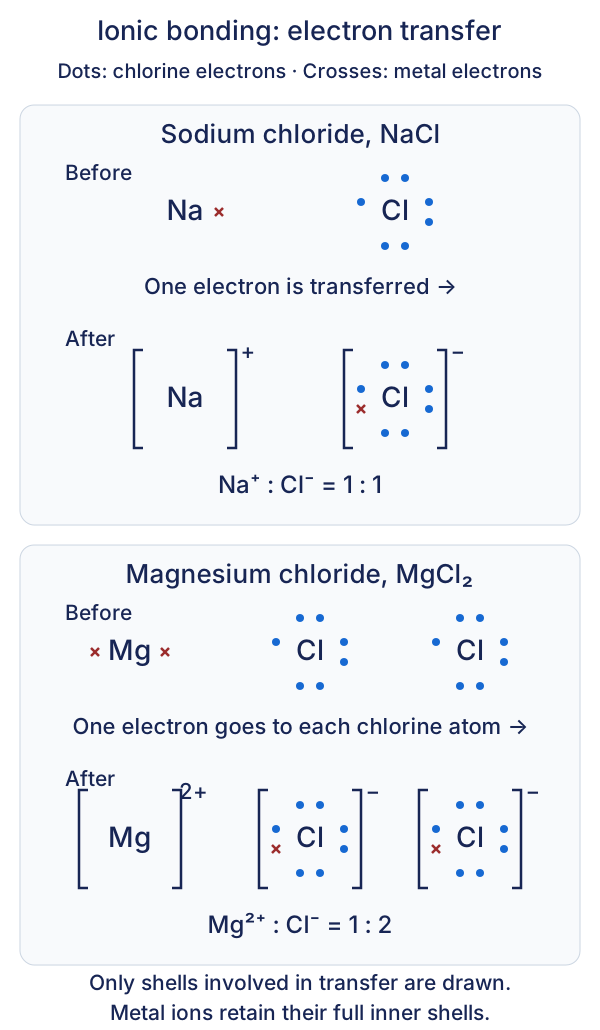
Balance charge, then use the simplest ratio
Modelled example 1
Form Magnesium Chloride
Problem
Study the worked solution
Transfer the electrons
Method
Magnesium loses two electrons; each of two chlorine atoms gains one.Reason
All three atoms then have noble-gas electron configurations.Working
Mg → Mg²⁺ + 2e⁻; two Cl each gain one e⁻.Form the ionic compound
Method
Attract one Mg²⁺ ion to two Cl⁻ ions.Reason
Opposite charges attract and the total charge must be zero.Working
Formula: MgCl₂.
The two electrons lost by magnesium must go to two chlorine atoms, one each. Putting both on one chlorine would give the wrong ion. The positive and negative charges balance: (+2) + 2(-1) = 0. Write one magnesium for two chlorine ions, MgCl₂; the subscript counts the ions in the ratio, not the charge on chloride.
For any supplied pair of ions, find the smallest whole numbers giving zero net charge. For example, Mg²⁺ and O²⁻ need a 1:1 ratio: MgO, not Mg₂O₂. Ion charges stay unchanged when you choose how many ions to include.
The bond is an attraction; the solid is a lattice
An ionic bond is the strong electrostatic attraction between oppositely charged ions. Electron transfer forms the ions; their attraction is the bond. In a crystal, each ion is attracted to surrounding ions of opposite charge, through a repeating giant ionic lattice. There are no separate sodium chloride molecules. NaCl gives the simplest 1:1 ratio in the lattice, not an isolated pair with no attraction to its neighbours.
Correct an electron-transfer account
A learner writes: “Magnesium gives two electrons to one chlorine atom, making Mg⁺ and Cl²⁻. These form one MgCl molecule.” Before opening the solution, identify the first error, draw the corrected outer-electron allocation, label every charge and write the simplest formula.
Check the correction
Each chlorine atom gains one electron, so two chlorine atoms are needed. Magnesium loses two electrons and becomes Mg²⁺; each chlorine becomes Cl⁻. Each chloride outer shell contains seven of its own electrons and one from magnesium. The ratio is 1:2, giving MgCl₂. The ions form a lattice, not separate molecules.
Next, compare this transfer with electron sharing in the covalent-bonding lesson. Keep your checks separate: electrons conserved, charges correct, ratio simplest, and attraction explained.