First Ionisation Energy Trends
Learn and apply First Ionisation Energy Trends in the published Chemistry course sequence.
Continue where you stopped
The core idea
On this page
First Ionisation Energy Trends: Orientation
First ionisation energy questions are “trend explanation” questions: you must name the driver(s) (nuclear charge / shielding / distance), link to attraction, then link to energy required. Compare this reasoning with successive ionisation energies, where jumps reveal changes in occupied shell.
Definitions (Must Know)
A. First ionisation energy, IE₁
The first ionisation energy is the energy required to remove one mole of electrons from one mole of gaseous atoms to form one mole of gaseous 1+ ions.
Definition equation: X(g) → X⁺(g) + e⁻
B. Nuclear charge
The nuclear charge is the positive charge of the nucleus (determined by the number of protons).
C. Shielding
Shielding is the reduction in attraction between the nucleus and an outer electron due to repulsion by inner-shell electrons.
Detailed Explanations
A. Across a period
Across a period, IE₁ generally increases because:
- nuclear charge increases (more protons)
- the electron removed is from the same shell (distance is similar)
- shielding by inner shells is similar
So the attraction between nucleus and the outer electron increases, so more energy is needed to remove the electron.
B. Down a group
Down a group, IE₁ generally decreases because:
- the electron removed is from a higher shell (greater distance from nucleus)
- there is more shielding from extra inner shells
So attraction is weaker, so less energy is needed to remove the electron.
C. Period 3 anomalies (what to say)
Across Period 3 there are two classic “drops”:
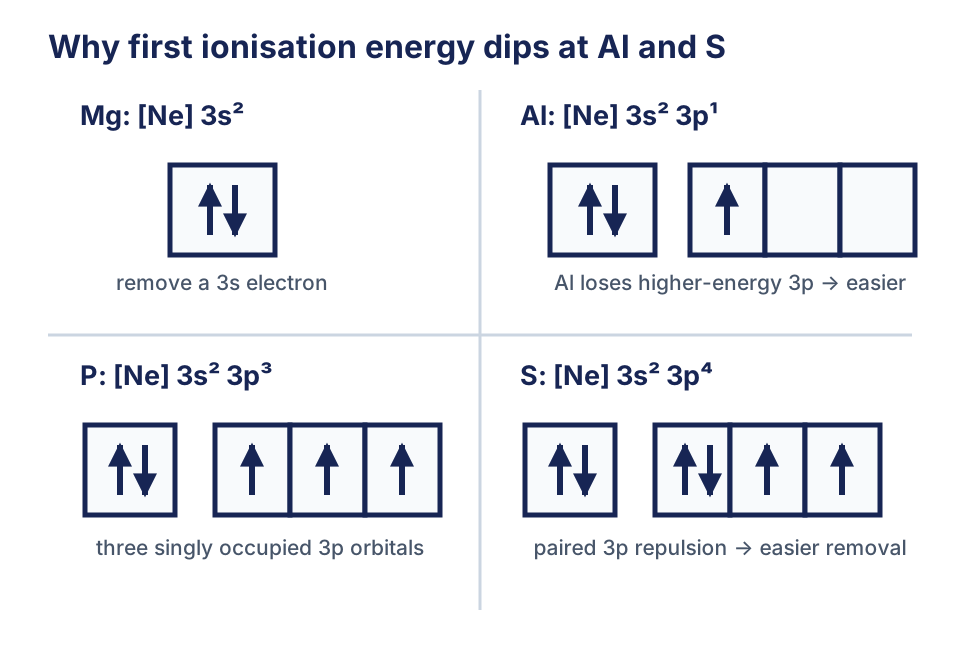
1) Mg → Al drop (3s vs 3p)
- Mg: [Ne]3s²; Al: [Ne]3s² 3p¹.
- In Al, the electron removed is from a 3p subshell (higher energy and more shielded by 3s).
- So it is easier to remove → IE₁ drops.
2) P → S drop (electron pairing repulsion)
- P: [Ne]3s² 3p³ (three unpaired 3p electrons).
- S: [Ne]3s² 3p⁴ (one paired 3p orbital).
- In S, electron-electron repulsion in the paired 3p orbital makes an electron easier to remove → IE₁ drops.
Data table
| Element | IE₁ |
|---|---|
| Na | 496 |
| Mg | 738 |
| Al | 578 |
| Si | 786 |
| P | 1012 |
| S | 1000 |
| Cl | 1251 |
| Ar | 1521 |
Ionisation energy is defined for gaseous atoms so the energy is only for removing an electron. If the atom was in a solid or molecule, you would also be breaking intermolecular forces/bonds.
Worked Examples
Modelled example 1
Explain the Period 3 Trend
Problem
Explain why first ionisation energy generally increases across Period 3.
Study the worked solution
Identify the changing driver
Method
State that proton number and nuclear charge increase across the period.Reason
Each successive element has one more proton in its nucleus.Working
Across Period 3: nuclear charge increases.Control distance and shielding
Method
State that the outer electrons are added to the same principal shell.Reason
Outer-electron distance and inner-shell shielding therefore remain similar.Working
The increasing nuclear charge is not cancelled by a new occupied shell.Link attraction to energy
Method
Conclude that attraction to the outer electron becomes stronger.Reason
More energy is required to overcome the stronger nuclear attraction and remove the electron.Working
Stronger attraction → higher first ionisation energy.
Guided practice 2
Explain the Magnesium–Aluminium Drop
Problem
Explain the drop in first ionisation energy from Mg to Al.
Try this before viewing the solution
Hints
Hint 1: compare the removed electrons
Hint 2: compare subshell energies
View solution step by step
Locate the removed electrons
Method
Compare the outer configurations Mg:3s² and Al:3s² 3p¹.Reason
The first electron removed from aluminium occupies a different subshell.Working
Mg loses 3s; Al loses 3p.Compare ease of removal
Method
State that aluminium’s 3p electron is easier to remove.Reason
It is higher in energy and more shielded than magnesium’s 3s electron.Working
IE₁(Al) < IE₁(Mg).
Common misconception 3
Correct an Across-Period Shielding Claim
Learner claim
A learner says, “First ionisation energy should decrease across Period 3 because every added electron greatly increases shielding.” Identify the error and replace it with the correct general explanation.
Judge the shielding change
View solution step by step
Correct the shielding statement
Method
State that inner-shell shielding remains approximately similar across the period.Reason
The added electrons enter the same principal shell rather than creating a new inner shell.Working
Distance and shielding change much less than nuclear charge.Restore the causal chain
Method
Use increasing nuclear charge to explain stronger attraction.Reason
With similar shielding and distance, the growing proton number dominates.Working
Increasing nuclear charge → stronger attraction → generally higher IE₁.
Examiner practice 4
Interpret Period 3 Ionisation-Energy Data
Problem
First ionisation energies in kJ mol⁻¹ for part of Period 3 are shown below.
| Element | Mg | Al | Si | P | S |
|---|---|---|---|---|---|
| IE₁ | 738 | 578 | 786 | 1012 | 1000 |
(a) Identify the two anomalies relative to the general increase across the period. (b) Explain both anomalies. [6 marks]
Try this before viewing the solution
View solution step by step
Identify the anomalies
2 marksMethod
Find each local decrease in the data.Reason
An anomaly here is a drop against the general across-period increase.Working
Mg → Al drops; P → S drops.Explain Mg to Al
2 marksMethod
Compare the subshells from which electrons are removed.Reason
Al loses a higher-energy, more shielded 3p electron rather than Mg’s 3s electron.Working
The Al electron is easier to remove, so IE₁ decreases.Explain P to S
2 marksMethod
Compare 3p³ with 3p⁴ orbital occupancy.Reason
S has a paired 3p electron; electron-electron repulsion within that orbital makes removal easier.Working
The paired electron lowers IE₁(S) relative to IE₁(P).
Self-mark with the mark scheme
Compare your response with each mark point. Select a point only when your response contains that evidence.
Credit identification and the physical cause of each anomaly separately.
Challenge 5
Transfer the Reasoning Down a Group
Problem
Calcium has more protons than magnesium, yet calcium has the lower first ionisation energy. Explain why.
Try this before viewing the solution
Hints
Hint 1: compare the outer shells
Hint 2: identify the dominant effects
View solution step by step
Compare distance and shielding
Method
State that calcium’s outer electron is in a higher principal shell.Reason
The 4s electron is farther from the nucleus and shielded by more inner shells than magnesium’s 3s electron.Working
Ca: greater outer-electron distance and greater shielding.Resolve the competing nuclear charge
Method
Conclude that the outer electron experiences weaker attraction in calcium.Reason
The increased distance and shielding outweigh calcium’s higher nuclear charge.Working
Weaker attraction → IE₁(Ca) < IE₁(Mg).
Mind Stretchers
Mind stretcher 1Extension
Which has the higher first ionisation energy: N or O? Explain using electron configuration and electron pairing.
Show Answer
Mark scheme:
- N is 1s² 2s² 2p³ (three unpaired 2p electrons).
- O is 1s² 2s² 2p⁴ (one pair in a 2p orbital).
- In O, electron-electron repulsion in the paired 2p orbital makes an electron easier to remove.
- So IE₁(N) > IE₁(O).
Mind stretcher 2Extension
Explain why the first ionisation energy of Al is lower than Mg, but the second ionisation energy of Al is higher than Mg.
Show Answer
Mark scheme:
- IE₁(Al) < IE₁(Mg) because Al loses a 3p electron, which is higher energy / more shielded than the 3s electron removed from Mg.
- After Al loses one electron, Al⁺ has [Ne]3s² and Mg still has [Ne]3s².
- IE₂ removes a 3s electron from Al⁺ and from Mg⁺, but Al⁺ has a higher nuclear charge (more protons) with similar shielding/distance.
- Therefore attraction is stronger in Al⁺, so IE₂(Al) > IE₂(Mg).