Molecular Shapes And Bond Angles Vsepr
Learn and apply Molecular Shapes And Bond Angles Vsepr in the published Chemistry course sequence.
Continue where you stopped
The core idea
On this page
Molecular Shapes and Bond Angles: Orientation
VSEPR questions are usually mark-scheme checklists: count regions, state shape, quote angle, then explain any deviation using lone pairs. This lesson trains that exact workflow.
Treat this as an extension of Atomic Structure (A Level), then use the Chemical Bonding hub to compare models across the topic.
Definitions (Must Know)
A. VSEPR theory
VSEPR theory predicts molecular shape by assuming electron pairs around a central atom repel and arrange to minimise repulsion.
B. Electron pair region (electron domain)
An electron pair region is a region of electron density around the central atom (a single bond, double bond, triple bond, or lone pair).
C. Bond pair vs lone pair
- Bond pair (BP): a shared pair of electrons in a covalent bond.
- Lone pair (LP): a non-bonding pair of electrons on the central atom.
D. Dipole moment
A dipole moment is a measure of charge separation in a bond or molecule. A molecule has a net dipole moment if its bond dipoles do not cancel due to the shape.
Detailed Explanations
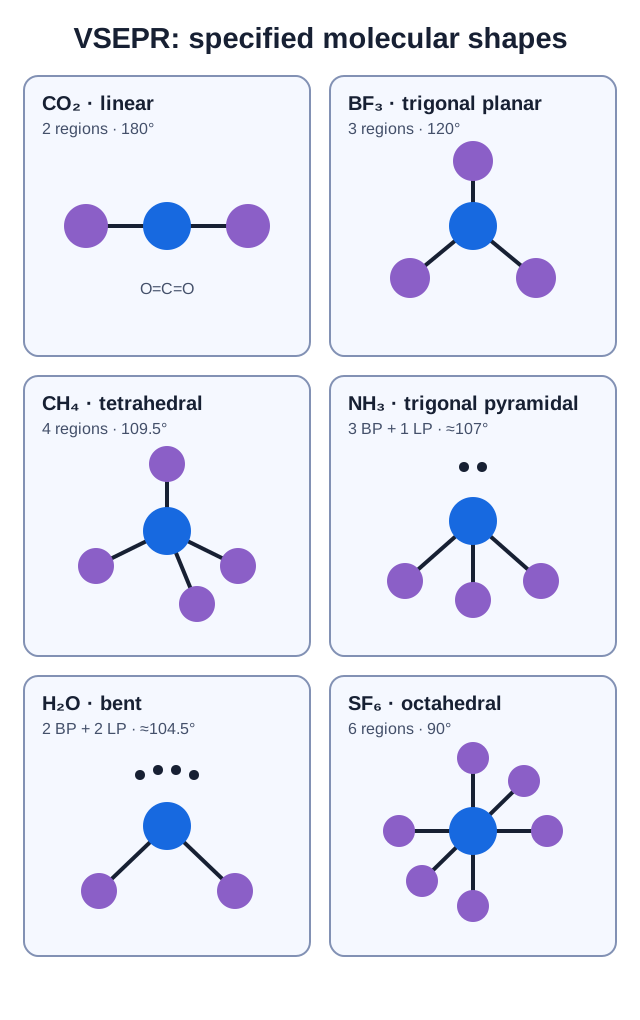
A. Quick shape table (must know)
| Electron pair regions | Shape (no lone pairs) | Example | Angle (ideal) |
|---|---|---|---|
| 2 | linear | CO₂ | 180° |
| 3 | trigonal planar | BF₃ | 120° |
| 4 | tetrahedral | CH₄ | 109.5° |
| 6 | octahedral | SF₆ | 90° |
Common lone pair shapes:
- 4 regions, 1 lone pair: trigonal pyramidal (NH₃) ~107°
- 4 regions, 2 lone pairs: bent (H₂O) ~104.5°
B. VSEPR workflow (how to answer fast)
- Draw the Lewis structure.
- Count electron pair regions around the central atom (double bonds count as 1).
- Use the table to state electron-pair geometry and molecular shape.
- Quote the angle (ideal or adjusted) and give the cause (lone pair repulsion).
Mini examples (fast checks):
- CO₂: 2 regions around C → linear (180°).
- BF₃: 3 regions around B → trigonal planar (120°).
- CH₄: 4 regions around C → tetrahedral (109.5°).
- NH₃: 4 regions around N → tetrahedral electron geometry; trigonal pyramidal molecular shape (~107°).
- H₂O: 4 regions around O → tetrahedral electron geometry; bent molecular shape (~104.5°).
- SF₆: 6 regions around S → octahedral (90° between adjacent bonds).
C. Multiple bonds and polarity (common mark traps)
- A double bond is one region because the electron density occupies one “direction” from the central atom.
- Symmetry matters for polarity: even if bonds are polar, dipoles can cancel (e.g. linear CO₂, trigonal planar BF₃).
To predict an analogous species, match its number of bonding regions and central-atom lone pairs to one of these models. For example, NH₄ + has four bonding regions and no lone pair on N, so it is tetrahedral like CH₄.
Worked Examples
Modelled example 1
Predict Ammonia Shape and Angle
Problem
Predict the shape and bond angle of NH₃.
Study the worked solution
Count electron-pair regions
Method
Count three N–H bond pairs and one lone pair around nitrogen.Reason
VSEPR uses all bonding and lone-pair regions around the central atom.Working
Four regions: 3 BP + 1 LP.Separate geometry from molecular shape
Method
Assign tetrahedral electron-pair geometry but name only atom positions for the molecular shape.Reason
One tetrahedral position is occupied by a lone pair.Working
Molecular shape: trigonal pyramidal.Adjust the angle
Method
Reduce the ideal tetrahedral angle from 109.5° to about 107°.Reason
Lone pair–bond pair repulsion is stronger than bond pair–bond pair repulsion.Working
H–N–H angle ≈ 107°.
Guided practice 2
Predict Carbon Dioxide Shape
Problem
Predict the shape and bond angle of CO₂.
Try this before viewing the solution
Hints
Hint 1: count regions, not bond lines
Hint 2: separate two regions maximally
View solution step by step
Count the regions
Method
Count the two C=O bonds as two regions around carbon.Reason
A multiple bond is one region for VSEPR shape prediction.Working
Two bonding regions; no central lone pairs.State shape and angle
Method
Place the two regions opposite each other.Reason
This maximises their separation and minimises repulsion.Working
Linear; O–C–O angle = 180°.
Common misconception 3
Correct the Water–Ammonia Angle Comparison
Learner claim
Asked why the bond angle in H₂O is smaller than in NH₃, a learner says, “Water has more lone pairs, so the bonds are pushed farther apart and its angle is larger.” Identify the error and give the correct explanation.
Judge the lone-pair effect
View solution step by step
Establish the common geometry
Method
State that both central atoms have four electron-pair regions.Reason
Both therefore begin from tetrahedral electron-pair geometry.Working
NH₃:3 BP + 1 LP; H₂O:2 BP + 2 LP.Compare repulsions
Method
Use the extra lone pair in water.Reason
Lone pair–lone pair and lone pair–bond pair repulsions exceed bond pair–bond pair repulsion.Working
The O–H bond pairs are compressed more strongly.Correct the angles
Method
State the smaller water angle.Reason
More lone-pair repulsion pushes the bond pairs closer together, not farther apart.Working
H₂O ≈ 104.5° < NH₃ ≈ 107°.
Examiner practice 4
Compare Methane and Ammonia Polarity
Problem
Explain why CH₄ is non-polar but NH₃ is polar. [4 marks]
Try this before viewing the solution
View solution step by step
State methane's shape
1 markMethod
Identify tetrahedral, symmetrical CH₄.Reason
Carbon has four bonding regions and no lone pairs.Working
CH₄: tetrahedral.Resolve methane's dipoles
1 markMethod
State that the C–H bond dipoles cancel.Reason
The equal dipoles are arranged symmetrically.Working
Net dipole = 0; CH₄ is non-polar.State ammonia's shape
1 markMethod
Identify trigonal-pyramidal NH₃.Reason
The nitrogen lone pair removes tetrahedral symmetry from the atom positions.Working
NH₃: trigonal pyramidal.Resolve ammonia's dipoles
1 markMethod
State that the N–H dipoles do not cancel.Reason
The pyramidal geometry gives a non-zero vector sum.Working
NH₃ has a net dipole and is polar.
Self-mark with the mark scheme
Compare your response with each mark point. Select a point only when your response contains that evidence.
Credit each shape and its dipole-cancellation conclusion separately.
Challenge 5
Transfer from Ammonia to Ammonium
Problem
Ammonia uses its nitrogen lone pair to bond to H⁺ and form NH₄ +. Predict the shape and H–N–H bond angle of NH₄ +, and explain why they differ from those of NH₃.
Try this before viewing the solution
Hints
Hint 1: recount after donation
Hint 2: remove the lone-pair compression
View solution step by step
Count ammonium's regions
Method
Count four N–H bonding regions and no central lone pair.Reason
The ammonia lone pair has become the shared pair in the fourth N–H bond.Working
NH₄ + :4 BP + 0 LP.Predict shape and angle
Method
Assign the ideal four-region arrangement.Reason
Four equivalent bonding regions maximise separation tetrahedrally.Working
Tetrahedral; H–N–H angle 109.5°.Compare with ammonia
Method
Contrast tetrahedral ammonium with trigonal-pyramidal ammonia at about 107°.Reason
Ammonium has no lone pair to compress its bond angles.Working
109.5° > 107°.
Mind Stretchers
Mind stretcher 1Extension
BF₃ has polar B–F bonds. Explain why BF₃ has no net dipole moment.
Show Answer
Mark scheme:
- BF₃ has 3 electron pair regions around B → trigonal planar shape.
- The molecule is symmetrical, so the three B–F bond dipoles are equal and separated by 120°.
- The dipoles cancel vectorially, so there is no net dipole moment.