Intermolecular Forces And Properties
Learn and apply Intermolecular Forces And Properties in the published Chemistry course sequence.
Continue where you stopped
The core idea
On this page
H1 Intermolecular Forces: Orientation
Intermolecular force questions are property questions: you must name the dominant force (London / dipole–dipole / hydrogen bonding) and then justify its strength using electrons, surface area, and polarity.
Treat this as an extension of Atomic Structure (A Level), then use the Chemical Bonding hub to compare models across the topic.
The H1 extension connects intermolecular attraction to the practical conditions needed to liquefy a gas.
Definitions (Must Know)
A. London (induced dipole–induced dipole)
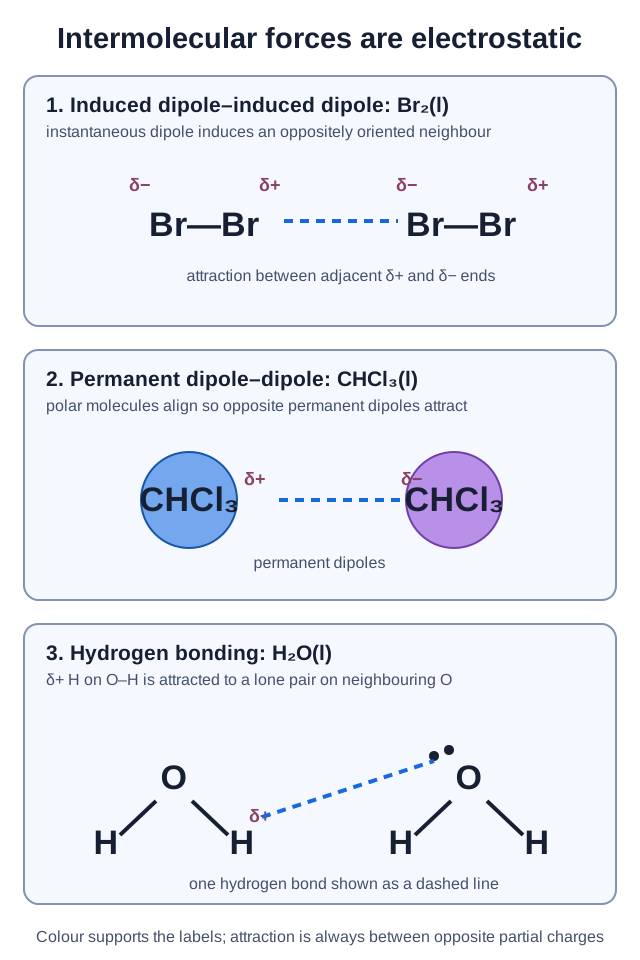
London forces are attractions caused by instantaneous dipoles inducing dipoles in neighbouring molecules.
B. Permanent dipole–dipole forces
Permanent dipole–dipole forces are attractions between the δ⁺ and δ⁻ ends of polar molecules.
C. Hydrogen bonding
Hydrogen bonding is the electrostatic attraction between a δ⁺ hydrogen atom in N-H, O-H, or F-H and a lone pair on N, O, or F in a neighbouring molecule.
D. Gas liquefaction
- Liquefaction is the change from gas to liquid when particles become close enough for intermolecular attractions to hold them together.
Detailed Explanations
A. What each force actually is (beginner explanation)
- London forces: electrons move randomly, so a molecule can have a temporary (instantaneous) dipole; this induces a dipole in a neighbour; the opposite ends attract.
- Permanent dipole–dipole: polar molecules have permanent δ⁺ and δ⁻ ends, so molecules align and attract.
- Hydrogen bonding: a strong dipole–dipole attraction when H is bonded to N/O/F, and the δ⁺ H is attracted to a lone pair on N/O/F in a neighbour.
B. Choosing the dominant intermolecular force (workflow)
- Does it have N-H, O-H, or F-H? → hydrogen bonding matters.
- If not, is the molecule polar? → permanent dipole–dipole matters.
- Always compare London forces using electrons and surface area (branching).
Mini example:
- CH₃CH₂OH (ethanol) has O-H → hydrogen bonding.
- CH₃OCH₃ (dimethyl ether) has no O-H → no hydrogen bonding (but it is polar, so dipole–dipole + London).
Required reference examples:
- CHCl₃(l) is polar, so permanent dipole–dipole attractions act as well as London forces.
- Br₂(l) is non-polar, so its intermolecular attraction is induced dipole–induced dipole (London) forces.
- Liquid noble gases consist of atoms rather than molecules, but instantaneous dipoles still induce dipoles in neighbouring atoms and allow condensation.
Data table
| Hydrogen halide | Boiling point |
|---|---|
| HF | 20 |
| HCl | -85 |
| HBr | -67 |
| HI | -35 |
C. Why Mᵣ and branching matter for London forces
- More electrons / higher Mᵣ → electron cloud is more polarisable → stronger London forces.
- Less branching → larger surface contact between molecules → stronger London forces.
Data table
| Isomer | Boiling point |
|---|---|
| n-pentane | 36 |
| isopentane | 28 |
| neopentane | 10 |
D. What happens on boiling
- Boiling separates molecules, so it overcomes intermolecular forces, not covalent bonds inside molecules.
E. Why hydrogen bonding matters in water and ice
- Water has an unusually high melting point and boiling point for its small molecular size because substantial energy is needed to overcome its hydrogen-bond network.
- In liquid water, hydrogen bonds continually break and reform, allowing molecules to pack more closely than in ice.
- In ice, hydrogen bonds hold water molecules in an open lattice. The molecules are further apart on average, so ice is less dense than liquid water and floats.
For “why ice floats”, do not write only “hydrogen bonding”. State that hydrogen bonds maintain an open lattice, placing water molecules further apart and making ice less dense than liquid water.
F. H1 focus: gas liquefaction
A gas approaches liquefaction when attractive forces become important relative to molecular kinetic energy. Low temperature reduces motion; high pressure reduces separation.
Cooling reduces average molecular kinetic energy; compression decreases average separation. Neither process creates a new type of intermolecular force.
At comparable conditions, particles with stronger attractions generally liquefy more readily.
Worked Examples
Modelled example 1
Compare Water and Hydrogen Sulfide
Problem
Study the worked solution
Identify water's attraction
Method
State that water molecules form hydrogen bonds.Reason
Hydrogen is bonded to oxygen, which also has lone pairs.Working
H₂O forms intermolecular hydrogen bonds.Contrast and conclude
Method
State that H₂S does not hydrogen-bond significantly and has weaker attractions.Reason
More energy is needed to separate hydrogen-bonded water molecules during boiling.Working
bp(H₂O)≫ bp(H₂S).
Guided practice 2
Explain Why Ice Is Less Dense
Problem
Try this before viewing the solution
Hints
Hint 1: describe the lattice
Hint 2: apply density
View solution step by step
Describe molecular spacing
Method
State that the open hydrogen-bonded lattice keeps molecules farther apart than in liquid water.Reason
The ordered solid structure contains more empty space.Working
Ice occupies a larger volume for the same number of molecules.Deduce density
Method
Use ρ = m/V.Reason
At the same mass, the larger ice volume gives a smaller density.Working
ρ_ice < ρ_water.
Guided practice 3
Compare Branched and Straight-Chain Isomers
Problem
Try this before viewing the solution
Hints
Hint 1: hold force type constant
Hint 2: compare shapes
View solution step by step
Compare contact area
Method
Identify (CH₃)₄C as the more compact, branched isomer.Reason
Its molecules make less surface-area contact with neighbours.Working
More branching → less intermolecular contact.Deduce boiling point
Method
Link reduced contact to weaker London attraction.Reason
Less energy is needed to separate the branched molecules.Working
bp((CH₃)₄C) is lower.
Guided practice 4
Liquefaction by Cooling and Compression
Problem
Try this before viewing the solution
Hints
Hint 1: effect of cooling
Hint 2: effect of pressure
View solution step by step
Explain cooling
Method
State that molecular kinetic energy decreases.Reason
Slower molecules are less able to escape intermolecular attractions.Working
Lower temperature → lower kinetic energy.Explain compression
Method
State that gas molecules are brought closer together.Reason
At smaller separation, existing intermolecular attractions become more significant.Working
Higher pressure → smaller separation.Conclude liquefaction
Method
State that attractions can now retain molecules in the liquid state.Reason
Attraction becomes sufficient relative to motion and separation.Working
Gas → liquid without changing molecular identity.
Common misconception 5
Correct an Ether Hydrogen-Bonding Claim
Learner claim
Identify the missing requirement
View solution step by step
Compare hydrogen-bond requirements
Method
State that ethanol has both O–H donors and oxygen lone-pair acceptors.Reason
Dimethyl ether has acceptor lone pairs but no O–H bond, so it cannot self-hydrogen-bond.Working
Ethanol: hydrogen bonding; ether: dipole–dipole and London forces.Deduce boiling point
Method
State that ethanol has stronger intermolecular attractions.Reason
More energy is required to separate ethanol molecules during boiling.Working
bp(ethanol) > bp(dimethyl ether).
Examiner practice 6
Explain Ethanol and Hexane Miscibility
Problem
Try this before viewing the solution
View solution step by step
Analyse ethanol
1 markMethod
State that ethanol forms hydrogen bonds with water.Reason
Its O–H group and oxygen lone pairs provide donor and acceptor sites.Working
Ethanol–water attractions are strong.Analyse hexane
1 markMethod
State that hexane is non-polar and cannot hydrogen-bond with water.Reason
Hexane–water attractions are weak compared with water–water hydrogen bonds.Working
Hexane–water interactions are insufficient for mixing.State miscibility
1 markMethod
Conclude that ethanol is miscible but hexane is not.Reason
Only ethanol replaces disrupted water attractions with comparably strong solute–solvent attractions.Working
Ethanol mixes; hexane separates.
Self-mark with the mark scheme
Compare your response with each mark point. Select a point only when your response contains that evidence.
Credit ethanol–water hydrogen bonding, the weak hexane–water contrast and the miscibility conclusion.
Challenge 7
Compare Liquefaction Conditions
Problem
Try this before viewing the solution
Hints
Hint 1: hold pressure constant
Hint 2: allow greater motion
View solution step by step
Make the prediction
Method
Select gas A.Reason
Its stronger attractions can retain molecules in a liquid at a higher kinetic energy.Working
Gas A liquefies at the higher temperature.Connect temperature and attraction
Method
State that gas B must be cooled further under the same pressure.Reason
Lower kinetic energy is needed before its weaker attractions can hold molecules together.Working
T_(liquefy,A) > T_(liquefy,B) at equal pressure.
Mind Stretchers
Mind stretcher 1Extension
Rank the boiling points of HF, HCl, and HI and explain your order.
Show Answer
Mark scheme:
- HF has hydrogen bonding → strongest intermolecular forces → highest boiling point.
- HCl and HI do not hydrogen bond; London forces dominate.
- HI has more electrons / higher Mᵣ than HCl → stronger London forces → higher boiling point than HCl.
- Order: HF > HI > HCl.
Mind stretcher 2: Microscopic explanationExtension
Why can high pressure assist liquefaction without changing molecular identity?
Show Hint
Focus on separation rather than intramolecular bonding.
Show Answer
Compression brings molecules closer, so existing intermolecular attractions become more significant. No covalent bonds within the molecules need change.
Mind stretcher 3: Two-variable reasoningExtension
A gas remains gaseous after compression at high temperature. Suggest why cooling may then cause liquefaction.
Show Hint
Compare attraction with kinetic energy.
Show Answer
At high temperature, molecular kinetic energy remains too large for attractions to retain close molecules. Cooling lowers kinetic energy until attractions can hold them together as a liquid.