Complex ion formation and solubility
Key idea: A ligand can increase solubility by binding a dissolved metal ion into a complex. Lower free-ion concentration drives more solid to dissolve, while Ksp remains unchanged.
Offline pages
Saved on this device only. Connect at least once every 30 days to confirm Premium. Sign-out or a change of account removes saved copies.
Loading guide controls…
Guided lessons · coming soon
Guided lesson
Guided steps
- Compare the usual qualitative-test observations for the three halides.
- Predict the dissolution shift and whether Ksp changes.
- Follow complex formation, the free-ion product and extra dissolution.
- Explain all four links with the complex equation.
- Calculate Q and decide which sample dissolves completely.
- Compare Q with each salt’s Ksp.
- Predict both silver trends before inspecting the graph.
- Explain the widening gap between free and total dissolved silver.
- Choose the silver concentration, then calculate Ksp and complexed silver.
- Explain why solubility rises while Ksp stays unchanged.
- Compare solubility and free silver in both samples.
- Explain both changes using the free-ion equations.
On this page
You stopped at:
ContinueIn the free-ion model, adding a common ion lowers solubility. A ligand can do the opposite: ammonia dissolves silver chloride, because it locks silver ions up in a complex ion. This lesson explains how complex formation raises solubility, and uses it to tell silver chloride, bromide and iodide apart.
Silver halides and ammonia
Adding aqueous silver nitrate to a solution of halide ions gives a precipitate of the silver halide:
For the usual qualitative test with small precipitate samples, adding aqueous ammonia helps distinguish the halides:
| Silver halide | Colour | Kₛₚ / mol² dm⁻⁶ | Dilute ammonia | Concentrated ammonia |
|---|---|---|---|---|
| AgCl | white | about 1.8 × 10⁻¹⁰ | dissolves | dissolves |
| AgBr | cream | about 5 × 10⁻¹³ | partly dissolves | dissolves |
| AgI | yellow | about 8 × 10⁻¹⁷ | does not dissolve | does not dissolve |
Check your understanding 1
Ammonia binds free Ag⁺. Before following the linked equilibria, predict the direction of the AgCl dissolution equilibrium and whether Ksp changes at fixed temperature.
Show answer
The dissolution equilibrium shifts right; Ksp stays the same. Follow how the two equilibria share free silver, rather than treating the silver in the complex as a free ion.
How a complex raises solubility
Two equilibria are linked through the free silver ions:
Ammonia is a ligand. It bonds to free Ag⁺ ions to form the diamminesilver(I) complex, which lowers [Ag⁺]. The ionic product [Ag⁺][Cl⁻] falls below Kₛₚ, so the first equilibrium shifts to the right and more AgCl dissolves. With enough ammonia, all of the precipitate dissolves.
Kₛₚ itself does not change. The silver in the complex is still dissolved, but it is no longer a free Ag⁺ ion, so it does not count in Kₛₚ.
Whether a silver halide dissolves depends on how low ammonia can push [Ag⁺], compared with how low it must be. AgCl has the largest Kₛₚ, so dilute ammonia is enough. AgBr needs the larger effect of concentrated ammonia. Under these qualitative-test conditions, AgI has so small a Kₛₚ that concentrated ammonia does not lower free silver enough to dissolve the visible precipitate.
Exam-style question 1
Why ammonia dissolves silver chloride
Problem
Try this before viewing the solution
Show solution step by step
Show the complex forming
1 markMethod
Ammonia bonds to silver ions.Reason
Ammonia is a ligand.Working
Answer
Ag⁺(aq) + 2NH₃(aq) ⇌ [Ag(NH₃)₂]⁺(aq)Free silver falls
1 markReason
Silver in the complex is not free Ag⁺.Working
Answer
[Ag⁺] falls, so [Ag⁺][Cl⁻] < Kₛₚ.The dissolving equilibrium shifts
1 markReason
The equilibrium replaces the silver ions that were removed.Working
Answer
AgCl(s) ⇌ Ag⁺(aq) + Cl⁻(aq) shifts to the right.Conclude
1 markMethod
More AgCl dissolves.Reason
The shift to the right uses up the solid.Working
Answer
The solubility of AgCl increases, and the precipitate dissolves.
Self-mark with the mark scheme
Tick each mark point that your answer includes.
Credit the complex, the fall in free silver, the shift and the increase in solubility.
Check your understanding 2
A precipitate is either AgBr or AgI. In a particular ammonia solution, complex formation holds free [Ag⁺] at 1.0 × 10⁻¹⁰ mol dm⁻³. If the whole precipitate dissolved, the halide concentration would be 1.0 × 10⁻³ mol dm⁻³. Use the Kₛₚ values in the table to decide which precipitate would dissolve completely.
Show answer
If all of it dissolved, Q = [Ag⁺][X⁻] = (1.0 × 10⁻¹⁰)(1.0 × 10⁻³) = 1.0 × 10⁻¹³ mol² dm⁻⁶. For AgBr, Q is below Kₛₚ ≈ 5 × 10⁻¹³, so the solution can hold all of it: AgBr dissolves completely. For AgI, Q is far above Kₛₚ ≈ 8 × 10⁻¹⁷, so most of the AgI stays as solid. The much smaller Kₛₚ of AgI means free [Ag⁺] would have to be pushed far lower before it dissolved. Kₛₚ itself does not change.
Check your understanding 3
Explain both trial-Q comparisons above and why the same given free silver allows complete dissolution of one halide but not the other.
Show answer
The trial Q = 1.0 × 10⁻¹³ is below AgBr’s Kₛₚ ≈ 5 × 10⁻¹³: with the given free silver held constant, all the sample can dissolve and leave an unsaturated solution. It is above AgI’s Kₛₚ ≈ 8 × 10⁻¹⁷, so that much dissolved iodide cannot coexist with the given free silver at equilibrium; some AgI remains solid. The dissolution constants differ and neither changes on adding ammonia.
Free silver and total dissolved silver
With a complex present, dissolved silver exists in two forms:
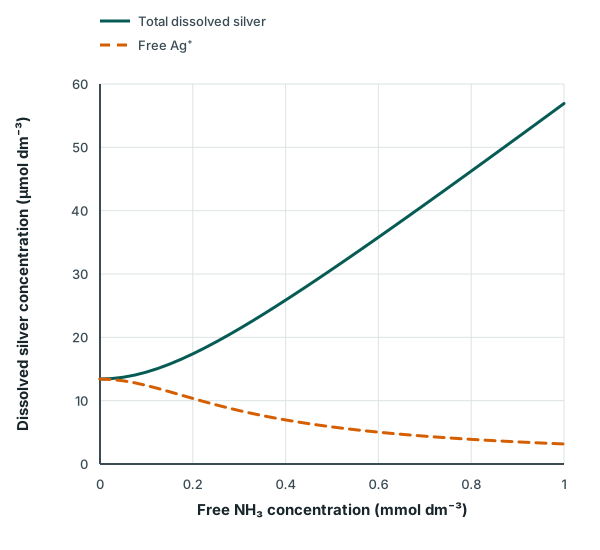
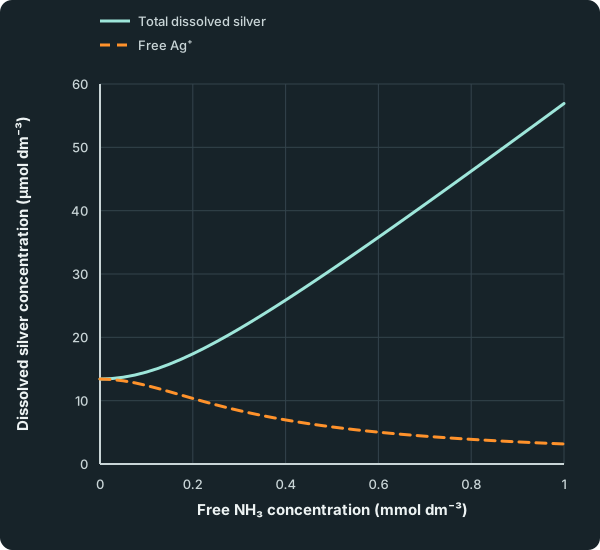
The graph follows both for AgCl at increasing specified free ammonia concentration, with excess AgCl solid remaining. Its two-species model includes only free silver and the diamminesilver complex, at fixed temperature and with no added chloride.
Check your understanding 4
Before reading the graph, predict the trend in free silver and total dissolved silver as free ammonia increases. Use the two linked equilibria, not just the falling concentration of one ion.
Show answer
Free silver falls while total dissolved silver rises. Inspect both series to test the distinction between a free ion and all dissolved forms of an element.
Free silver falls while dissolved silver rises
Concentrations of total dissolved silver and free silver ions against specified free ammonia concentration. Both begin at 13.4 μmol dm⁻³ without ammonia; increasing free ammonia produces opposing trends.
Scroll across the figure to read all labels.
View figure data
| Free NH₃ concentration (mmol dm⁻³) | Total dissolved silver | Free Ag⁺ |
|---|---|---|
| 0.000 | 13.42 | 13.416 |
| 0.025 | 13.49 | 13.346 |
| 0.050 | 13.70 | 13.140 |
| 0.075 | 14.04 | 12.818 |
| 0.100 | 14.51 | 12.403 |
| 0.125 | 15.09 | 11.926 |
| 0.150 | 15.77 | 11.410 |
| 0.175 | 16.54 | 10.880 |
| 0.200 | 17.39 | 10.351 |
| 0.225 | 18.30 | 9.836 |
| 0.250 | 19.27 | 9.342 |
| 0.275 | 20.28 | 8.874 |
| 0.300 | 21.34 | 8.435 |
| 0.325 | 22.43 | 8.024 |
| 0.350 | 23.56 | 7.642 |
| 0.375 | 24.70 | 7.286 |
| 0.400 | 25.88 | 6.956 |
| 0.425 | 27.07 | 6.650 |
| 0.450 | 28.28 | 6.365 |
| 0.475 | 29.50 | 6.101 |
| 0.500 | 30.74 | 5.855 |
| 0.525 | 31.99 | 5.627 |
| 0.550 | 33.25 | 5.413 |
| 0.575 | 34.52 | 5.214 |
| 0.600 | 35.80 | 5.028 |
| 0.625 | 37.09 | 4.854 |
| 0.650 | 38.38 | 4.690 |
| 0.675 | 39.68 | 4.537 |
| 0.700 | 40.98 | 4.392 |
| 0.725 | 42.29 | 4.256 |
| 0.750 | 43.60 | 4.128 |
| 0.775 | 44.92 | 4.007 |
| 0.800 | 46.24 | 3.892 |
| 0.825 | 47.57 | 3.784 |
| 0.850 | 48.90 | 3.681 |
| 0.875 | 50.23 | 3.584 |
| 0.900 | 51.56 | 3.491 |
| 0.925 | 52.90 | 3.403 |
| 0.950 | 54.24 | 3.319 |
| 0.975 | 55.58 | 3.239 |
| 1.000 | 56.92 | 3.162 |
Check your understanding 5
Use the two graph trends to judge the claim “less free silver means less AgCl has dissolved”. Identify which dissolved form accounts for the widening gap between the curves.
Show answer
The graph shows falling free Ag⁺ but rising total dissolved silver. The difference is silver in [Ag(NH₃)₂]⁺. The falling free-ion concentration drives more salt dissolution while complex formation holds much of that dissolved silver. Only free silver belongs in Ksp; both forms count towards solubility.
Check your understanding 6 Which silver goes into Ksp?
In a saturated AgCl solution containing ammonia, free [Ag⁺] = 3.16 × 10⁻⁶, [Cl⁻] = 5.69 × 10⁻⁵, and total dissolved silver is 5.69 × 10⁻⁵ mol dm⁻³. A learner puts the total dissolved silver into Kₛₚ and concludes that Kₛₚ has increased. Find the error, check Kₛₚ correctly and calculate the concentration of silver held in the complex.
Show answer
Kₛₚ uses the free Ag⁺ concentration, not the silver held in the complex. With free silver: (3.16 × 10⁻⁶)(5.69 × 10⁻⁵) = 1.8 × 10⁻¹⁰, the same Kₛₚ as in pure water. Total dissolved silver equals [Cl⁻], because every dissolved AgCl released one chloride ion, so the solubility has risen to 5.69 × 10⁻⁵ mol dm⁻³ even though free Ag⁺ has fallen.
Check your understanding 7
Explain why the correct free-ion product is unchanged while solubility has risen. Show the complex-silver subtraction and identify which concentration measures dissolved AgCl.
Show answer
Kₛₚ = (3.16 × 10⁻⁶)(5.69 × 10⁻⁵) = 1.8 × 10⁻¹⁰ mol² dm⁻⁶. Complex silver is (5.69 × 10⁻⁵)-(3.16 × 10⁻⁶) = 5.37 × 10⁻⁵ mol dm⁻³. Total silver, 5.69 × 10⁻⁵ mol dm⁻³, measures AgCl dissolved because each formula unit supplies one silver atom. With no added chloride, chloride also measures that total, whereas the smaller free-silver concentration measures only one dissolved form.
Common ions and complexes compared
Check your understanding 8
Two identical saturated AgCl samples contain undissolved solid. Add NaCl to A and excess aqueous ammonia to B. Choose each solubility direction and compare the final free-silver trends. Keep temperature fixed, ignore volume changes and exclude chloride complexes in sample A.
Show answer
Solubility falls in A and rises in B; free silver falls in both. In the next response, explain both directions with equations and compare the initial Q with the equilibrium free-ion product.
Try it yourself 1
Sodium chloride or ammonia?
Problem
Try this before viewing the solution
Hints
Hint 1
sample A
Sodium chloride adds one of the ions of the equilibrium.Hint 2
sample B
What does ammonia do to the free silver ions?Show solution step by step
Sample A
Method
Solubility decreases.Reason
Added Cl⁻ is a common ion; the equilibrium shifts to the left.Working
Answer
More AgCl precipitates.Sample B
Method
Solubility increases.Reason
Ammonia removes Ag⁺ as [Ag(NH₃)₂]⁺; the equilibrium shifts to the right.Working
Answer
More AgCl dissolves.Compare
Method
The two changes go in opposite directions.Reason
A common ion adds a product of the dissolving equilibrium; complex formation removes one.Working
Answer
In both samples free [Ag⁺] ends up lower, and Kₛₚ is unchanged.
Quick check
Common mistakes
- Saying ammonia increases Kₛₚ. It increases the solubility; Kₛₚ stays the same.
- Counting silver in the complex as free Ag⁺ in the Kₛₚ expression.
- Saying ammonia “reacts with the chloride”. It bonds to the silver ions.
- Mixing up the halide results: AgCl dissolves in dilute ammonia, AgBr fully only in concentrated ammonia, AgI in neither.
- Using free [Ag⁺] alone as a measure of how much salt has dissolved.
Spotted an error? Report a correction
Syllabus and review details
- GCE A-Level H2 Chemistry 2027 · 9476-2027
9476 (2027), complete syllabus
Last reviewed: