pH of weak acids and bases
Key idea: For a slightly dissociated monoprotic acid, [H⁺] ≈ √(Ka × concentration). Check the dissociated fraction and that water contributes negligibly; weak bases use the analogous Kb relationship.
Offline pages
Saved on this device only. Connect at least once every 30 days to confirm Premium. Sign-out or a change of account removes saved copies.
Loading guide controls…
Guided lessons · coming soon
Guided lesson
Guided steps
- Write the concentration balance before making the approximation.
- Find hydrogen-ion concentration, percentage dissociated and pH.
- Check acid depletion and water’s ion contribution.
- Calculate the estimated depletion and judge the approximation.
- Predict concentration and fractional dissociation before inspecting the graph.
- Calculate both pH rises from the graph endpoints.
- Use the graph trends to explain your predictions.
- Calculate both pH values and percentages after dilution.
- Use the base equilibrium to find hydroxide concentration.
- Calculate ammonia pH with less support.
- Compare your complete method and both approximation conditions.
On this page
You stopped at:
ContinueAt ordinary laboratory concentrations, a weak acid often remains mostly undissociated, so the hydrogen-ion concentration is far smaller than the acid concentration. To find it, use Kₐ. This lesson builds the calculation for weak acids, checks when its shortcut is allowed, and applies the same method to weak bases.
Hydrogen-ion concentration in a weak acid
For a monoprotic acid with no added conjugate base, neglect water’s hydrogen-ion contribution. Let the initial acid concentration be c, and let x mol dm⁻³ of it dissociate:
| Species | Equilibrium concentration |
|---|---|
| HA | c-x |
| H⁺ | x |
| A⁻ | x |
Each molecule that dissociates gives one H⁺ and one A⁻, so
For a weak acid, x is usually tiny compared with c, so c-x ≈ c. Then
This approximation also ignores the H⁺ from water, which is fine unless the acid is extremely dilute.
Exam-style question 1
The pH of ethanoic acid
Problem
Try this before viewing the solution
Show the steps Optional working
Show the steps Optional working
Show solution step by step
Set up the expression
1 markMethod
Write Kₐ with [H⁺] = [CH₃COO⁻] = x and [CH₃COOH] ≈ c.Reason
Each dissociated molecule gives one of each ion, and only a small fraction dissociates.Working
Answer
Kₐ = x²/(c-x) ≈ x²/cFind the hydrogen-ion concentration
1 markReason
Rearrange for x.Working
Answer
x = square root of ((1.8 × 10⁻⁵)(0.100)) = 1.34 × 10⁻³ mol dm⁻³Check the approximation
1 markMethod
Compare x with c.Reason
c-x ≈ c is only fair if x is a small fraction of c; a common test is under 5%.Working
Answer
x/c = 0.0134, or 1.3%, so the approximation is valid.Calculate pH
1 markMethod
Take the negative logarithm.Reason
pH depends on the equilibrium [H⁺], not on c.Working
Answer
pH = - log ₁₀(1.34 × 10⁻³) = 2.87
Self-mark with the mark scheme
Tick each mark point that your answer includes.
Credit the expression, the hydrogen-ion concentration, the validity check and the pH.
When the shortcut fails
The shortcut assumes the acid is only slightly dissociated. That is true for most weak acids at ordinary concentrations, but not for a fairly strong weak acid or a very dilute solution. Always check x/c after using it. You will not be asked to solve the full equation, but you should recognise when the shortcut is not valid.
Spot the mistake 1
A shortcut that does not hold
Learner method
Choose the missing step
Show solution step by step
Make the check
Method
Compare the estimate of x with c.Reason
The square-root formula depends on c-x ≈ c.Working
Answer
x/c = 3.16 × 10⁻³/0.0100 = 0.316, or 32%Judge the answer
Method
The approximation is not valid, so pH 2.50 cannot be trusted.Reason
The shortcut estimates roughly 30% dissociation, so c-x is much smaller than c.Working
Answer
Solving Kₐ = x²/(c-x) exactly gives x = 2.70 × 10⁻³ mol dm⁻³ and pH 2.57.
Common mistake
Dilution and the fraction dissociated
Check your understanding 1
The same weak acid is diluted at fixed temperature while the square-root approximation remains valid. Predict both [H⁺] and the fraction of acid dissociated before inspecting the graph.
Show answer
[H⁺] falls, but x/c rises. A larger fraction of a smaller total can give a lower ion concentration. The unchanged Kₐ keeps the acid’s strength fixed.
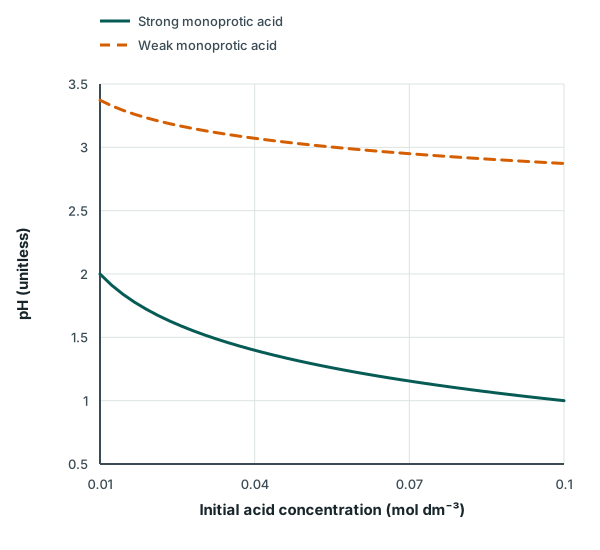
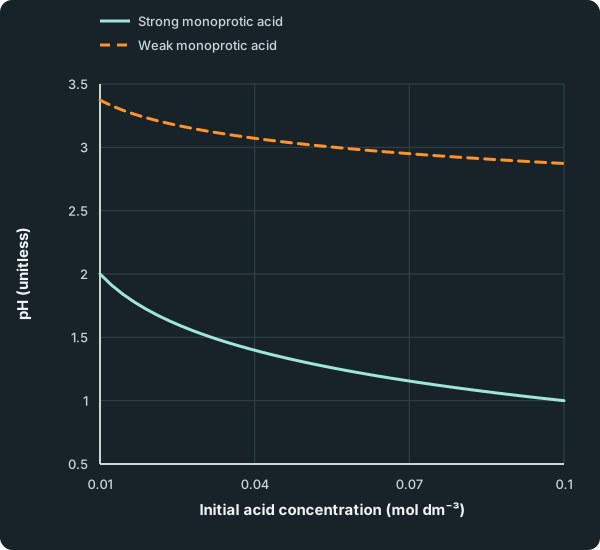
Concentration changes pH at fixed acid strength
pH against initial acid concentration from 0.0100 to 0.100 mol dm⁻³. Strong-acid pH falls from 2.00 to 1.00; the weak-acid estimate falls from 3.37 to 2.87.
Scroll across the figure to read all labels.
View figure data
| Initial acid concentration (mol dm⁻³) | Strong monoprotic acid | Weak monoprotic acid |
|---|---|---|
| 0.01000 | 2.000 | 3.372 |
| 0.01225 | 1.912 | 3.328 |
| 0.01450 | 1.839 | 3.292 |
| 0.01675 | 1.776 | 3.260 |
| 0.01900 | 1.721 | 3.233 |
| 0.02125 | 1.673 | 3.209 |
| 0.02350 | 1.629 | 3.187 |
| 0.02575 | 1.589 | 3.167 |
| 0.02800 | 1.553 | 3.149 |
| 0.03025 | 1.519 | 3.132 |
| 0.03250 | 1.488 | 3.116 |
| 0.03475 | 1.459 | 3.102 |
| 0.03700 | 1.432 | 3.088 |
| 0.03925 | 1.406 | 3.075 |
| 0.04150 | 1.382 | 3.063 |
| 0.04375 | 1.359 | 3.052 |
| 0.04600 | 1.337 | 3.041 |
| 0.04825 | 1.317 | 3.031 |
| 0.05050 | 1.297 | 3.021 |
| 0.05275 | 1.278 | 3.011 |
| 0.05500 | 1.260 | 3.002 |
| 0.05725 | 1.242 | 2.993 |
| 0.05950 | 1.225 | 2.985 |
| 0.06175 | 1.209 | 2.977 |
| 0.06400 | 1.194 | 2.969 |
| 0.06625 | 1.179 | 2.962 |
| 0.06850 | 1.164 | 2.955 |
| 0.07075 | 1.150 | 2.948 |
| 0.07300 | 1.137 | 2.941 |
| 0.07525 | 1.123 | 2.934 |
| 0.07750 | 1.111 | 2.928 |
| 0.07975 | 1.098 | 2.921 |
| 0.08200 | 1.086 | 2.915 |
| 0.08425 | 1.074 | 2.910 |
| 0.08650 | 1.063 | 2.904 |
| 0.08875 | 1.052 | 2.898 |
| 0.09100 | 1.041 | 2.893 |
| 0.09325 | 1.030 | 2.888 |
| 0.09550 | 1.020 | 2.882 |
| 0.09775 | 1.010 | 2.877 |
| 0.10000 | 1.000 | 2.872 |
The graph compares a strong acid with ethanoic acid. Diluting from 0.100 to 0.0100 mol dm⁻³ raises the strong acid’s pH by 1.00, but the weak acid’s pH by only 0.50. Dilution shifts the weak acid’s equilibrium to the right: a larger fraction dissociates, rising from 1.3% to 4.2%, even though [H⁺] itself falls. Kₐ does not change, so the acid is no stronger.
Check your understanding 2
Use the graph endpoints at 0.100 and 0.0100 mol dm⁻³ to calculate the pH rise on dilution for the strong acid and ethanoic acid. Calculate each difference, then explain the trends in the next response.
Show answer
The strong-acid rise is 2.00-1.00 = 1.00; the weak-acid rise is 3.37-2.87 = 0.50. The two acids undergo the same tenfold concentration dilution, but different hydrogen-ion concentration changes.
Check your understanding 3
Use the graph trends and your calculated pH rises to test the predictions about hydrogen-ion concentration and fraction dissociated. Explain how a larger fraction can accompany a smaller ion concentration.
Show answer
Read strong-acid pH 1.00 → 2.00 and weak-acid pH 2.87 → 3.37. Higher pH means lower [H⁺] in both. The weak-acid 0.50 rise corresponds to a √10 concentration decrease, while its total acid concentration decreases tenfold; its fraction dissociated therefore rises. These are calculated approximation curves, rather than measured universal weak-acid fractions.
Check your understanding 4
A weak acid has Kₐ = 1.0 × 10⁻⁵ mol dm⁻³. Its solution is diluted from 0.0400 to 0.0100 mol dm⁻³. Calculate the pH and the percentage dissociated before and after dilution. Has the acid become stronger?
Show the steps Optional working
Show the steps Optional working
Show the steps Optional working
Show the steps Optional working
Show answer
Before: [H⁺] = square root of ((1.0 × 10⁻⁵)(0.0400)) = 6.32 × 10⁻⁴ mol dm⁻³, so pH = 3.20, and x/c = 1.6%.
After: [H⁺] = square root of ((1.0 × 10⁻⁵)(0.0100)) = 3.16 × 10⁻⁴ mol dm⁻³, so pH = 3.50, and x/c = 3.2%.
A larger fraction is dissociated after dilution, but Kₐ is unchanged, so the acid is not stronger. Both percentages are small, so the shortcut is valid.
Weak bases
A weak base works in the same way, with Kb and hydroxide ions in place of Kₐ and hydrogen ions:
Check x/c, find pOH, then use pH = pKw-pOH. Ammonia does not contain hydroxide ions; it makes them by taking protons from water.
Try it yourself 2
The pH of aqueous ammonia
Problem
Try this before viewing the solution
Show the steps Optional working
Hints
Hint 1
base equilibrium
Which equilibrium expression gives the ion concentration for a weak base?Hint 2
two steps
Find pOH from [OH⁻], then subtract it from 14.00.Show solution step by step
Find the hydroxide concentration
Method
Use the square-root approximation with Kb.Reason
Kb = x²/(c-x) ≈ x²/c when little of the base reacts.Working
Answer
[OH⁻] = square root of ((1.8 × 10⁻⁵)(0.200)) = 1.90 × 10⁻³ mol dm⁻³Check the approximation
Method
Compare x with c.Reason
The shortcut needs a small fraction.Working
Answer
x/c = 0.0095, under 1%, so it is valid.Convert to pH
Method
Find pOH, then pH.Reason
The calculation gave hydroxide ions, not hydrogen ions.Working
Answer
pOH = 2.72, so pH = 14.00-2.72 = 11.28
Quick check
Check your understanding 5
For the ammonia problem, show the equilibrium setup, hydroxide concentration, fraction reacted, pOH and pH. Explain why the approximation is acceptable and why the first logarithm gives pOH.
Show answer
Kb = x²/(c-x) ≈ x²/c with x = [OH⁻]. Hence x = square root of ((1.8 × 10⁻⁵)(0.200)) = 1.90 × 10⁻³ mol dm⁻³. The reacted fraction is x/c = 0.00949, about 0.95%, so depletion is small; hydroxide also greatly exceeds water’s contribution. pOH = 2.72, so pH = 14.00 − 2.72 = 11.28 at 25 °C. The calculated ion was hydroxide, which is why its negative logarithm is pOH.
Common mistakes
- Setting [H⁺] equal to the concentration of a weak acid.
- Using square root of Kₐc without checking that x is a small fraction of c.
- Writing Kₐ = x²/c as if it were exact. It is an approximation.
- Saying a weak acid becomes stronger when diluted. The fraction dissociated rises; Kₐ does not change.
- For a weak base, reporting pOH as pH, or using Kₐ in place of Kb.
Spotted an error? Report a correction
Syllabus and review details
- GCE A-Level H2 Chemistry 2027 · 9476-2027
9476 (2027), complete syllabus
Last reviewed: