Ionic and Covalent Bonding Models
Learn and apply Ionic and Covalent Bonding Models in the published Chemistry course sequence.
Continue where you stopped
The core idea
On this page
Ionic and Covalent Bonding Models: Orientation
Most bonding questions boil down to one move: name the structure, then name the attraction, then link to the property. This lesson gives you the mark-scheme definitions and the dot-and-cross workflow that starts almost every bonding answer.
Treat this as an extension of Atomic Structure (A Level), then use the Chemical Bonding hub to compare models across the topic.
Definitions (Must Know)
A. Ionic bonding
Ionic bonding is the electrostatic attraction between oppositely charged ions.
B. Covalent bonding
Covalent bonding is the electrostatic attraction between a shared pair of electrons and the nuclei of the bonded atoms.
C. Ionic lattice (giant ionic structure)
An ionic lattice is a giant structure of alternating ions held by ionic bonding in all directions.
D. Simple molecular substance
A simple molecular substance contains molecules held together by intermolecular forces.
E. Giant covalent structure (network)
A giant covalent structure is a network of atoms linked by covalent bonds throughout the structure.
F. Electrostatic attraction
Electrostatic attraction is the attraction between opposite charges.
G. Metallic bonding
Metallic bonding is the electrostatic attraction between a lattice of positive metal ions and delocalised electrons.
Detailed Explanations
A. Dot-and-cross diagrams (workflow)
- Decide whether it is ionic (lattice of ions) or covalent (molecules/network).
- Count valence (outer-shell) electrons for each atom/ion.
- Draw only outer electrons:
- use different symbols (• and ×) for electrons from different atoms
- For ionic diagrams:
- show the electron transfer result as ions in brackets with charges
- show a full outer shell (octet) on ions where applicable
- For covalent diagrams:
- show shared pairs between atoms (one dot + one cross per bond)
- show lone pairs on the correct atom
Required ionic examples:
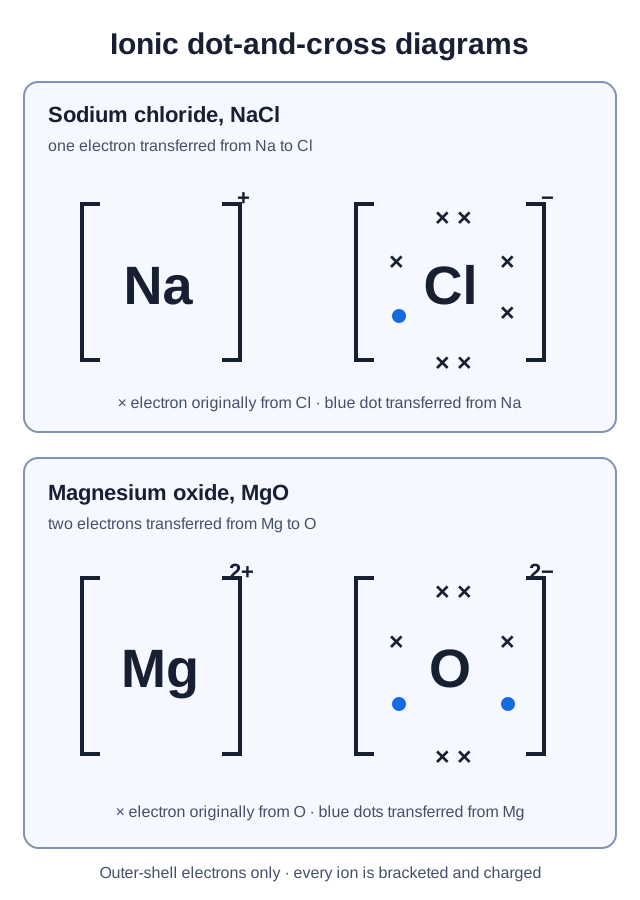
- NaCl: one electron is transferred from Na to Cl; show [Na]⁺ and [Cl]⁻, with eight outer electrons around Cl⁻.
- MgO: two electrons are transferred from Mg to O; show [Mg]²⁺ and [O]²⁻, with eight outer electrons around O²⁻.
Required covalent examples:
| Species | Shared pairs between the named atoms | Lone-pair check |
|---|---|---|
| H₂, Cl₂, HCl | one shared pair | each Cl has three lone pairs |
| O₂ | two shared pairs | each O has two lone pairs |
| N₂ | three shared pairs | each N has one lone pair |
| CO₂ | two shared pairs in each C = O | each O has two lone pairs |
| CH₄ | four C–H shared pairs | no lone pair on C |
| C₂H₄ | two shared pairs between C atoms; four C–H shared pairs | no lone pair on C |
B. What “electrostatic attraction” means (avoid the wrong definition)
- Ionic bond: attraction between Na⁺ and Cl⁻ (opposite charges).
- Covalent bond: attraction between a shared electron pair and both nuclei.
So “transfer” and “sharing” are formation stories. The bond itself is the attraction.
C. Metallic bonding
Metal atoms contribute outer electrons to a delocalised electron system. The remaining positive ions occupy lattice positions, and attraction between the ions and delocalised electrons acts throughout the structure. Because the electrons are mobile, metals conduct electricity in both solid and molten states.
D. Using bonding models to predict properties (exam chain)
Use a structure-first chain:
- Identify structure (ionic lattice / molecules / giant covalent).
- State the forces/bonds present (ionic bonding / intermolecular forces / covalent bonds).
- Link to the property asked (melting point / conductivity / solubility).
Mini example (1–2 sentences, exam style): Solid NaCl does not conduct because ions are fixed in the lattice (no mobile charge carriers). Molten NaCl conducts because ions are mobile.
Worked Examples
Modelled example 1
Construct the Magnesium Oxide Diagram
Problem
Draw a dot-and-cross diagram for MgO.
Study the worked solution
Show the electron transfer
Method
Transfer magnesium’s two outer electrons to oxygen.Reason
Magnesium forms Mg²⁺ and oxygen completes its outer shell as O²⁻.Working
Mg → Mg²⁺ + 2e⁻; O + 2e⁻ → O²⁻.Draw separate bracketed ions
Method
Place Mg²⁺ and O²⁻ in separate brackets with charges.Reason
An ionic diagram shows transferred electrons and distinct ions, not a shared pair.Working
[Mg]²⁺\ [O]²⁻Complete the oxide outer shell
Method
Show eight outer electrons around oxide, distinguishing their origins.Reason
Six came from oxygen and two came from magnesium.Working
Eight electrons around O²⁻: six of one symbol and two of the other.
Guided practice 2
Specify the Carbon Dioxide Diagram
Problem
Describe what a correct dot-and-cross diagram of CO₂ must show.
Try this before viewing the solution
Hints
Hint 1: satisfy the central atom
Hint 2: check each oxygen
View solution step by step
Set the bond pattern
Method
Place carbon between two oxygen atoms with a double bond to each.Reason
Two C = O double bonds complete the outer shells of all three atoms.Working
O = C = OShow shared-pair origins
Method
Use two shared pairs in each double bond, with one electron from each bonded atom per pair.Reason
Dot-and-cross symbols distinguish electron origin without implying different electron types.Working
Each C = O bond contains two dot-cross pairs.Add lone pairs
Method
Give each oxygen two lone pairs and carbon none.Reason
This accounts for all valence electrons and completes every octet.Working
Two lone pairs on each O; no lone pairs on C.
Common misconception 3
Identify the Mobile Charge Carrier
Learner claim
Asked why solid NaCl does not conduct electricity but molten NaCl does, a learner says, “Melting releases delocalised electrons that carry charge.” Identify the error and give the correct explanation.
Choose the mobile species
View solution step by step
Explain the solid
Method
State that the ions are fixed in the ionic lattice.Reason
Without mobile charged particles, the solid cannot carry current.Working
Solid NaCl: ions present but not mobile.Explain the melt
Method
State that melting allows the ions to move.Reason
Mobile Na⁺ and Cl⁻ ions carry charge through the liquid.Working
Molten NaCl conducts by ion movement.
Examiner practice 4
Define Metallic Bonding and Explain Conduction
Problem
Define metallic bonding and explain why copper conducts electricity as a solid. [3 marks]
Try this before viewing the solution
View solution step by step
Name the two charged components
1 markMethod
Identify a lattice of positive ions and delocalised electrons.Reason
A metallic-bond definition must specify what attracts what.Working
Positive metal ions and delocalised electrons.Define the attraction
1 markMethod
State that metallic bonding is electrostatic attraction between those components.Reason
The bond is the attraction, not either component by itself.Working
Electrostatic attraction: positive-ion lattice ↔ delocalised electrons.Explain solid conduction
1 markMethod
State that delocalised electrons move through the solid lattice and carry charge.Reason
The electrons remain mobile even when the positive ions occupy fixed lattice positions.Working
Mobile electrons → electrical conduction.
Self-mark with the mark scheme
Compare your response with each mark point. Select a point only when your response contains that evidence.
Credit both parts of the definition and the mobile-electron explanation.
Challenge 5
Transfer the Ionic Diagram to Aluminium Oxide
Problem
Describe how to draw a complete dot-and-cross diagram for one formula unit of Al₂O₃. Your description must include the number and charges of all ions and the origin of the outer electrons around each oxide ion.
Try this before viewing the solution
Hints
Hint 1: balance the charges
Hint 2: track the transferred electrons
View solution step by step
Set the ion ratio
Method
Draw two aluminium ions and three oxide ions in separate brackets.Reason
The 2:3 ratio balances 2(3 +) with 3(2-).Working
2[Al]³⁺ and 3[O]²⁻.Track electron transfer
Method
Show each aluminium atom losing three electrons and each oxygen atom gaining two.Reason
Six electrons lost by aluminium must equal six gained by oxygen.Working
2 × 3 = 3 × 2 = 6 transferred electrons.Complete the oxide ions
Method
Show eight outer electrons around every O²⁻, with six oxygen symbols and two aluminium symbols.Reason
Each oxide ion has a complete outer shell and preserves electron origin in the diagram.Working
Three complete oxide octets; no shared electron pairs.
Mind Stretchers
Mind stretcher 1Extension
Explain why MgO has a higher melting point than NaCl.
Show Answer
Mark scheme:
- Both are ionic lattices (giant ionic structures).
- Mg²⁺ and O²⁻ have higher charges than Na⁺ and Cl⁻.
- Higher charge (and typically smaller ions) gives stronger electrostatic attraction in the lattice.
- Stronger attraction means more energy is needed to melt → higher melting point.