Sigma and Pi Bonds (Orbital Overlap)
Learn and apply Sigma and Pi Bonds (Orbital Overlap) in the published Chemistry course sequence.
Continue where you stopped
The core idea
On this page
Sigma and Pi Bonds: Orbital Overlap: Orientation
This lesson explains covalent bonding through overlap of s and p orbitals, the scope specified in the syllabus. The decisive distinction is whether overlap occurs along the internuclear axis (σ) or above and below it (π).
Treat this as an extension of Atomic Structure (A Level), then use the Chemical Bonding hub to compare models across the topic.
Definitions (Must Know)
A. Sigma bond, σ
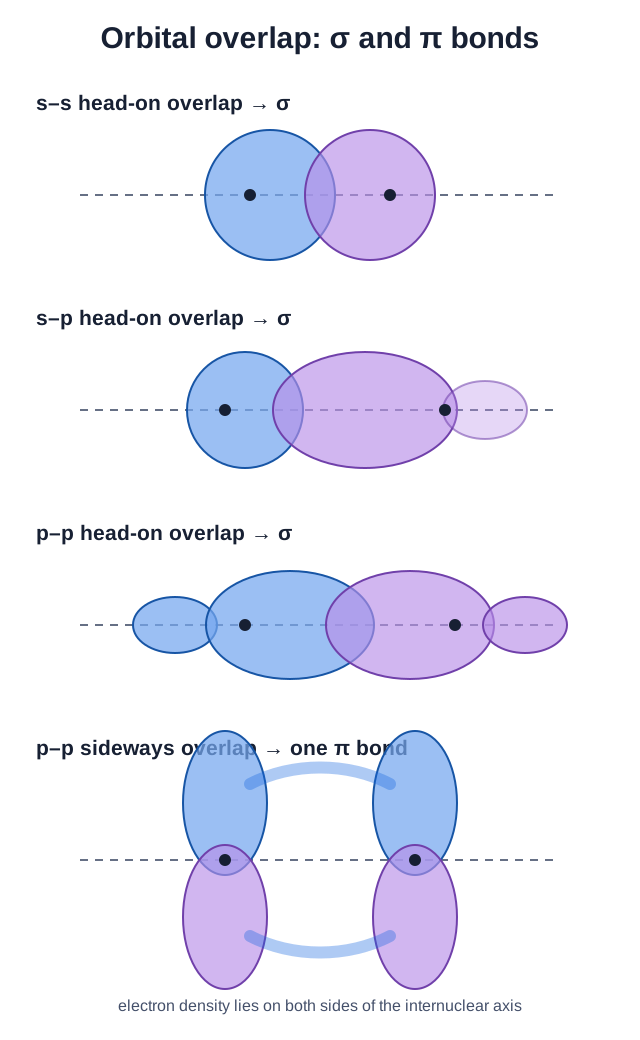
A σ bond forms by head-on overlap of orbitals along the internuclear axis.
B. Pi bond, π
A π bond forms by sideways overlap of p orbitals above and below the internuclear axis.
Detailed Explanations
A. Head-on overlap gives a σ bond
Head-on overlap concentrates shared electron density directly between the nuclei, along the internuclear axis. Within the specified s/p scope, this may be:
- s–s overlap, as in the H–H bond in H₂;
- s–p overlap, as a simplified description of H–Cl bonding;
- p–p head-on overlap, as in the σ component of Cl₂ or N₂.
B. Sideways p–p overlap gives a π bond
Two parallel p orbitals can overlap sideways. This creates two continuous regions of shared electron density, one on each side of the internuclear axis. It is still one π bond, not two bonds.
C. Bond-counting method
- Every bond between two atoms contains one σ bond.
- Any “extra” bond is a π bond:
- double bond = 1 extra bond → 1 π
- triple bond = 2 extra bonds → 2 π
For example, C = C has one σ bond and one π bond, while N#N has one σ bond and two π bonds in perpendicular planes.
D. Applying overlap later
Rotation about a double bond would destroy the parallel p-orbital overlap, so rotation is restricted. The organic-chemistry consequences are developed in Isomerism and Stereochemistry and Alkenes and Electrophilic Addition.
Worked Examples
Modelled example 1
Decompose the Nitrogen Triple Bond
Problem
How many σ and π bonds are in N₂?
Study the worked solution
Identify the bond order
Method
Represent nitrogen as N#N.Reason
The two nitrogen atoms are joined by a triple bond.Working
Bond order = 3.Apply the overlap rule
Method
Assign one first bond as σ and the two additional bonds as π.Reason
Every bonded atom pair has one head-on σ bond; extra bonds arise from sideways p-orbital overlap.Working
N#N contains 1σ + 2π.
Guided practice 2
Count Bonds in Ethene
Problem
How many σ and π bonds are in CH₂ = CH₂ (ethene)?
Try this before viewing the solution
Hints
Hint 1: split the double bond
Hint 2: include every single bond
View solution step by step
Count the carbon–carbon components
Method
Split the double bond into one σ and one π.Reason
A double bond contains one first bond and one additional bond.Working
C = C:1σ + 1π.Count the carbon–hydrogen bonds
Method
Count four C–H single bonds.Reason
Every single bond is one σ bond.Working
4C-H:4σ.State the totals
Method
Add like bond types.Reason
The carbon–carbon sigma component and all C–H bonds contribute to the sigma total.Working
σ = 1 + 4 = 5; π = 1.
Common misconception 3
Correct an Ethyne Bond Count
Learner attempt
Asked how many σ and π bonds are in HC#CH, a learner counts the C#C triple bond as three σ bonds. Identify the error and give the correct totals.
Classify the triple bond
View solution step by step
Correct the carbon–carbon bond
Method
Assign one σ and two π bonds to C#C.Reason
One head-on overlap lies on the internuclear axis; the two additional overlaps are sideways.Working
C#C:1σ + 2π.Include the C–H bonds
Method
Add the two C–H single bonds to the sigma count.Reason
Each C–H bond is one σ bond.Working
Total σ = 1 + 2 = 3; total π = 2.
Examiner practice 4
Compare Sigma and Pi Overlap
Problem
Compare the orbital overlap and position of shared electron density in a σ bond and a π bond. [4 marks]
Try this before viewing the solution
View solution step by step
Describe sigma overlap
1 markMethod
State that orbitals overlap head-on.Reason
The overlap is aligned with the internuclear axis.Working
σ: head-on overlap.Locate sigma density
1 markMethod
Place shared electron density directly between the nuclei.Reason
Head-on overlap concentrates density along the internuclear axis.Working
σ density lies on the axis.Describe pi overlap
1 markMethod
State that two parallel p orbitals overlap sideways.Reason
Parallel alignment permits overlap on both sides of the axis.Working
π: sideways p–p overlap.Locate pi density
1 markMethod
Place two connected regions of density on opposite sides of the axis.Reason
Those two regions are parts of one π bond.Working
π density lies above and below the axis.
Self-mark with the mark scheme
Compare your response with each mark point. Select a point only when your response contains that evidence.
Credit overlap direction and electron-density location for each bond type separately.
Challenge 5
Explain Restricted Rotation in Ethene
Problem
Use orbital overlap to explain why rotation about the C = C bond in ethene is restricted, whereas rotation about a carbon–carbon single bond is much less restricted.
Try this before viewing the solution
Hints
Hint 1: track the pi orbitals
Hint 2: consider rotation
View solution step by step
Identify the alignment requirement
Method
State that the unhybridised p orbitals must remain parallel.Reason
Only parallel p orbitals can overlap sideways to sustain the π bond.Working
Parallel p orbitals → continuous π overlap.Explain the restriction
Method
State that rotation would break the sideways overlap.Reason
Energy must be supplied to disrupt the π bond before free rotation can occur.Working
Rotation destroys π overlap, so it is restricted.Contrast a single bond
Method
State that a C–C single bond contains only a σ bond.Reason
Head-on overlap is cylindrically symmetric about the internuclear axis and is retained during rotation.Working
σ-only C–C rotation is much less restricted.
Mind Stretchers
Mind stretcher 1Extension
Propene is CH₃CH = CH₂. Count the total number of σ and π bonds.
Show Answer
Mark scheme:
- One C = C: 1 σ + 1 π.
- One C–C single bond: 1 σ.
- C–H bonds: CH₃ has 3, CH has 1, CH₂ has 2 → 6 C–H σ bonds.
- Total: σ = 1(C = C) + 1(C-C) + 6(C-H) = 8, π = 1.
Mind stretcher 2Extension
A shared electron-density region lies directly between two nuclei and was formed from one s orbital and one p orbital. Identify the bond type and justify your answer.
Show Answer
Mark scheme:
- It is a σ bond.
- The s and p orbitals overlap head-on along the internuclear axis.
- A π bond would require sideways overlap of two parallel p orbitals.