Haber Process Case Study
Learn and apply Haber Process Case Study for H2 Chemistry 9476.
Continue where you stopped
The core idea
On this page
Haber Process Case Study: Orientation
This case study is the “perfect storm” of exam skills: equilibrium position (yield), kinetics (rate), and real-world constraints (economics/safety). Your marks come from naming the trade-off explicitly, not from memorising one “best” condition.
Use the course selector and topic navigator on this page to connect this case study to dynamic equilibrium and Le Chatelier’s principle, the equilibrium-constant lesson for your course, and the Chemical Equilibria hub.
What this page is really testing
- Can you discuss yield and rate together without contradiction?
- Can you justify compromise conditions using chemistry plus economics/safety?
- Can you explain catalyst role correctly (faster equilibrium, not bigger K)?
Definitions (Must Know)
A. Haber process
The Haber process is the industrial production of ammonia: N₂(g) + 3H₂(g) ⇌ 2NH₃(g)
B. Compromise conditions
Compromise conditions are industrial conditions chosen to balance:
- equilibrium yield
- reaction rate
- economics and safety
Key Ideas (What Earns Marks)
- Forward reaction is exothermic and produces fewer moles of gas.
- High pressure increases equilibrium yield of NH₃.
- Lower temperature increases equilibrium yield, but slows the rate.
- A catalyst speeds up reaching equilibrium but does not change K or equilibrium yield.
- Removing NH₃ as it forms shifts equilibrium right and increases overall yield.
- Pressure ↑ → shifts right → yield ↑ (but cost/safety ↑).
- Temperature ↑ (exothermic) → shifts left → yield ↓ (but rate ↑).
- Catalyst → rate ↑ only (no change to K or equilibrium position).
Quick visuals (trade-offs):
Data table
| Pressure | Yield |
|---|---|
| 50 atm | 1 |
| 100 atm | 2 |
| 200 atm | 2 |
| 300 atm | 3 |
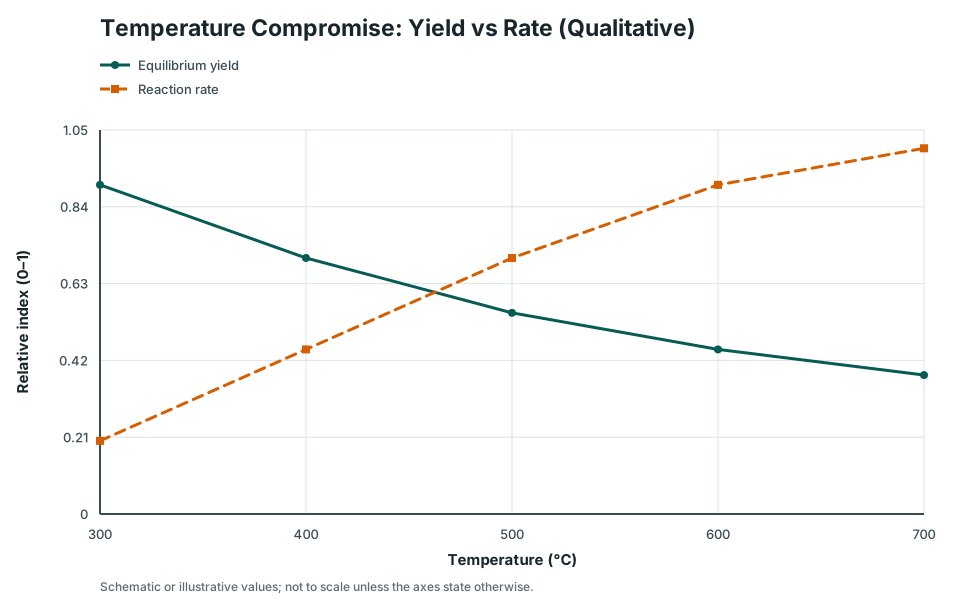
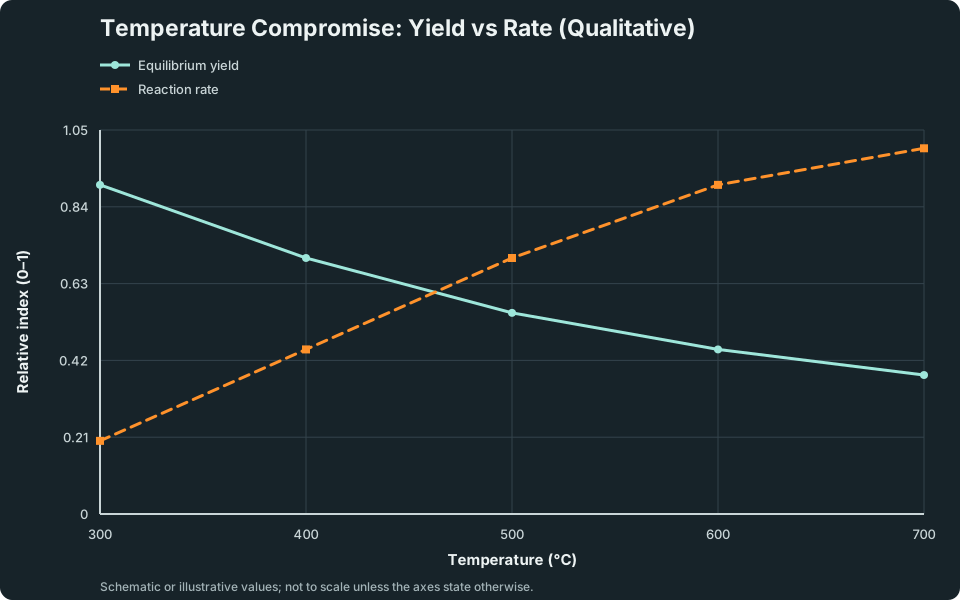
Temperature Compromise: Yield vs Rate (Qualitative)
Temperature Compromise: Yield vs Rate (Qualitative). Equilibrium yield, Reaction rate plotted as Relative index against Temperature.
Scroll across the graph to read all labels.
View figure data
| Temperature (°C) | Equilibrium yield | Reaction rate |
|---|---|---|
| 300 | 0.9 | 0.2 |
| 400 | 0.7 | 0.45 |
| 500 | 0.55 | 0.7 |
| 600 | 0.45 | 0.9 |
| 700 | 0.38 | 1 |
Detailed Explanations
A. Pressure trade-off
Higher pressure shifts equilibrium to fewer moles of gas (right), improving yield, but increases equipment cost and safety demands.
B. Temperature trade-off
Lower temperature increases yield for exothermic reactions but reduces rate (lower kinetic energy, fewer effective collisions).
C. Catalyst role
An iron catalyst increases rate (lower Eₐ) so equilibrium is reached faster. It does not change the equilibrium position.
D. Continuous removal and recycling
Ammonia is condensed and removed; unreacted N₂ and H₂ are recycled, increasing overall efficiency.
Because the process is reversible, removing product reduces its partial pressure; therefore the system shifts right to oppose that removal, producing more ammonia overall.
E. Worked exam method (condition-evaluation questions)
When asked “explain why these conditions are used”, use this sequence:
- State reaction features: exothermic forward; 4 mol gas → 2 mol gas.
- Pressure sentence: higher pressure increases equilibrium yield, but increases cost/risk.
- Temperature sentence: lower temperature increases yield, but slows rate.
- Catalyst sentence: iron catalyst increases rate only; no change in K.
- Final judgement: industry uses compromise conditions plus recycling/condensation.
Worked Examples
Modelled example 1
Explain the Haber pressure effect
Problem
Study the worked solution
Count gaseous moles
Method
Add the gaseous coefficients on each side.Reason
Pressure favours a side only through a difference in total gaseous amount.Working
Reactants: 1 + 3 = 4 mol gas; products: 2 mol gas.Apply Le Chatelier
Method
Choose the side with fewer gaseous moles when pressure increases.Reason
A rightward shift opposes the increased pressure.Working
The equilibrium shifts right.Name the yield effect
Method
State that the equilibrium ammonia yield increases.Reason
The rightward shift converts more nitrogen and hydrogen into ammonia.Working
P↑ ⇒ equilibrium NH₃ yield ↑.
Guided practice 2
Justify a moderate operating temperature
Problem
Try this before viewing the solution
Hints
Hint 1: separate yield and rate
Hint 2: make the industrial judgement
View solution step by step
State the yield effect
Method
Recognise that lower temperature increases the equilibrium ammonia yield.Reason
The exothermic forward direction is favoured when heat is removed.Working
Lower T ⇒ shift right and higher equilibrium yield.State the rate cost
Method
Explain that a very low temperature gives a slow reaction.Reason
Fewer collisions have enough energy to overcome the activation barrier.Working
Very low T ⇒ low production rate.Reach the compromise
Method
Justify a moderate temperature as a balance.Reason
It retains a useful equilibrium yield while allowing ammonia to be formed at an economically useful rate.Working
Moderate temperature = yield–rate compromise.
Common misconception 3
Correct a catalyst-yield claim
Learner claim
Classify the catalyst effect
View solution step by step
Correct the rate statement
Method
State that the catalyst lowers activation energy for both forward and reverse reactions.Reason
Both directions are accelerated rather than only ammonia formation.Working
Forward rate ↑ and reverse rate ↑.Set the equilibrium boundary
Method
State that equilibrium position, K and equilibrium yield are unchanged.Reason
The catalyst does not change the reaction energetics or temperature.Working
Same equilibrium composition at the same temperature.Name the industrial benefit
Method
State that equilibrium is reached faster.Reason
A faster approach to equilibrium increases throughput under the chosen operating conditions.Working
Catalyst benefit: faster production, not a higher equilibrium percentage.
Examiner practice 4
Evaluate Haber compromise conditions
Problem
Try this before viewing the solution
View solution step by step
Pressure benefit
1 markMethod
State that high pressure favours the two-mole product side over the four-mole reactant side.Reason
The equilibrium shifts right and ammonia yield increases.Working
High pressure improves equilibrium yield.Pressure limitation
1 markMethod
State that pressure is limited rather than increased without bound.Reason
Compression and pressure-resistant equipment raise energy cost, capital cost and safety demands.Working
Chosen pressure balances yield against cost and risk.Temperature trade-off
2 marksMethod
Contrast the high yield at low temperature with the faster rate at higher temperature.Reason
The forward reaction is exothermic, while collision energy and successful-collision frequency rise with temperature.Working
A moderate temperature balances equilibrium yield and production rate.Catalyst role
1 markMethod
State that iron lowers activation energy and speeds both directions.Reason
Equilibrium is reached faster without changing its position.Working
The catalyst raises rate, not equilibrium yield.Industrial judgement
1 markMethod
Conclude that the operating conditions are a compromise.Reason
Industrial output depends on yield, throughput, energy, equipment and safety together.Working
No single extreme condition optimises all constraints.
Self-mark with the mark scheme
Compare your response with each mark point. Select a point only when your response contains that evidence.
Credit linked equilibrium, kinetic and industrial constraints rather than a list of conditions alone.
Challenge 5
Explain a continuous Haber loop
Problem
Try this before viewing the solution
Hints
Hint 1: follow ammonia removal
Hint 2: follow unreacted feed
View solution step by step
Explain condensation
Method
Remove ammonia from the gas stream by cooling and condensation.Reason
Lowering product partial pressure causes the equilibrium system to favour further ammonia formation.Working
Product removal encourages a rightward equilibrium response.Explain recycling
Method
Return unreacted nitrogen and hydrogen to the reactor feed.Reason
Reactants not converted in one pass can participate in later passes rather than being discarded.Working
Repeated passes raise overall feedstock utilisation.Combine the operations
Method
Distinguish single-pass conversion from overall process production.Reason
Continuous product separation plus reactant recycle can give high overall output even when one pass is incomplete.Working
Condense NH₃ + recycle N₂/H₂ → greater overall ammonia production.
Check what I know
Start here to see which parts you already know.
About 8 minutes
Time is up, but your answers have not been submitted yet. Check your connection and try again.
Answer 6 short questions. It shows what to work on next and doesn't count towards mastery.
Recent attempts
History is stored only in this browser.
No completed attempts are saved yet.
Beyond the syllabus: optional enrichment that does not count towards your progress.
Practise
Work through questions with marking and feedback as you learn.
About 10 minutes
Time is up, but your answers have not been submitted yet. Check your connection and try again.
Questions are picked at random each time you start. You'll see the answer after each question. It's for practice only and doesn't count towards mastery.
Recent attempts
History is stored only in this browser.
No completed attempts are saved yet.
Beyond the syllabus: optional enrichment that does not count towards your progress.
Practise after feedback
After a check, practise the skills it showed you need to work on.
About 10 minutes
Time is up, but your answers have not been submitted yet. Check your connection and try again.
Questions are picked at random each time you start. You'll see the answer after each question. It's for practice only and doesn't count towards mastery.
Recent attempts
History is stored only in this browser.
No completed attempts are saved yet.
Beyond the syllabus: optional enrichment that does not count towards your progress.
Check my progress
When you feel ready, answer on your own to show what you can do.
About 10 minutes
Time is up, but your answers have not been submitted yet. Check your connection and try again.
Answer 7 questions. You'll see your score, the answers and explanations at the end. Your result can count towards your course progress.
Recent attempts
History is stored only in this browser.
No completed attempts are saved yet.
Beyond the syllabus: optional enrichment that does not count towards your progress.
Check again
After practising what your progress check showed, check those skills again.
About 10 minutes
Time is up, but your answers have not been submitted yet. Check your connection and try again.
Answer 7 questions. You'll see your score, the answers and explanations at the end. Your result can count towards your course progress.
Recent attempts
History is stored only in this browser.
No completed attempts are saved yet.
Beyond the syllabus: optional enrichment that does not count towards your progress.
Review
Come back later to see whether your learning has lasted.
About 10 minutes
Time is up, but your answers have not been submitted yet. Check your connection and try again.
Answer 7 questions. You'll see your score, the answers and explanations at the end. A scheduled review counts towards your course progress only when it is due.
Recent attempts
History is stored only in this browser.
No completed attempts are saved yet.
Beyond the syllabus: optional enrichment that does not count towards your progress.
Mind Stretchers
Connect This To
- Dynamic Equilibrium and Le Chatelier for direction shifts with pressure and temperature changes.
- Equilibrium Constants for separating “equilibrium position” from “value of K”; use the version selected for your course.
- Catalysis and Enzymes for the rate-only catalyst reasoning used in this case study.
Mind stretcher 1Extension
Explain why removing ammonia as it forms increases the overall yield.
Show Hint
Discuss yield, rate, energy cost, equipment cost and safety rather than calling one condition simply ‘best’.
Show Answer
Mark scheme:
- Removing product reduces its concentration/partial pressure.
- By Le Chatelier’s principle, equilibrium shifts right to replace the removed ammonia.
- More NH₃ is produced overall.
Mind stretcher 2Extension
Explain why the Haber process uses high pressure, a moderate temperature, and an iron catalyst.
Show Hint
Separate the yield effect, rate effect and practical limitation of each condition.
Show Answer
Mark scheme:
- High pressure shifts equilibrium right (fewer moles of gas), increasing ammonia yield, but pressure is limited by equipment cost and safety.
- Moderate temperature is a compromise: low temperature gives higher equilibrium yield (exothermic), but the rate would be too slow; higher temperature increases rate but lowers yield.
- An iron catalyst increases the rate (lower Eₐ) so equilibrium is reached faster, but it does not change K or the equilibrium position.