Le Chatelier’s principle
Key idea: An equilibrium shifts to oppose a change in conditions. Compression favours fewer gas molecules, heating favours the endothermic direction, and only temperature changes the equilibrium constant.
Offline pages
Saved on this device only. Connect at least once every 30 days to confirm Premium. Sign-out or a change of account removes saved copies.
Loading guide controls…
Guided lessons · coming soon
Guided lesson
Guided steps
- Explain why opposing a change does not completely undo it.
- Predict the rate imbalance before reading the concentration graph.
- Follow the concentration jump and the new equilibrium.
- Explain the final concentration using the total and unchanged ratio.
- Explain how hydrogen addition changes hydrogen iodide and Kc.
- Predict what happens when oxygen is added.
- Compare gas amounts, compression and adding an inert gas.
- Decide whether compression shifts an equilibrium with equal gas counts.
- Explain your pressure prediction using the gas coefficients.
- Predict the colour after cooling before reading the explanation.
- Explain the colour change and the change in Kc.
- Find the reverse and net rates after adding the catalyst.
- Explain how a catalyst affects composition and time to equilibrium.
- Compare the separate pressure and temperature effects.
- Predict all four ammonia changes before using the model.
- Press Play and wait for equal rates. Add N₂: compare the immediate concentration jump with the later change as equal rates return.
- Compare your predictions with ammonia amounts and reaction-rate curves.
On this page
You stopped at:
ContinueIndustrial chemists change the concentration, pressure and temperature of an equilibrium mixture to get more of the product they want. Le Chatelier’s principle predicts which way an equilibrium moves when the conditions change. This lesson applies it to each kind of change, and shows which changes also alter the equilibrium constant.
Le Chatelier’s principle
Le Chatelier’s principle: if a change is made to a system in dynamic equilibrium, the position of equilibrium moves to oppose the change.
When the position of equilibrium moves to the right, the forward reaction goes faster than the reverse reaction for a while, until a new equilibrium is reached. When it moves to the left, the reverse reaction goes faster for a while.
“Oppose” does not mean “cancel”. The system reduces the effect of the change, but does not undo it completely.
Check your understanding 1
For A ⇌ B at equilibrium, extra A is added at constant temperature and volume. Predict the immediate rate imbalance and the later change in B before reading the graph.
Show answer
The forward rate initially exceeds the reverse rate. B then increases as some of the added A reacts. Equal rates return at the new equilibrium.
Changing a concentration
At constant temperature:
- adding a reactant, or removing a product, moves the position of equilibrium to the right;
- adding a product, or removing a reactant, moves the position of equilibrium to the left.
Adding a reactant increases its forward consumption rate initially; adding a product increases its reverse consumption rate. Removing a product lowers the reverse rate initially, so forward production exceeds reverse consumption. Removing a reactant lowers the forward rate, so the reverse reaction predominates. At the new equilibrium, the two rates are equal again.
This applies only to substances whose concentrations can change. Adding more of a pure solid has no effect.
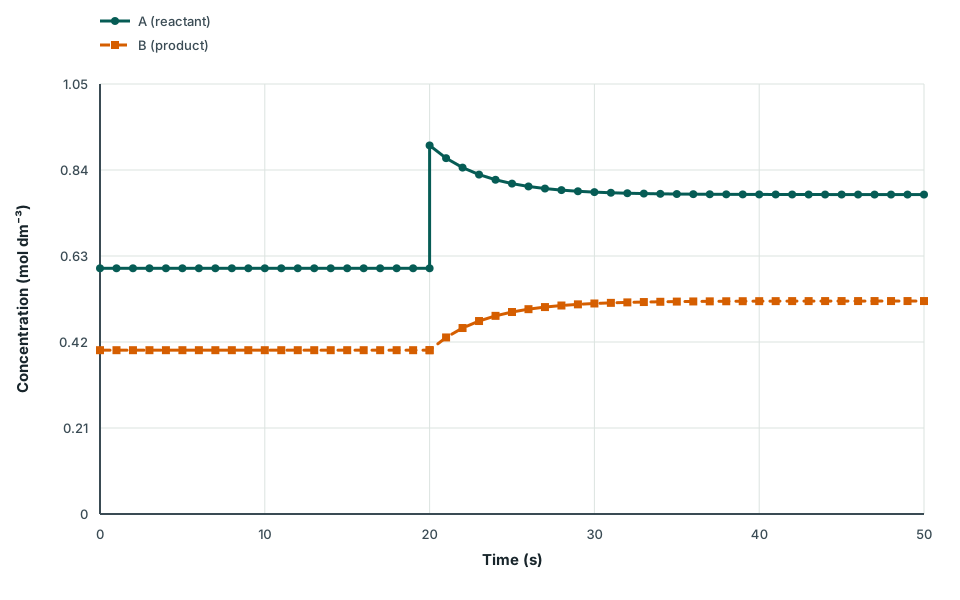
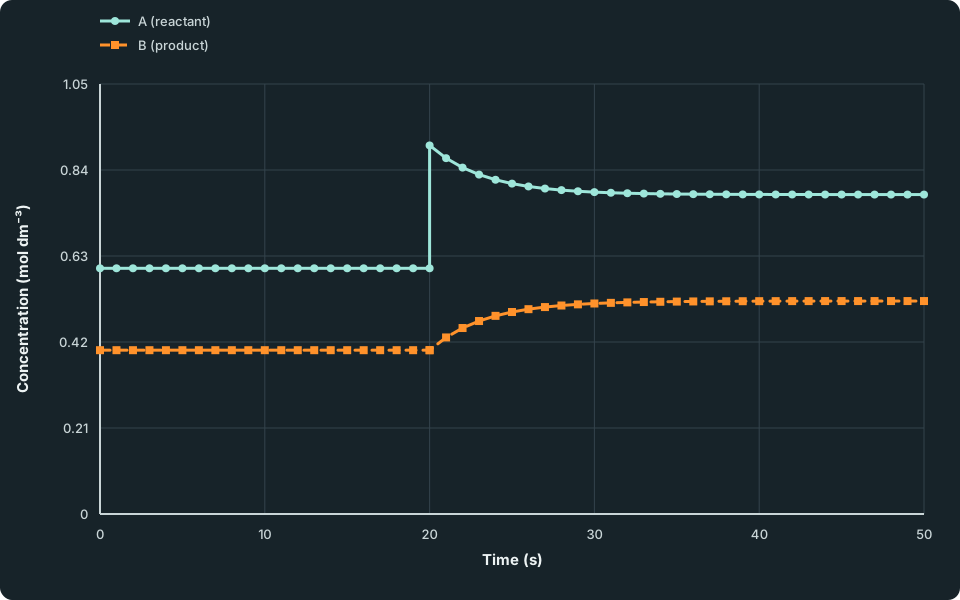
Adding A: jump, then redistribution
A starts at 0.600 and B at 0.400 mol dm⁻³. At 20 s, A jumps to 0.900 while B stays 0.400. A then falls towards 0.780 and B rises towards 0.520 mol dm⁻³; the total is 1.300 after addition.
Scroll across the figure to read all labels.
View figure data
| Time (s) | A (reactant) | B (product) |
|---|---|---|
| 0 | 0.6000 | 0.4000 |
| 1 | 0.6000 | 0.4000 |
| 2 | 0.6000 | 0.4000 |
| 3 | 0.6000 | 0.4000 |
| 4 | 0.6000 | 0.4000 |
| 5 | 0.6000 | 0.4000 |
| 6 | 0.6000 | 0.4000 |
| 7 | 0.6000 | 0.4000 |
| 8 | 0.6000 | 0.4000 |
| 9 | 0.6000 | 0.4000 |
| 10 | 0.6000 | 0.4000 |
| 11 | 0.6000 | 0.4000 |
| 12 | 0.6000 | 0.4000 |
| 13 | 0.6000 | 0.4000 |
| 14 | 0.6000 | 0.4000 |
| 15 | 0.6000 | 0.4000 |
| 16 | 0.6000 | 0.4000 |
| 17 | 0.6000 | 0.4000 |
| 18 | 0.6000 | 0.4000 |
| 19 | 0.6000 | 0.4000 |
| 20 | 0.6000 | 0.4000 |
| 20 | 0.9000 | 0.4000 |
| 21 | 0.8689 | 0.4311 |
| 22 | 0.8459 | 0.4541 |
| 23 | 0.8288 | 0.4712 |
| 24 | 0.8161 | 0.4839 |
| 25 | 0.8068 | 0.4932 |
| 26 | 0.7998 | 0.5002 |
| 27 | 0.7947 | 0.5053 |
| 28 | 0.7909 | 0.5091 |
| 29 | 0.7881 | 0.5119 |
| 30 | 0.7860 | 0.5140 |
| 31 | 0.7844 | 0.5156 |
| 32 | 0.7833 | 0.5167 |
| 33 | 0.7824 | 0.5176 |
| 34 | 0.7818 | 0.5182 |
| 35 | 0.7813 | 0.5187 |
| 36 | 0.7810 | 0.5190 |
| 37 | 0.7807 | 0.5193 |
| 38 | 0.7805 | 0.5195 |
| 39 | 0.7804 | 0.5196 |
| 40 | 0.7803 | 0.5197 |
| 41 | 0.7802 | 0.5198 |
| 42 | 0.7802 | 0.5198 |
| 43 | 0.7801 | 0.5199 |
| 44 | 0.7801 | 0.5199 |
| 45 | 0.7801 | 0.5199 |
| 46 | 0.7800 | 0.5200 |
| 47 | 0.7800 | 0.5200 |
| 48 | 0.7800 | 0.5200 |
| 49 | 0.7800 | 0.5200 |
| 50 | 0.7800 | 0.5200 |
In this model of A ⇌ B, extra A is added at 20 s, so [A] jumps from 0.600 to 0.900 mol dm⁻³. The forward reaction then uses up some of the extra A: [A] falls to 0.780 mol dm⁻³ and [B] rises to 0.520 mol dm⁻³. The ratio [B]/[A] is 2/3 at both equilibria.
Check your understanding 2
In the model above, why does [A] at the new equilibrium (0.780 mol dm⁻³) not fall back to its original value of 0.600 mol dm⁻³?
Show answer
Adding A increased the total of A and B from 1.000 to 1.300 mol dm⁻³. The new equilibrium must still have [B]/[A] = 2/3, so with a larger total, both [A] and [B] are larger than before. The equilibrium moves to oppose the addition of A, but cannot remove all of it.
Exam-style question 1
Adding hydrogen
Problem
Try this before viewing the solution
Show solution step by step
Position of equilibrium
1 markMethod
Decide which way the equilibrium moves.Reason
The forward reaction uses up some of the added hydrogen, opposing the change.Working
Answer
The position of equilibrium moves to the right.Hydrogen iodide
1 markReason
Moving to the right forms more product.Working
Answer
The amount of HI at the new equilibrium increases.Equilibrium constant
1 markWorking
Answer
The temperature has not changed, so the equilibrium constant is unchanged.
Self-mark with the mark scheme
Tick each mark point that your answer includes.
Mark the direction with its reason, the effect on HI and the equilibrium constant separately.
Check your understanding 3 Adding oxygen
For 2SO₂(g) + O₂(g) ⇌ 2SO₃(g), oxygen is added at constant temperature and volume. Predict the change in the position of equilibrium. Is the new equilibrium concentration of sulfur dioxide higher or lower than before the oxygen was added? Does the equilibrium constant change?
Show answer
The position of equilibrium moves to the right, to use up some of the added oxygen. Sulfur dioxide is used up as well, so its concentration at the new equilibrium is lower than before, and more sulfur trioxide forms. The temperature is unchanged, so the equilibrium constant is unchanged.
Changing the pressure of a gas mixture
Compressing a gas mixture at constant temperature increases its pressure. The position of equilibrium moves to reduce the pressure, by favouring the side with fewer moles of gas:
- increasing the pressure favours the side with fewer moles of gas;
- decreasing the pressure favours the side with more moles of gas;
- if both sides have the same number of moles of gas, changing the pressure has no effect on the position of equilibrium.
Count only gases. Solids, liquids and aqueous species do not count.
Adding a gas that does not take part in the reaction, such as argon, at constant volume increases the total pressure but does not change the concentrations of the reacting gases, so the position of equilibrium does not move.
Worked example 1
Compressing an ammonia mixture
Problem
Show full solution
Count moles of gas
Method
Add the coefficients of the gases on each side.Reason
Increasing the pressure favours the side with fewer moles of gas.Working
Answer
Left: 1 + 3 = 4 mol of gas. Right: 2 mol of gas.Direction
Method
Choose the side with fewer moles of gas.Reason
Fewer gas molecules exert a lower pressure, which opposes the increase.Working
Answer
The position of equilibrium moves to the right.Yield
Working
Answer
The equilibrium yield of ammonia increases.
Quick check
Spot the mistake 2
Does pressure always move the equilibrium?
Learner claim
Compare the moles of gas
Show solution step by step
Count moles of gas
Method
Compare the two sides.Reason
Pressure favours the side with fewer moles of gas, so it matters only if the numbers differ.Working
Answer
Left: 1 + 1 = 2 mol of gas. Right: 2 mol of gas.Correct the prediction
Working
Answer
Moving either way would not change the number of gas molecules, so the position of equilibrium does not change.
Common mistake
Check your understanding 4
Explain why compressing H₂(g) + Cl₂(g) ⇌ 2HCl(g) at constant temperature does not favour either direction.
Show answer
Compare gas counts and their consequence: both sides contain 2 mol of gas per reaction as written. A shift would not reduce the number of gas molecules, so compression favours neither side. Both concentrations and reaction rates can rise without changing the equilibrium proportions.
Check your understanding 5
For N₂O₄(g) ⇌ 2NO₂(g), Δ H = +58 kJ mol⁻¹. Nitrogen dioxide is brown. Predict the colour change when the sealed mixture is cooled.
Show answer
Cooling favours the exothermic reverse reaction. The mixture becomes paler as nitrogen dioxide is converted to dinitrogen tetroxide.
Changing the temperature
Raising the temperature favours the endothermic direction, which absorbs heat. Lowering the temperature favours the exothermic direction, which releases heat. Use the sign of Δ H for the forward reaction:
- if the forward reaction is exothermic (Δ H negative), raising the temperature moves the position of equilibrium to the left and lowers the yield of products;
- if the forward reaction is endothermic (Δ H positive), raising the temperature moves the position of equilibrium to the right and raises the yield of products.
Raising the temperature makes both reactions faster, so equilibrium is reached sooner, even when the yield falls. The rate and the yield are separate questions.
Guided practice 3
Cooling a brown gas mixture
Problem
Try this before viewing the solution
Hints
Hint 1
the other direction
The forward reaction absorbs heat. What does the reverse reaction do?Hint 2
the rule
Lowering the temperature favours the direction that releases heat.Show solution step by step
The exothermic direction
Method
Identify which direction releases heat.Reason
Reversing a reaction changes the sign of Δ H.Working
Answer
The forward reaction is endothermic, so the reverse reaction, forming N₂O₄, is exothermic.Colour and constant
Working
Answer
Cooling favours the exothermic reverse reaction, so the position of equilibrium moves to the left: less NO₂ and the mixture becomes paler. Because the temperature changed, the equilibrium constant changes; for an endothermic forward reaction it decreases on cooling.
Quick check
Adding a catalyst
A catalyst provides a faster route in both directions. In an equilibrium mixture, the forward and reverse rates increase together and remain equal, so it has no effect on the position of equilibrium. Equilibrium is simply reached sooner.
Check your understanding 6
For A ⇌ B at equilibrium, both reaction rates are 5.0 mmol min⁻¹. After a catalyst is added at the same temperature, the forward rate becomes 15.0 mmol min⁻¹. Predict the reverse rate and the net rate of formation of B. What would differ if the catalyst were present from the start?
Show answer
The reverse rate is also 15.0 mmol min⁻¹. The net formation rate of B is 15.0-15.0 = 0, so the composition stays constant. Present from the start, the catalyst would let the mixture reach this same equilibrium sooner, without changing its equilibrium composition.
Check your understanding 7
Explain why adding this catalyst leaves the composition unchanged, and what would differ if it were present from the start.
Show answer
Compare equal rates, zero net change and approach time: forward and reverse rates both become 15.0 mmol min⁻¹ at the same composition, so net formation is zero. A fresh mixture reaches that same equilibrium sooner with the catalyst.
Which changes alter the equilibrium constant?
For a given equation, the equilibrium constant depends only on the temperature.
| Change | Position of equilibrium | Equilibrium constant |
|---|---|---|
| Concentration | may move | unchanged |
| Pressure | may move | unchanged |
| Catalyst | unchanged | unchanged |
| Temperature | moves | changes |
Raising the temperature decreases the equilibrium constant for an exothermic forward reaction and increases it for an endothermic forward reaction.
Try it yourself 4
Two changes at once
Problem
Try this before viewing the solution
Hints
Hint 1
one change at a time
Count the moles of gas for the pressure change; find the endothermic direction for the temperature change.Hint 2
opposite effects
If the two changes favour opposite directions, can you tell which is bigger?Show solution step by step
Pressure
Method
Compare the moles of gas.Reason
Higher pressure favours the side with fewer moles of gas.Working
Answer
Left: 3 mol; right: 2 mol. Higher pressure favours the right, increasing the yield of SO₃.Temperature
Method
Identify the endothermic direction.Reason
Higher temperature favours the endothermic direction.Working
Answer
The reverse reaction is endothermic, so higher temperature favours the left, decreasing the yield of SO₃.Overall
Method
Combine the two effects.Reason
Le Chatelier’s principle gives directions, not sizes.Working
Answer
The effects are in opposite directions, so the overall effect on the yield cannot be predicted from this information.Equilibrium constant
Working
Answer
Only the temperature change affects the equilibrium constant. The forward reaction is exothermic, so the equilibrium constant decreases.
Quick check
Check your understanding 8
For exothermic N₂(g) + 3H₂(g) ⇌ 2NH₃(g), predict the equilibrium amount of ammonia after each change. Hold temperature fixed for compression and hydrogen addition; hold volume fixed for heating. Compare each with its own starting equilibrium.
Show answer
Hydrogen addition and compression increase the equilibrium amount of ammonia. Heating decreases it. A catalyst leaves it unchanged and speeds up the approach to equilibrium.
Testing one change at a time
[N₂] = 1.00 mol/dm³, [H₂] = 3.00 mol/dm³, [NH₃] = 0 mol/dm³ at 450 °C. Qc is less than Kc, so the forward reaction is faster.
- [N₂]
- 1.00 mol/dm³
- [H₂]
- 3.00 mol/dm³
- [NH₃]
- 0 mol/dm³
- [NO₂]
- 1.00 mol/dm³
- [N₂O₄]
- 3.00 mol/dm³
- Qc
- 0
- Kc
- 0.185
- Pressure
- 237 atm
- NH₃ at equilibrium
- 25.9 %
- Relative rate
- 0.13
Try this
0 of 5 doneLet the closed mixture reach equilibrium and compare concentrations with the two reaction rates. (not done yet)
Concentrations stay constant because the forward and backward reactions continue at equal nonzero rates.
Let nitrogen and hydrogen reach equilibrium, then add nitrogen and watch equilibrium re-establish. (not done yet)
Adding N₂ makes Qc smaller than Kc, so the forward reaction speeds up until the rates are equal again. Some of the added N₂ is used up, more NH₃ forms, and Kc is unchanged.
Squeeze the NO₂ and N₂O₄ syringe at equilibrium and watch the colour. (not done yet)
Squeezing raises every concentration, so the brown darkens at once. The mixture then shifts towards N₂O₄, which has fewer gas molecules, and the colour partly fades.
Heat an equilibrium mixture and compare Kc before and after. (not done yet)
Both forward reactions are exothermic (ΔH is negative), so heating lowers Kc and the mixture shifts left. Only a temperature change alters Kc.
In Haber conditions, compare the ammonia content and the rate at 350 °C and at 450 °C at the same pressure. (not done yet)
A lower temperature gives more ammonia at equilibrium but reaches it far more slowly. Plants use about 450 °C with an iron catalyst as a compromise, and about 200 atm because higher pressures cost more to build and run.
You’ve tried every task.
Keep Reaction set to Ammonia. If Play is shown, press it to start. Let the mixture settle, then record the ammonia concentration and the volume of the vessel. Work out the amount of ammonia using n = cV: when the volume changes, a higher concentration does not always mean more ammonia.
Check your understanding 9 One change at a time
Use Add H₂, reduce Vessel volume, raise Temperature, or switch on Catalyst to test how each change affects the equilibrium amount of ammonia: adding hydrogen, compressing the vessel, heating, and adding a catalyst. Record your prediction before each run. Make one change at a time, and reset between changes. Compare settled values of n = cV, not concentration alone; also compare the forward and reverse rate curves. The formation of ammonia is exothermic.
Show answer
Compare your recorded predictions with the settled amounts and the rate curves. Adding hydrogen and compressing the vessel both increase the amount of ammonia. Heating decreases it, because the reverse reaction is endothermic. A catalyst makes the mixture reach equilibrium sooner but does not change the amount of ammonia at equilibrium.
Common mistakes
- Saying that the equilibrium “cancels” a change. It only partly opposes it.
- Counting solids, liquids or aqueous species when deciding the effect of pressure.
- Saying that pressure always moves the equilibrium. If both sides have the same number of moles of gas, it has no effect.
- Saying that adding an unreactive gas at constant volume moves the equilibrium.
- Mixing up rate and yield. Raising the temperature means equilibrium is reached sooner, even when the yield falls.
- Saying that a catalyst increases the yield.
- Saying that a change in concentration or pressure changes the equilibrium constant. Only temperature does.
Spotted an error? Report a correction
Syllabus and review details
- GCE A-Level H2 Chemistry 2027 · 9476-2027
9476 (2027), complete syllabus
Last reviewed: