Catalysis and Enzymes
Learn and apply Catalysis and Enzymes in the published Chemistry course sequence.
Continue where you stopped
The core idea
On this page
Catalysis and Enzymes: Orientation
Catalysis questions are usually “explain in one chain”: catalyst → lower Eₐ → larger fraction with E ≥ Eₐ → faster rate. Enzyme questions add biology-specific ideas (active site, optimum conditions, denaturation) but the kinetic logic is still the same.
Link this page to Rate Equations, Orders, and Rate Constant and the Reaction Kinetics hub to keep mechanism and data interpretation consistent.
Definitions (Must Know)
A. Catalyst
A catalyst increases reaction rate by providing an alternative pathway with a lower activation energy, Eₐ, and is regenerated (not used up overall).
B. Heterogeneous catalysis
Heterogeneous catalysis occurs when the catalyst is in a different phase from the reactants (often a solid catalyst with gaseous reactants). It typically involves adsorption onto the catalyst surface.
C. Homogeneous catalysis
Homogeneous catalysis occurs when the catalyst is in the same phase as the reactants. It typically involves intermediates in a catalytic cycle.
D. Adsorption
Adsorption is the sticking of reactant particles onto the surface of a solid catalyst at active sites.
E. Enzyme
An enzyme is a biological catalyst with a specific active site that binds substrates and catalyses a reaction.
F. Denaturation
Denaturation is a permanent change in the enzyme’s structure (active site shape), usually caused by high temperature or extreme pH, causing loss of catalytic activity.
Detailed Explanations
A. Why catalysts don’t change equilibrium
A catalyst lowers the activation energy for both the forward and reverse reactions. Therefore equilibrium is reached faster, but the equilibrium position is unchanged.
B. Heterogeneous catalysis (surface mechanism)
Typical steps:
- reactants adsorb onto the catalyst surface (at active sites)
- bonds weaken / new bonds form on the surface (reaction occurs)
- products desorb and leave the surface
Increasing surface area increases the number of active sites, so more reactant particles can react per unit time.
C. Homogeneous catalysis (intermediate cycle)
In homogeneous catalysis, the catalyst forms an intermediate and is regenerated.
Example (iodide-catalysed decomposition of hydrogen peroxide):
- Step 1: H₂O₂(aq) + I⁻(aq) → H₂O(l) + IO⁻(aq)
- Step 2: H₂O₂(aq) + IO⁻(aq) → H₂O(l) + O₂(g) + I⁻(aq)
Overall (add steps, cancel I⁻ and IO⁻): 2H₂O₂(aq) → 2H₂O(l) + O₂(g)
So I⁻ is the catalyst (regenerated) and IO⁻ is an intermediate.
D. Enzymes (optimum conditions and denaturation)
Enzymes are proteins that act as biological catalysts. In the lock-and-key model, only a substrate with a complementary shape can fit the enzyme’s active site. Binding forms an enzyme–substrate complex and provides a lower-activation-energy route. The products leave and the active site can be used again.
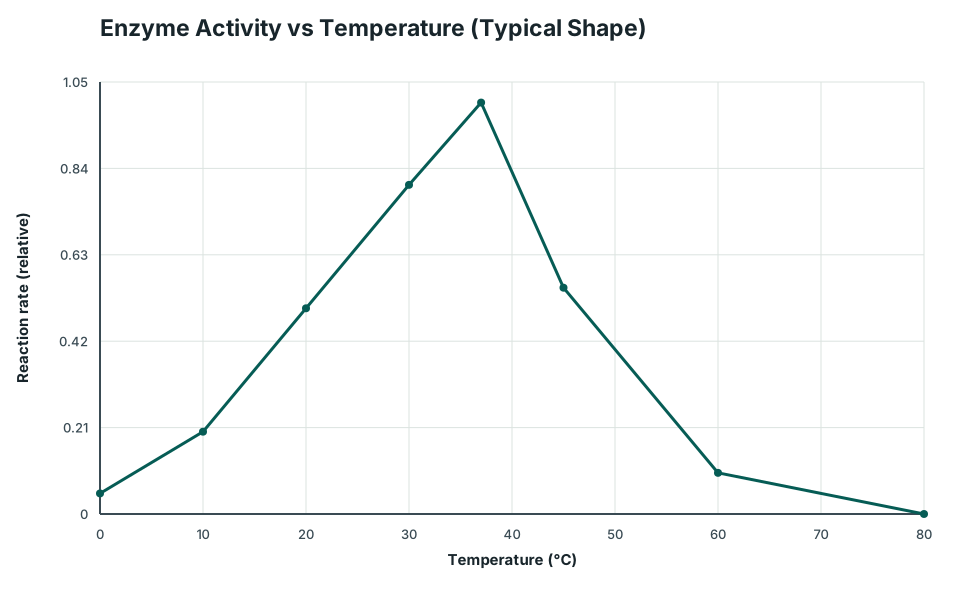
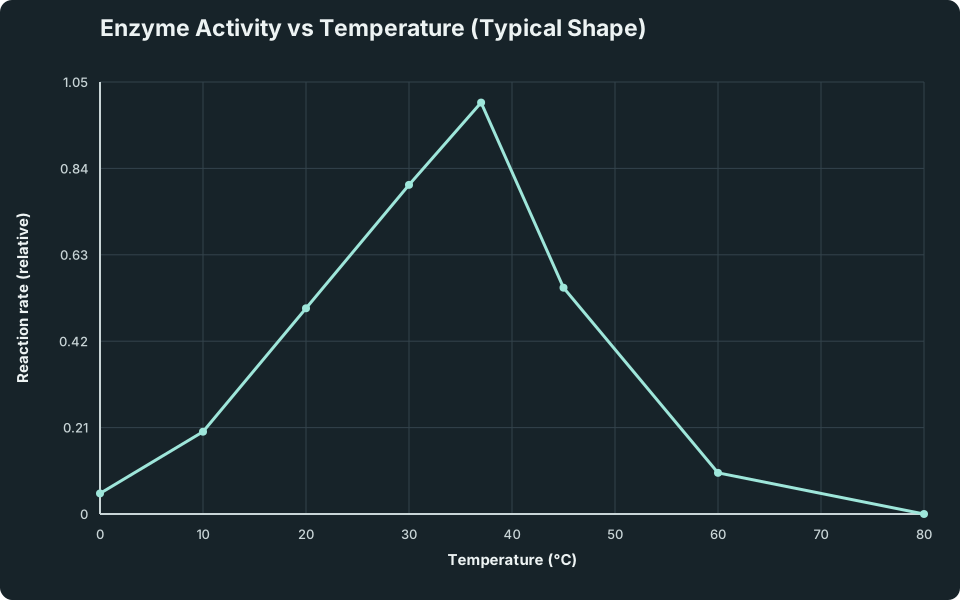
At low to moderate temperature, increasing temperature increases kinetic energy and collision frequency, so rate increases.
Above an enzyme’s optimum temperature, the enzyme denatures, changing the active site shape, so fewer enzyme–substrate complexes form and rate falls sharply.
Enzyme Activity vs Temperature (Typical Shape)
Enzyme Activity vs Temperature (Typical Shape). Enzyme activity plotted as Reaction rate against Temperature.
Scroll across the graph to read all labels.
View figure data
| Temperature (°C) | Enzyme activity |
|---|---|
| 0 | 0.05 |
| 10 | 0.2 |
| 20 | 0.5 |
| 30 | 0.8 |
| 37 | 1 |
| 45 | 0.55 |
| 60 | 0.1 |
| 80 | 0 |
E. Required catalytic examples
Use each example to connect the catalyst type to a lower-energy route:
| Process | Catalyst and type | What to explain |
|---|---|---|
| Haber process, N₂ + 3H₂ ⇌ 2NH₃ | iron, heterogeneous | nitrogen and hydrogen adsorb, their bonds weaken, ammonia forms and desorbs |
| Catalytic converter | platinum, palladium or rhodium surfaces, heterogeneous | harmful gases such as CO and NO adsorb and react to form less harmful products such as CO₂ and N₂ |
| Oxidation of atmospheric SO₂ | NO/NO₂ cycle, homogeneous | NO is oxidised to NO₂; NO₂ then oxidises SO₂ to SO₃ and regenerates NO |
| S₂O₈²⁻ with I⁻ | Fe²⁺/Fe³⁺, homogeneous | two faster redox steps replace a slow reaction between two negatively charged ions; the iron ion is regenerated |
For the iron-ion cycle:
S₂O₈²⁻ + 2Fe²⁺ → 2SO₄²⁻ + 2Fe³⁺ 2Fe³⁺ + 2I⁻ → 2Fe²⁺ + I₂
Adding the steps cancels the iron ions and gives the overall equation. That cancellation is the clearest check that the catalyst is regenerated.
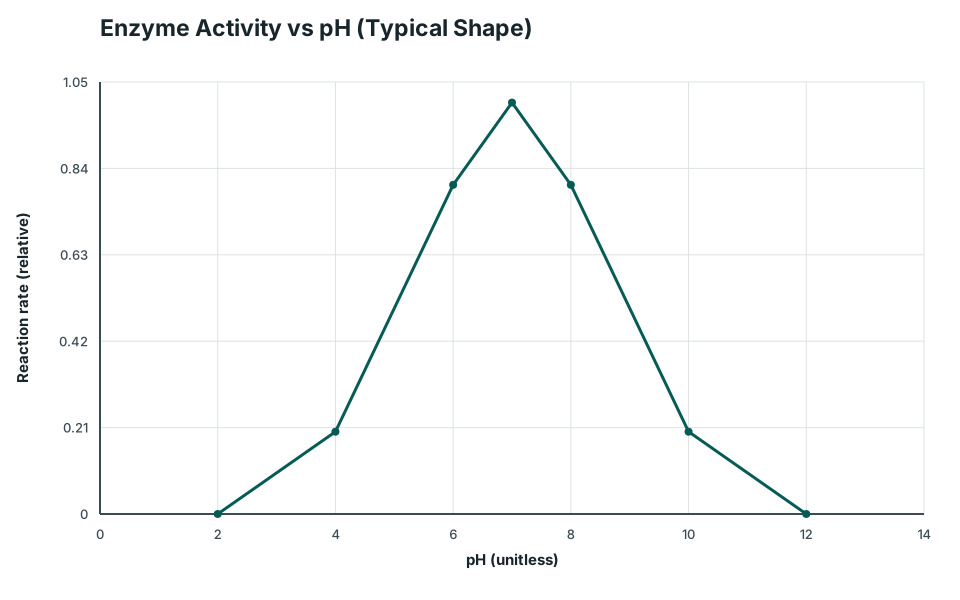
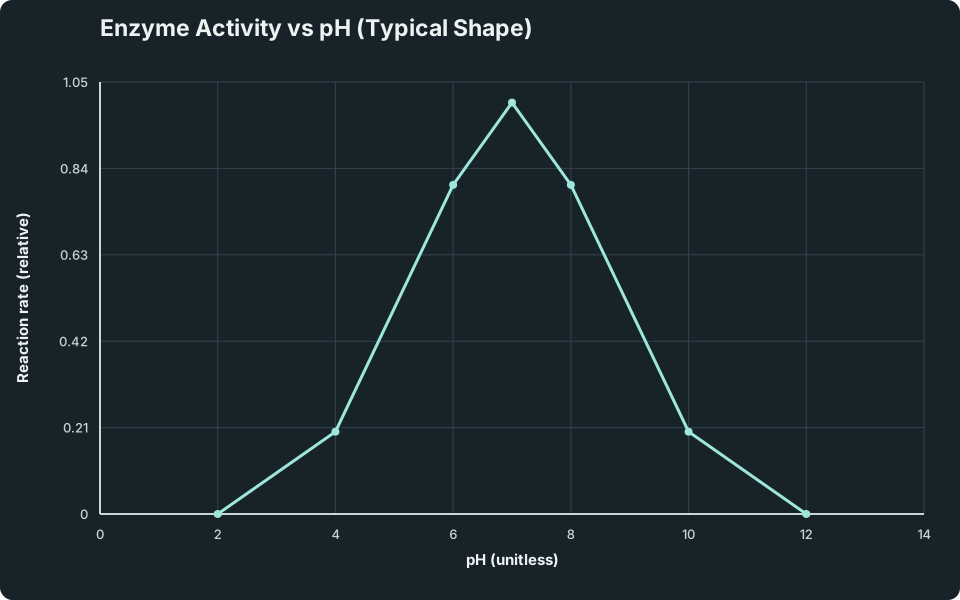
Enzyme Activity vs pH (Typical Shape)
Enzyme Activity vs pH (Typical Shape). Enzyme activity plotted as Reaction rate against pH.
Scroll across the graph to read all labels.
View figure data
| pH (unitless) | Enzyme activity |
|---|---|
| 2 | 0 |
| 4 | 0.2 |
| 6 | 0.8 |
| 7 | 1 |
| 8 | 0.8 |
| 10 | 0.2 |
| 12 | 0 |
Worked Examples
Modelled example 1
Explain a solid catalyst surface-area effect
Problem
Study the worked solution
Increase site availability
Method
State that a larger exposed surface provides more active sites.Reason
Only accessible catalyst surface can adsorb reactant particles.Working
Surface area ↑ ⇒ available active sites ↑.Increase adsorption and reaction
Method
State that more reactant particles can adsorb simultaneously.Reason
Adsorption brings particles onto the lower-energy surface pathway where bonds can weaken and rearrange.Working
More adsorbed reactants can undergo surface reaction per unit time.Conclude
Method
Link the larger number of surface events to rate.Reason
Products desorb and free sites for further cycles.Working
Successful catalytic events per unit time increase, so rate increases.
Guided practice 2
Explain why equilibrium position is unchanged
Problem
Try this before viewing the solution
Hints
Hint 1: treat both directions
Hint 2: separate speed from position
View solution step by step
Describe the pathway
Method
State that the catalyst lowers activation energy for both directions.Reason
The same alternative pathway connects reactants and products in either direction.Working
Forward rate ↑ and reverse rate ↑.Preserve equilibrium
Method
State that equilibrium is reached faster but at the same composition.Reason
The catalyst changes neither temperature nor the relative energies determining K.Working
Equilibrium position and K remain unchanged.
Common misconception 3
Correct an active-site collision claim
Learner claim
Classify the barrier
View solution step by step
Correct the energy claim
Method
State that the alternative pathway has lower, not zero, activation energy.Reason
Adsorbed particles still need sufficient energy for the surface reaction steps.Working
A lower barrier increases successful fraction; it does not guarantee success.Correct the collision claim
Method
State that adsorption geometry, energy and site availability still matter.Reason
Some encounters fail to form the required bonds or occur at blocked/unsuitable sites.Working
More active sites raise the event frequency, but not every collision reacts.
Examiner practice 4
Identify a catalyst and intermediate
Problem
Try this before viewing the solution
View solution step by step
Track iodide
2 marksMethod
Identify I⁻ as the catalyst.Reason
It is consumed in the first step and regenerated in the second, so it cancels from the overall equation.Working
Catalyst: I⁻.Track hypoiodite
2 marksMethod
Identify IO⁻ as the intermediate.Reason
It is formed in the first step and consumed in the second, so it also cancels but was not present initially.Working
Intermediate: IO⁻.
Self-mark with the mark scheme
Compare your response with each mark point. Select a point only when your response contains that evidence.
Credit each identity and its consumed/formed/regenerated evidence.
Examiner practice 5
Use the prescribed catalyst examples in context
Problem
Try this before viewing the solution
View solution step by step
Haber process
1 markMethod
Name iron and classify it as a heterogeneous catalyst.Reason
Nitrogen and hydrogen adsorb on the solid surface, bonds weaken and ammonia eventually desorbs.Working
N₂ and H₂ are gases; Fe is a solid surface.Catalytic converter
1 markMethod
Name platinum, palladium or rhodium surfaces and classify the catalysis as heterogeneous.Reason
Exhaust gases adsorb and react on the metal surface to form less harmful products such as CO₂ and N₂.Working
Gas reactants + solid catalyst = heterogeneous catalysis.Atmospheric sulfur dioxide
1 markMethod
Identify the homogeneous NO/NO₂ cycle.Reason
NO is oxidised to NO₂; NO₂ then oxidises SO₂ to SO₃ and regenerates NO.Working
2NO + O₂ → 2NO₂
NO₂ + SO₂ → NO + SO₃ (combine the steps in the correct ratio to cancel the nitrogen oxides).Iron-ion cycle
3 marksMethod
Classify the cycle as homogeneous and show that the iron ions are regenerated.Reason
All reacting species are in the same aqueous phase, and two faster electron-transfer steps avoid the slow direct collision between two negatively charged ions.Working
S₂O₈²⁻ + 2Fe²⁺ → 2SO₄²⁻ + 2Fe³⁺
2Fe³⁺ + 2I⁻ → 2Fe²⁺ + I₂
The iron species cancel when the steps are added.
Self-mark with the mark scheme
Compare your response with each mark point. Select a point only when your response contains that evidence.
Credit accurate examples and phase classifications, plus regeneration and the two-step reason for the iron-ion cycle.
Challenge 6
Explain an enzyme temperature profile
Problem
Try this before viewing the solution
Hints
Hint 1: before the optimum
Hint 2: after the optimum
View solution step by step
Explain the initial rise
Method
Link increasing temperature to faster-moving enzyme and substrate particles.Reason
Collision frequency and productive complex formation increase up to the optimum.Working
Temperature ↑ ⇒ rate ↑ initially.Explain the sharp fall
Method
State that excessive temperature denatures the enzyme and alters its active site.Reason
Fewer substrate molecules bind in a productive geometry.Working
Above optimum: productive complexes ↓ ⇒ rate falls sharply.
Mind Stretchers
Mind stretcher 1Extension
In heterogeneous catalysis, explain why catalyst “poisoning” (a substance binding strongly to the surface) decreases reaction rate.
Show Hint
A catalyst changes the pathway and is regenerated; surface availability can therefore control its effectiveness.
Show Answer
Mark scheme:
- Poison molecules occupy active sites on the catalyst surface.
- Fewer reactant particles can adsorb and react.
- Therefore the number of successful surface reactions per unit time decreases, lowering the rate.
Mind stretcher 2: Diagnosing catalyst poisoningExtension
Question. A solid catalyst works initially but slows sharply when a trace impurity is added, although temperature and reactant concentrations are unchanged. Give a particle-level explanation.
Show Hint
Consider adsorption sites rather than activation energy of the original uncatalysed route.
Show Answer
The impurity can adsorb strongly on active sites and block reactant adsorption. Fewer surface encounters follow the catalytic pathway, so the observed rate falls even though the remaining sites still provide the same lower-energy route.