Electrolysis Predictions and Faraday’s Law
Predict products, calculate yield and explain industrial cells.
On this page
Electrolysis questions are prediction + calculation: decide what is discharged (molten vs aqueous), write half-equations, then use Q = It and n(e⁻) = Q/F to find product amounts.
Before the harder applications, review Writing Redox Equations from Half-Equations and keep the Electrochemistry hub as your route map.
Definitions (Must Know)
A. Electrolysis
Electrolysis is the conduction of electricity through an ionic compound (electrolyte), leading to chemical changes at the electrodes.
Key labels:
- cathode (negative): reduction occurs
- anode (positive): oxidation occurs
B. Faraday constant, F
The Faraday constant is the charge per mole of electrons: F ≈ 9.65 × 10⁴ C mol⁻¹
It links the Avogadro constant, L, and the elementary charge, e: F = Le
Key Ideas (What Earns Marks)
- Molten electrolysis: only the ions of the compound are present → products are usually straightforward.
- Aqueous electrolysis: water competes, so product prediction depends on the ions present, their ease of discharge, and concentration.
- Faraday relationships:
- charge passed: Q = It
- moles of electrons: n(e⁻) = Q/F
- use stoichiometry to link electrons to product amount
- Predict/choose the half-equations. 2) Use the half-equation electron ratio for the Faraday calculation.
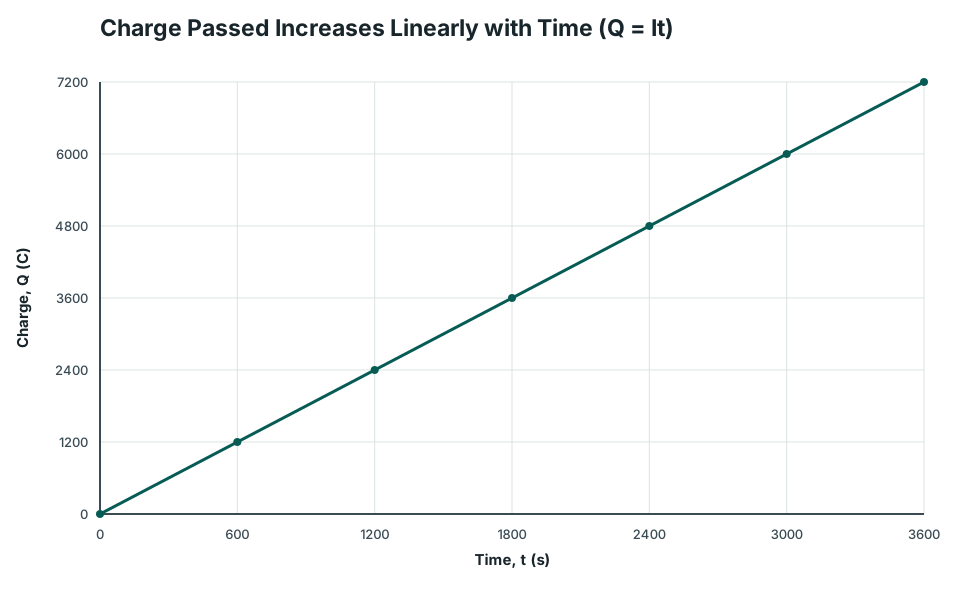
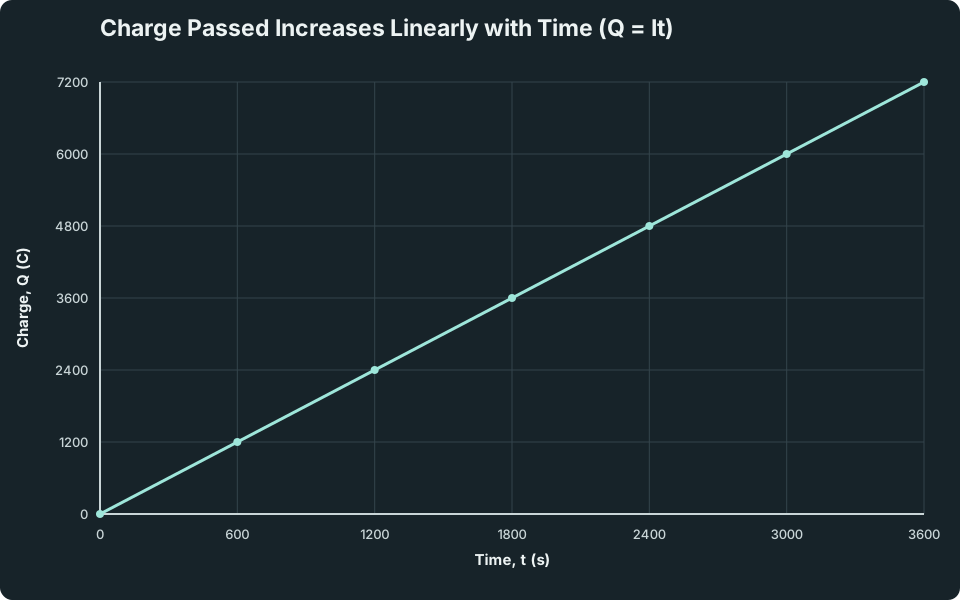
Charge Passed Increases Linearly with Time (Q = It)
Charge Passed Increases Linearly with Time (Q = It). Q = It (I = 2.00 A) plotted as Charge, Q against Time, t.
Scroll across the graph to read all labels.
View figure data
| Time, t (s) | Q = It (I = 2.00 A) |
|---|---|
| 0 | 0 |
| 600 | 1200 |
| 1200 | 2400 |
| 1800 | 3600 |
| 2400 | 4800 |
| 3000 | 6000 |
| 3600 | 7200 |
Data table
| Product formed | e- |
|---|---|
| H2 | 2 |
| Cl2 | 2 |
| O2 | 4 |
| Al | 3 |
| Cu | 2 |
Detailed Explanations
A. Why electrode signs matter in electrolysis
Because the cathode is negative in electrolysis, therefore it attracts cations and supplies electrons (reduction). Because the anode is positive, therefore it attracts anions and removes electrons (oxidation).
B. Predicting products: molten vs aqueous
1) Molten ionic compounds (general rule)
- at the cathode: the cation is reduced
- at the anode: the anion is oxidised
Example (molten NaCl): Na + (l) + e⁻ → Na(l) 2Cl-(l) → Cl₂(g) + 2e⁻
2) Aqueous solutions (common syllabus patterns)
At the cathode (reduction), common competing reductions include:
- H⁺ / water → H₂
- metal ions → metal (for less reactive metals)
At the anode (oxidation), common competing oxidations include:
- halide ions → halogen (often if concentrated)
- water / OH⁻ → O₂
What to write in exams:
- identify which species is preferentially discharged and justify it (reactivity / electrode potential ideas + concentration if given)
Aqueous electrolysis: product decision guide
Use the question’s stated electrolyte, concentration and electrode material. These are qualitative syllabus rules for the stated examples, not numerical cut-offs or universal predictions for every electrolyte.
1 · Cathode (reduction)
Compare the cations
- For a metal less reactive than hydrogen, such as copper in the required examples, its ions can be discharged to form the metal.
- For ions of a very reactive metal, such as Na+, water is reduced and H2 forms in aqueous solution.
2 · Anode (oxidation)
Check electrode and anions
- A reactive anode may itself be oxidised; a copper anode can form Cu2+.
- With an inert anode, use the stated anions and concentration. In the required NaCl comparison, dilute solution gives O2 while concentrated brine gives Cl2.
3 · Verify the answer
Write and check
- Write one balanced half-equation at each electrode, including states.
- Check both atoms and total charge, then state the observation or gas test if asked.
C. Faraday’s Law calculations (workflow)
- Find Q from current and time: Q = It
- Find moles of electrons: n(e⁻) = Q/F
- Use the electrode half-equation to convert n(e⁻) to moles of product
- Convert to mass or gas volume if needed:
- mass: m = nM
- gas: use pV = nRT with the temperature, pressure and units stated in the question
Mini example: If Q = 9650 C, then n(e⁻) = Q/F = 9650/(9.65 × 10⁴) = 0.100 mol.
Copper-plate a key at different currents, record the gain in mass at several charges, and check that every point lies on one straight line through the origin.
Aqueous copper(II) sulfate with a copper anode and an iron key as the cathode and a current of 1.0 A. Cations will move to the cathode and anions to the anode when it is switched on.
- Charge, Q = It
- 0 C
- n(e⁻) = Q/F
- 0 mol
- At the cathode
- —
- At the anode
- —
- Voltmeter
- 1.10 V
- Electrons flow
- left → right
- ΔG = −nFE
- −212 kJ/mol
Try this
0 of 4 doneSwitch on with a solid salt (heat off), then melt it and switch on again. (not done yet)
A solid ionic compound does not conduct: its ions are held in a lattice. Once molten, the ions are free to move to the electrodes.
Electrolyse dilute, then concentrated, sodium chloride. Compare the gas at the anode. (not done yet)
In dilute solution OH⁻ is discharged and oxygen forms (half the volume of hydrogen). In concentrated solution the many Cl⁻ ions are discharged instead, giving chlorine.
In copper(II) sulfate, record the cathode's gain in mass at three different charges. (not done yet)
The mass of copper is proportional to the charge: 2 mol of electrons (193 000 C) deposit 1 mol (63.5 g) of copper, whatever the current.
Build a simple cell that gives the largest voltage you can. (not done yet)
The further apart the metals are in the reactivity series, the larger the voltage. The more reactive metal is the negative electrode: it loses electrons.
Your readings
| # | I / A | t / s | Q / C | Δm(cathode) / g | Remove |
|---|---|---|---|---|---|
| No readings yet. Set up a measurement, then record it. | |||||
D. Industrial electrolysis
Anodising aluminium: the aluminium object is made the anode. Oxidation forms a thicker, adherent aluminium oxide layer on its surface. The layer protects the underlying metal against further corrosion; technical operating details are not required.
Electrolytic purification of copper: impure copper is the anode and pure copper is the cathode in a solution containing Cu²⁺. At the anode, Cu(s) → Cu²⁺(aq) + 2e⁻; at the cathode, Cu²⁺(aq) + 2e⁻ → Cu(s). Copper therefore transfers from the impure anode to the pure cathode. Less reactive impurities may form an anode sludge while more reactive impurities may remain as ions; the assessed explanation rests on the electrode reactions.
Anode (+): Impure copper loses electrons and supplies copper(II) ions.
Cathode (−): Copper(II) ions gain electrons and build the pure copper sheet.
Charge paths: electrons move in the wires and electrodes; ions move in the solution.
Impurities: insoluble material collects as sludge below the anode; other impurities can dissolve and remain in solution.
Swipe or scroll sideways to inspect the complete overview.
Worked Examples
Modelled example 1
Write Molten-Electrolyte Half-Equations
Problem
Study the worked solution
Cathode reduction
Method
Add electrons to lead(II) ions.Reason
Positive ions gain electrons at the cathode.Working
Pb²⁺(l) + 2e⁻ → Pb(l)Anode oxidation
Method
Remove electrons from bromide ions and pair bromine atoms.Reason
Bromide is the only anion in the molten compound.Working
2Br-(l) → Br₂(g) + 2e⁻
Guided practice 2
Calculate Moles of Electrons
Problem
A current of 2.00 A passes for 30.0 minutes. Calculate moles of electrons transferred.
Try this before viewing the solution
Hints
Hint 1: seconds
Current uses coulombs per second.
Hint 2: faraday
After Q = It, use n(e⁻) = Q/F.
View solution step by step
Find charge
Method
Convert 30.0 min to 1800 s, then multiply by current.
Reason
An ampere is one coulomb per second.Working
Q = (2.00)(1800) = 3600 CConvert charge to amount
Method
Divide by Faraday’s constant.Reason
F is charge per mole of electrons.Working
n(e⁻) = 3600/(9.65 × 10⁴) = 3.73 × 10⁻² mol
Common misconception 3
Correct the Time-Unit Error
Learner attempt
For 1.50 A flowing for 20.0 min, a learner writes Q = (1.50)(20.0) = 30.0 C. Correct the first error and the charge.
Try this before viewing the solution
View solution step by step
Convert time
Method
Multiply minutes by 60.Reason
The current unit contains seconds.Working
t = (20.0)(60) = 1200 sRecalculate
Method
Multiply 1.50 A by 1200 s.Reason
Current × time gives charge.Working
Q = 1800 C
Examiner practice 4
Convert Electron Amount to Aluminium
Problem
Try this before viewing the solution
View solution step by step
Use the ratio
1 markMethod
Relate 3 mol electrons to 1 mol aluminium.Reason
The half-equation coefficients give the mole ratio.Working
n(Al) = n(e⁻)/3Calculate
1 markMethod
Divide 0.150 by 3.Reason
Three electron moles are required per aluminium mole.Working
n(Al) = 0.0500 mol
Self-mark with the mark scheme
Compare your response with each mark point. Select a point only when your response contains that evidence.
Credit the electron ratio and result separately.
Examiner practice 5
Compare copper purification with aluminium anodising
Problem
Try this before viewing the solution
View solution step by step
Oxidise the impure copper anode
1 markMethod
Write the loss of electrons from copper atoms.Reason
Oxidation always occurs at the anode.Working
Cu(s) → Cu²⁺(aq) + 2e⁻.Deposit copper at the pure cathode
2 marksMethod
Reduce copper(II) ions onto the pure copper sheet.Reason
The cathode supplies electrons, so copper transfers from the impure electrode to the pure one.Working
Cu²⁺(aq) + 2e⁻ → Cu(s); the cathode gains pure copper.Account for impurities
1 markMethod
State that less reactive impurities can collect below the anode while more reactive ones may remain as ions.Reason
They do not plate onto the cathode under the chosen operating conditions in the same way as copper.Working
The process separates copper from its impurities rather than merely moving the whole anode.Explain anodising
2 marksMethod
Make the aluminium object the positive anode so oxidation at its surface builds a thicker adherent oxide layer.Reason
The oxide layer protects the underlying aluminium from further corrosion.Working
Purification removes impurities from copper; anodising deliberately changes and protects the aluminium surface.
Self-mark with the mark scheme
Compare your response with each mark point. Select a point only when your response contains that evidence.
Credit the two copper electrode processes, the direction and purpose of copper transfer, impurity behaviour, and the purpose of the oxide layer in anodising.
Challenge 6
Predict Brine Products
Problem
Try this before viewing the solution
Hints
Hint 1: aqueous
Hint 2: concentrated-halide
View solution step by step
Cathode
Method
Reduce water to hydrogen.Reason
Sodium ions are not discharged from aqueous solution under these conditions.Working
2H₂O(l) + 2e⁻ → H₂(g) + 2OH-(aq)Anode
Method
Oxidise chloride to chlorine.Reason
Concentrated halide is preferentially discharged at the inert anode.Working
2Cl-(aq) → Cl₂(g) + 2e⁻
Common Mistakes
- Using minutes instead of seconds in Q = It.
- Confusing anode/cathode signs in electrolysis (cathode is negative in electrolytic cells).
- Forgetting electron stoichiometry (e.g. 2 e⁻ per H₂).
Use the Electrochemistry topic check to practise and check your understanding.
Exam Tips
- Always write a half-equation first; it forces the correct electron ratio for calculations.
- If the question is aqueous, explicitly mention that water is present and may compete.
- If a halide is said to be concentrated, oxidation to halogen is more likely than oxygen.
Mind Stretchers
Mind stretcher 1Extension
Why can the products of aqueous electrolysis differ from molten electrolysis for the same compound?
Show Hint
List every species actually present in the molten and aqueous cases; water adds competing discharge possibilities.
Show Answer
Mark scheme:
- In aqueous solutions, water provides H⁺/OH⁻ which can be discharged instead of the ions from the compound.
- The preferred discharge depends on relative ease of oxidation/reduction and concentration, so products can change.
Mind stretcher 2: Using charge conservation across cells in seriesExtension
Question. Two electrolytic cells are connected in series. One deposits copper by Cu²⁺ + 2e⁻ → Cu while the other produces oxygen by 2H₂O → O₂ + 4H⁺ + 4e⁻. If 0.0200 mol of copper is deposited, determine the amount of oxygen formed and explain why current and time need not be given.
Show Hint
Use the copper half-equation to infer electron amount. Cells in series receive the same charge.
Show Answer
Copper deposition uses 2(0.0200) = 0.0400 mol of electrons. The same charge, and therefore the same amount of electrons, passes through both series cells. Four moles of electrons produce one mole of oxygen, so n(O₂) = 0.0400/4 = 0.0100 mol. Current and time are unnecessary because the copper deposit already measures the charge passed.
Syllabus and review details
- GCE A-Level H2 Chemistry 9476-2027 · 9476-2027
9476 (2027), complete syllabus
Last reviewed: