Gibbs Free Energy and Feasibility
Use entropy and Gibbs free energy, ΔG = ΔH − TΔS, to decide whether a reaction is feasible.
On this page
An exothermic reaction is not automatically feasible, and an endothermic reaction can be feasible. Gibbs free energy combines the enthalpy and entropy changes so that you can decide the direction favoured under the stated conditions.
Keep Enthalpy Changes and Energy Profiles and the Energetics and Thermodynamics hub in view, because most questions mix definitions with cycle reasoning.
Connect entropy to feasibility
Start with Predicting entropy changes. Entropy describes how energy can be distributed among the accessible microscopic arrangements of a system. Here, Δ S⦵ is a supplied standard entropy change in J mol⁻¹ K⁻¹; you do not need to calculate it from tabulated molar entropies for H2.
D. Gibbs free energy change, Δ G⦵
At constant temperature and pressure, use: Δ G⦵ = Δ H⦵ - TΔ S⦵
Feasible (under standard conditions) when Δ G⦵ < 0.
Feasible does not mean fast: a reaction can be feasible but have a high activation energy (slow) unless conditions/catalysts are provided.
E. Temperature, T
Temperature must be in kelvin (K): T(K) = T(°C) + 273.15.
Key Ideas (What Earns Marks)
- Unit discipline in Δ G⦵ = Δ H⦵ - TΔ S⦵:
- Δ H⦵ often in kJ mol⁻¹
- Δ S⦵ often in J mol⁻¹ K⁻¹
- convert so units match (common choice: convert Δ S⦵ to kJ mol⁻¹ K⁻¹ by dividing by 1000)
Temperature dependence, treating Δ H and Δ S as approximately constant within the temperature range and phases considered:
| Δ H | Δ S | Feasible when… |
|---|---|---|
| − | + | all positive T in this model |
| + | − | no positive T in this model |
| − | − | low T |
| + | + | high T |
- Use T in K. - If Δ H is in kJ mol⁻¹, convert Δ S to kJ mol⁻¹ K⁻¹ (divide by 1000). - Then TΔ S comes out in kJ mol⁻¹.
ΔG Changes with Temperature (Example Lines)
ΔG Changes with Temperature (Example Lines). ΔH = +35.0, ΔS = +120, ΔH = −50.0, ΔS = −120 plotted as Gibbs free energy change, ΔG against Temperature, T.
Scroll across the graph to read all labels.
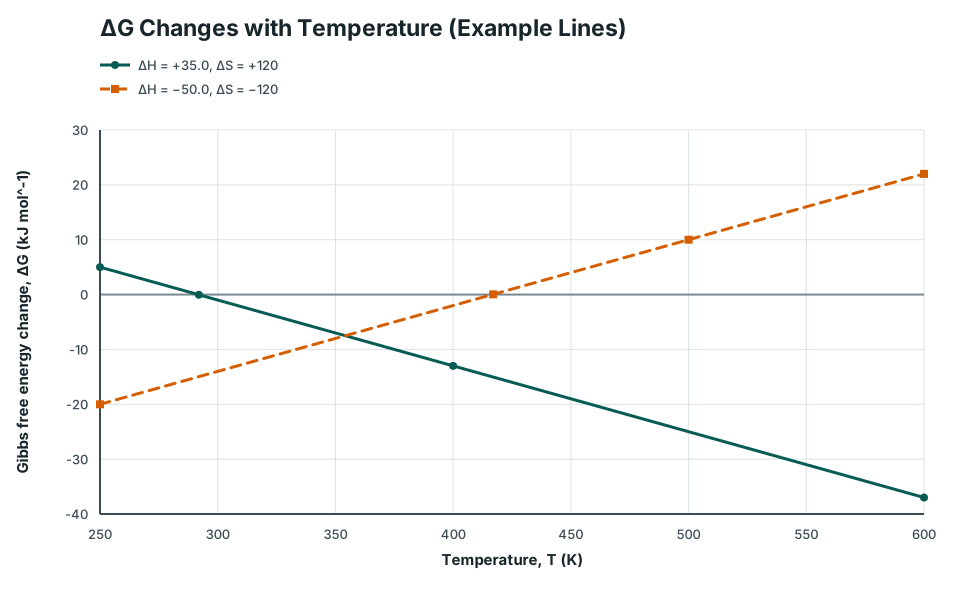
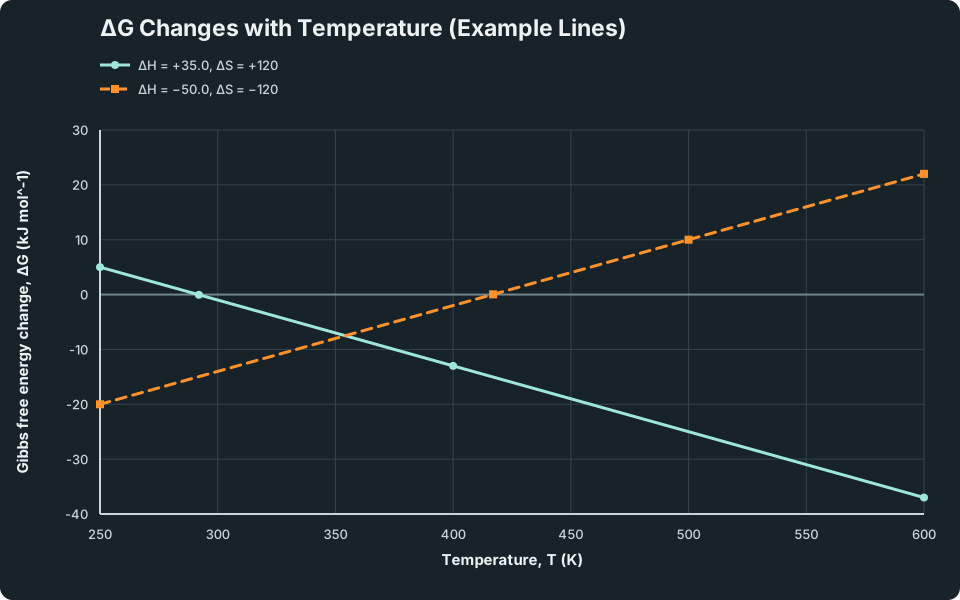
View figure data
| Series | Temperature, T (K) | Temperature, T uncertainty | Gibbs free energy change, ΔG (kJ mol^-1) | Gibbs free energy change, ΔG uncertainty |
|---|---|---|---|---|
| ΔH = +35.0, ΔS = +120 | 250 | 5 | ||
| ΔH = +35.0, ΔS = +120 | 292 | -0.04 | ||
| ΔH = +35.0, ΔS = +120 | 400 | -13 | ||
| ΔH = +35.0, ΔS = +120 | 600 | -37 | ||
| ΔH = −50.0, ΔS = −120 | 250 | -20 | ||
| ΔH = −50.0, ΔS = −120 | 417 | 0.04 | ||
| ΔH = −50.0, ΔS = −120 | 500 | 10 | ||
| ΔH = −50.0, ΔS = −120 | 600 | 22 |
Detailed Explanations
B. Using Δ G⦵ (workflow)
- Convert T to K.
- Make units consistent (kJ with kJ, or J with J).
- Calculate Δ G⦵ = Δ H⦵ - TΔ S⦵.
- Interpret:
- Δ G⦵ < 0: feasible
- Δ G⦵ > 0: not feasible
- Δ G⦵ = 0: the boundary of standard-state feasibility
C. Threshold temperature
At the boundary between negative and positive standard Gibbs energy, Δ G⦵ = 0: T = (Δ H⦵)/(Δ S⦵)
Use this only when Δ H⦵ and Δ S⦵ are approximately constant over the temperature range and no phase change invalidates the model. The threshold must also be positive to represent a physical thermodynamic temperature.
Keep standard and actual conditions separate. At equilibrium the actual reaction Gibbs energy change is Δ G = 0. A standard value Δ G⦵ = 0 does not mean that every mixture is at equilibrium: it identifies the standard-state boundary. A mixture’s composition also affects the direction favoured. Likewise, Δ G⦵ > 0 does not mean that no product can form.
Worked Examples
Modelled example 1
Test feasibility at a stated temperature
Problem
Study the worked solution
Make units consistent
Method
Convert the entropy change to kilojoules per mole per kelvin.Reason
TΔ S must use the same energy unit as Δ H.Working
Δ S⦵ = 80.0/1000 = 0.0800 kJ mol⁻¹K⁻¹.Calculate Gibbs free energy
Method
Substitute into Δ G⦵ = Δ H⦵-TΔ S⦵.Reason
Both energy terms are now expressed in kilojoules per mole.Working
Δ G⦵ = 20.0-(298)(0.0800) = -3.84 kJ mol⁻¹.Interpret the sign
Method
State feasibility for the specified conditions.Reason
A negative standard Gibbs free-energy change is thermodynamically feasible.Working
Δ G⦵ < 0, so the reaction is feasible at 298 K.
For the ammonia entropy prediction, see Predicting entropy changes.
Common misconception 2
Correct a Gibbs unit mismatch
Learner substitution
Choose the valid correction
View solution step by step
Audit dimensions
Method
Identify that TΔ S is in joules per mole while Δ H is in kilojoules per mole.Reason
Quantities in different energy units cannot be subtracted.Working
(298)(80.0) = 23840 J mol⁻¹, not 23840 kJ mol⁻¹.Choose one energy unit
Method
Convert Δ S to 0.0800 kJ mol⁻¹K⁻¹.Reason
Then both terms in the Gibbs equation are in kilojoules per mole.Working
Δ G = 20.0-(298)(0.0800) = -3.84 kJ mol⁻¹.
Examiner practice 3
Explain low-temperature feasibility
Problem
Try this before viewing the solution
View solution step by step
Identify competing terms
1 markMethod
Recognise that negative Δ H favours negative Δ G, while negative Δ S makes -TΔ S positive.Reason
The enthalpy and entropy contributions oppose one another.Working
Δ G = negative + positive temperature term.Consider low temperature
1 markMethod
Make the positive entropy term small.Reason
At low T, negative Δ H can dominate.Working
Δ G < 0 is favoured, so the reaction is feasible at sufficiently low temperature.Consider high temperature
1 markMethod
Increase the positive -TΔ S contribution.Reason
It can outweigh the negative enthalpy term.Working
At sufficiently high temperature, Δ G > 0 and the reaction is not feasible under the stated conditions.
Self-mark with the mark scheme
Compare your response with each mark point. Select a point only when your response contains that evidence.
Credit the opposing signs, low-temperature feasibility and loss of feasibility at sufficiently high temperature.
Challenge 4
Find the boundary temperature
Problem
Try this before viewing the solution
Hints
Hint 1: boundary equation
Hint 2: keep signs and units
View solution step by step
Convert entropy units
Method
Divide the entropy value by 1000 while retaining its sign.Reason
The enthalpy is expressed in kilojoules per mole.Working
Δ S⦵ = -0.120 kJ mol⁻¹K⁻¹.Solve the boundary equation
Method
Use T = Δ H⦵/Δ S⦵ at Δ G⦵ = 0.Reason
Both negative signs cancel to give a physically meaningful positive temperature.Working
T = (-50.0)/(-0.120) = 417 K to three significant figures.State the feasible range
Method
Select temperatures below the threshold.Reason
For negative Δ S, increasing temperature raises Δ G.Working
The reaction is feasible when T < 417 K under the stated approximation.
Common Mistakes
- Using °C instead of K in TΔ S.
- Mixing units: using Δ S in J K⁻¹ mol⁻¹ with Δ H in kJ mol⁻¹ without converting.
- Incorrect feasibility language (e.g. saying Δ G > 0 is feasible).
- Saying “not feasible” means “cannot happen” (it means not thermodynamically favourable under the stated conditions).
Use the Energetics Thermodynamics topic check to practise and check your understanding.
Exam Tips
- Use Δ G = Δ H - TΔ S with T in K.
- Convert Δ S to kJ K⁻¹ mol⁻¹ if Δ H is in kJ mol⁻¹.
- State feasibility language: Δ G⦵ < 0 favours the forward reaction under standard conditions; Δ G⦵ > 0 favours the reverse. At equilibrium, the actual Δ G = 0.
Mind Stretchers
Mind stretcher 1Extension
A reaction has Δ H⦵ = +35.0 kJ mol⁻¹ and Δ S⦵ = +120 J mol⁻¹K⁻¹. Calculate the temperature at which Δ G⦵ = 0, and state the temperature range where the reaction is feasible.
Show Hint
Set Δ G⦵ = 0, match the energy units, and check which side of the threshold makes Δ G⦵ negative.
Show Answer
Mark scheme:
- Convert Δ S⦵ to kJ: 120 J mol⁻¹K⁻¹ = 0.120 kJ mol⁻¹K⁻¹
- At Δ G⦵ = 0: T = (Δ H⦵)/(Δ S⦵) = 35.0/0.120 = 292 K (3 s.f.)
- Since Δ H > 0 and Δ S > 0, it is feasible at high T, so feasible when T > 292 K.
Mind stretcher 2: Finding a feasibility thresholdExtension
Question. For a process, Δ H° = +42.0 kJ mol⁻¹ and Δ S° = +120 J mol⁻¹K⁻¹. Estimate the temperature above which Δ G° < 0 and state one limitation of the prediction.
Show Hint
At the threshold, set ΔG° to zero and convert ΔS° to kJ mol⁻¹ K⁻¹.
Show Answer
T = Δ H°/Δ S° = 42.0/0.120 = 350 K. The process is thermodynamically feasible above about 350 K under the stated standard-data approximation, but this does not imply a measurable rate and assumes ΔH° and ΔS° do not vary significantly with temperature.
Syllabus and review details
- GCE A-Level H2 Chemistry 9476-2027 · 9476-2027
9476 (2027), complete syllabus
Last reviewed: