Factors Affecting Rate of Reaction
Explain concentration, gas compression, solid particle size and temperature using collisions; compare rates with fair tests and graphs.
On this page
This lesson builds on effective collisions and activation energy. Revise Collision Theory first if those ideas are unfamiliar.
1. Definition
Factors affecting rate of reaction are conditions that change how fast reactants are used up or products are formed by changing the number of effective collisions per unit time.
2. Key Ideas
- Factors that increase rate do one (or both) of these:
- increase collision frequency (more collisions per unit time), and/or
- increase the proportion of collisions that are effective (energy ≥ Eₐ).
- These are the syllabus factors:
- Concentration (solutions) and pressure (gases): more particles per unit volume → more collisions per unit time.
- Particle size (solids): smaller particles give a larger total surface area → more collisions at the surface per unit time.
- Temperature: particles move faster and more particles have energy ≥ Eₐ.
- Catalysts act through a different mechanism: see catalysts and enzymes.
| Change considered | Applies to | What changes? | Explanation to include |
|---|---|---|---|
| Concentration | solutions | particles per unit volume ↑ | “more frequent collisions per unit time” → “more frequent effective collisions per unit time” |
| Compress reacting gas (fixed amount, constant T) | gases | particles per unit volume ↑ | “particles closer together” → “more collisions per unit time” |
| Smaller particle size | solids | total surface area and exposed particles ↑ | “larger total surface area” → “more collisions at the surface per unit time” |
| Temperature | most reactions | speed ↑; fraction with energy ≥ Eₐ ↑ | “move faster”, “more collisions per unit time”, “larger proportion have energy ≥ Eₐ” |
3. Detailed Explanations
- Concentration and gas compression change the number of reacting particles per unit volume.
- Smaller solid pieces expose more surface for the same mass.
- Temperature changes particle speeds and the fraction of collisions above the activation-energy barrier.
- End each explanation with more frequent effective collisions per unit time.
A. Concentration (solutions)
For a reacting solute, increasing concentration means more reactant particles per unit volume. In the collision model, the rate increases because:
- there are more reactant particles per unit volume,
- particles are closer together,
- so there are more frequent collisions per unit time,
- so there are more frequent effective collisions per unit time (faster rate).
“More concentrated” is not the explanation. The explanation is “more reactant particles per unit volume → more collisions per unit time.”
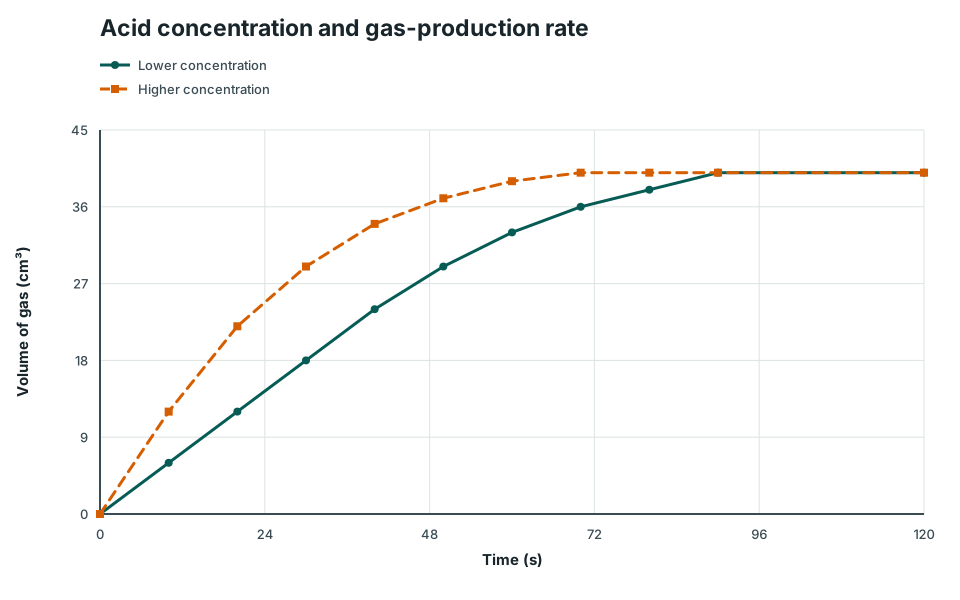
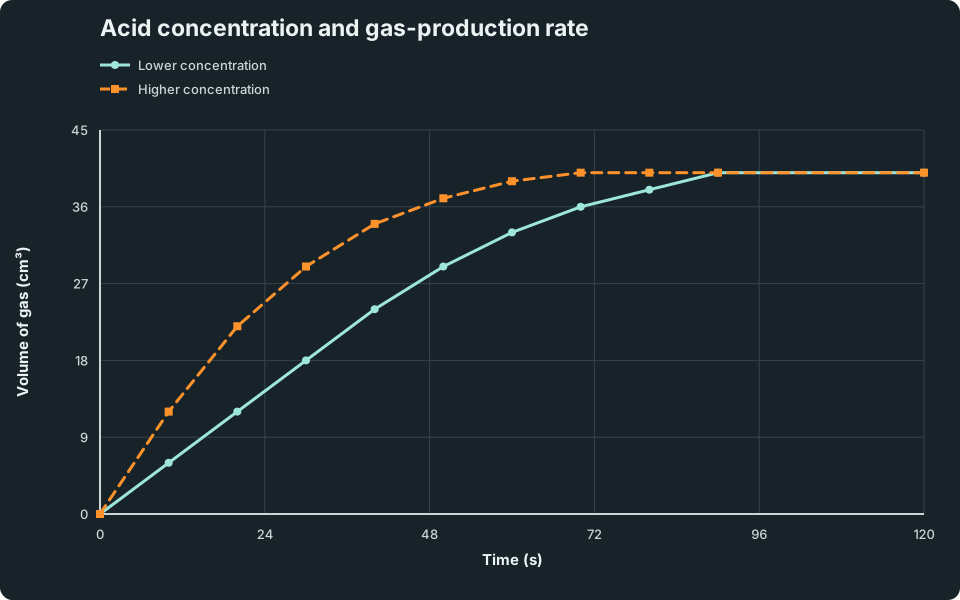
Acid concentration and gas-production rate
Two illustrative cumulative gas-volume curves. Both reach 40 cm³ and remain there through 120 s. The higher-concentration trial reaches its plateau sooner.
Scroll across the graph to read all labels.
View figure data
| Time (s) | Lower concentration | Higher concentration |
|---|---|---|
| 0 | 0 | 0 |
| 10 | 6 | 12 |
| 20 | 12 | 22 |
| 30 | 18 | 29 |
| 40 | 24 | 34 |
| 50 | 29 | 37 |
| 60 | 33 | 39 |
| 70 | 36 | 40 |
| 80 | 38 | 40 |
| 90 | 40 | 40 |
| 120 | 40 | 40 |
These constructed curves compare equal marble portions with acid at different concentrations. Acid is in excess in both trials; marble mass and particle size, acid volume, temperature and gas-collection conditions are held fixed. The more concentrated acid gives a greater initial rate, but the same marble amount gives the same final gas volume. Changing concentration does not always preserve final amount: check which reactant limits the reaction.
B. Pressure (gases)
For a fixed amount of reacting gas at constant temperature, compressing it into a smaller volume raises pressure and usually increases the rate in the collision model because:
- gas particles are forced closer together (same number of particles in a smaller volume),
- so there are more collisions per unit time,
- so there are more frequent effective collisions per unit time.
In the Haber process, higher pressure increases rate because gas collisions become more frequent. If supplied data also show a yield change, describe that as a separate trend rather than treating rate and yield as the same quantity. See:
Haber Process
and
Reversible Reactions
.
C. Surface area (solids)
For reactions involving a solid, the syllabus factor is particle size; the collision-theory explanation uses the resulting change in total surface area.
For the same mass of solid, decreasing particle size (for example, powdering it) increases rate because:
- total surface area increases,
- more solid particles are exposed to the other reactant,
- so there are more collisions at the surface per unit time,
- so there are more frequent effective collisions per unit time.
Compare equal masses of large chips and powder while keeping acid concentration and temperature fixed.
0.20 g of marble as large chips in 20 cm³ of 1.00 mol/dm³ hydrochloric acid at 25 °C. After 0 s the gas syringe reads 0 cm³.
- Volume of gas
- 0 cm³
- Rate at the tangent
- — cm³/s
- Half-life
- — s
Try this
0 of 4 doneDuring a run, drag the tangent back to the start of the curve to find the initial rate. (not done yet)
The rate is the gradient of the volume–time graph. It is greatest at the start, when the reactants are most concentrated, and falls to zero.
Use two different acid concentrations, with the marble used up both times. (not done yet)
More concentrated acid gives a steeper curve: acid particles hit the marble more often. The final volume is the same, because the same mass of marble reacts.
Compare large chips with powder of the same mass. (not done yet)
Powder has a much larger surface area, so many more acid particles collide with the marble each second.
Decompose H₂O₂ with no MnO₂, then with some MnO₂. (not done yet)
MnO₂ gives the reaction a pathway with a lower activation energy. It is a catalyst: the same mass of MnO₂ is left at the end.
Your readings
| # | t / s | V / cm³ | Remove |
|---|---|---|---|
| No readings yet. Set up a measurement, then record it. | |||
Write “larger surface area” and “more collisions at the surface per unit time”. Writing only “smaller particles” is a half-answer.
In this ideal model, one cube of edge 2a has six faces with total area 6(2a)² = 24a². Eight separate cubes of edge a expose 8 × 6a² = 48a². Their combined volume is still 8a³, so the same solid has twice the exposed surface. The new cut faces matter only when the other reactant can reach them; pieces pressed tightly together do not expose every face.
D. Temperature
For the reactions described by this model, increasing temperature usually increases rate because:
- particles have more kinetic energy (energy of motion) and move faster,
- so there are more collisions per unit time, and
- a larger proportion of particles have energy ≥ Eₐ, so a larger proportion of collisions are effective,
- so there are more frequent effective collisions per unit time.
Particles move faster and collide more frequently. A larger fraction of collisions also has enough energy to overcome the barrier. Temperature does not lower Eₐ. Enzyme-catalysed reactions can behave differently if heat damages the enzyme; see Catalysts and Enzymes.
E. Catalysts
Catalysts change the reaction pathway rather than reactant concentration, particle size or temperature. Continue with Catalysts and Enzymes for lower activation energy, industrial examples and biological catalysts.
4. Common Mistakes
- Writing “rate increases because concentration/pressure is higher” with no particle explanation.
- Treating total gas pressure as sufficient evidence: check that the concentration of reacting gas particles has increased.
- Using “particle size” without linking it to surface area and collisions at the surface.
- Explaining temperature using only “more collisions” and forgetting “larger proportion have energy ≥ Eₐ”.
- Saying “a catalyst is used up” or “a catalyst gives particles energy” (both false).
- Confusing “faster rate” with “more products”. Rate describes how quickly change occurs; any yield conclusion must come from the reaction information or supplied data.
5. Exam Tips
Start with the changed condition. Connect it to particle spacing, exposed solid surface, or particle energy. State the effect on collision frequency and, for temperature, on the fraction of effective collisions. A list of memorised phrases is not a causal explanation.
- In a fair test, change the intended factor and hold the others fixed. For a concentration comparison, use different concentrations but the same acid volume, marble mass and particle size, temperature and apparatus.
- For temperature, distinguish greater particle energy from a changed activation-energy barrier.
6. Worked Examples
Modelled example 1
Pressure (gases only)
Problem
Study the worked solution
State the particle change
Method
Bring the gas particles closer together.Reason
The stated compression puts the same number of gas particles into a smaller volume at constant temperature.Working
More reacting particles per unit volume.Infer the collision change
Method
Increase collisions per unit time.Reason
Closer gas particles encounter one another more frequently.Working
Higher collision frequency.Conclude with effective collisions
Method
State that effective collisions occur more frequently.Reason
A greater number of collisions per second gives more successful collisions per second under otherwise unchanged conditions.Working
More frequent effective collisions per unit time, so rate increases.
Guided practice 2
Surface area (marble + acid)
Problem
Complete the solid-interface chain
Hints
Hint 1: particle size to area
Hint 2: interface
View solution step by step
Translate particle size to surface area
Method
Give powder the larger total surface area.Reason
Dividing the same mass into smaller particles exposes more solid.Working
More CaCO₃ particles are exposed.Translate area to rate
Method
Increase collisions at the surface per unit time.Reason
More exposed sites allow more frequent effective acid–marble collisions.Working
More frequent effective collisions per unit time, so powder reacts faster.
Common misconception 3
Concentration vs volume (spot the mistake)
Learner claim
Separate amount of solution from particles per volume
View solution step by step
Identify the variable error
Method
Reject volume as proof of higher concentration.Reason
Concentration is the number of solute particles per unit volume, not the total volume present.Working
50 cm³ of a given solution has the same concentration as 25 cm³ of that solution.State the correct concentration mechanism
Method
Use acid with more reactant particles per unit volume.Reason
Closer, more numerous acid particles collide with the other reactant more frequently.Working
Higher concentration → more frequent effective collisions per unit time → faster rate.
Examiner practice 4
Temperature (full marks)
Examination question
Write the complete causal chain
View solution step by step
Kinetic energy and speed
1 markMethod
State that particles gain kinetic energy and move faster.Reason
Temperature measures the average kinetic energy of the particle population.Working
Higher temperature → faster particle motion.Collision frequency
1 markMethod
Increase collisions per unit time.Reason
Faster-moving particles meet more often.Working
Collision frequency increases.Activation threshold
1 markMethod
Increase the proportion with energy at least Eₐ.Reason
A larger fraction of collisions can overcome the activation-energy barrier.Working
Larger proportion with energy ≥ Eₐ.Rate conclusion
1 markWorking
More frequent effective collisions per unit time, so rate increases.
Self-mark with the mark scheme
Compare your response with each mark point. Select a point only when your response contains that evidence.
Self-mark the two temperature effects, activation-energy threshold and rate conclusion.
Catalyst: what changes and what stays the same
This exercise now belongs with the pathway explanation: Catalyst: what changes and what stays the same.
7. Mind Stretchers
Mind stretcher 1: Same concentration, different ratesExtension
Question: Equal masses of large marble chips and marble powder react with identical acid portions at the same concentration and temperature. Acid is in excess in both trials. Predict the initial gas-production rates and the final gas volumes, and explain both comparisons.
Show Answer
Powder has a larger total exposed surface area, so acid particles collide with the marble surface more frequently. Its initial gas-production rate is greater. Both trials have the same final gas volume because the same marble amount is completely used up with acid in excess. Initial rate and final amount answer different questions.
Mind stretcher 2: Choose the correct explanation sentenceExtension
Question: A student adds an inert gas to a reacting gas mixture without changing the vessel volume or temperature. Total pressure increases, but the amounts of reacting gases stay the same. Does the usual compression explanation predict a greater reaction rate? Explain.
Show Answer
No. The same numbers of reacting particles still occupy the same volume, so their concentrations have not increased. Adding inert gas raises total pressure without compressing the reactants. At the same temperature, the usual collision explanation therefore gives no rate increase. Compare reacting-particle density, not total pressure alone.
8. Practise and check
Use the topic check to practise rate explanations and fair-test design. Continue with Catalysts and Enzymes for the pathway mechanism.
Practise and check reaction ratesSyllabus and review details
- SEC G3 Pure Chemistry 2027 · 2027
Content structure and subject content, PDF pages 9–24
Last reviewed: