Gas Calculations (pV = nRT)
Combine pV = nRT with reacting ratios to calculate gas quantities.
On this page
In stoichiometry, pV = nRT is just a tool to get moles of a gas. Once you have moles, the rest is the usual chain: balanced equation → mole ratio → convert to what the question asks.
Definitions (Must Know)
A. Ideal gas equation
The ideal gas equation is:
B. Molar gas constant, R
The molar gas constant, R, is given in the Data Booklet (commonly 8.31 J mol⁻¹K⁻¹).
C. Absolute temperature (K)
Temperature must be in kelvin: T(K) = T(°C) + 273.15
Key Ideas (What Earns Marks)
- Use Kelvin: T(K) = T(°C) + 273.
- Use consistent units for p, V, and R.
- In gas stoichiometry, use moles from pV = nRT then apply the reaction ratio.
- If mass of a gas sample is given, you can find molar mass: M = mRT/pV.
- Use p in kPa and V in dm³, with R = 8.31 kPa dm³ mol⁻¹K⁻¹.
- Convert: 1000 cm³ = 1 dm³, and 1 kPa = 1000 Pa.
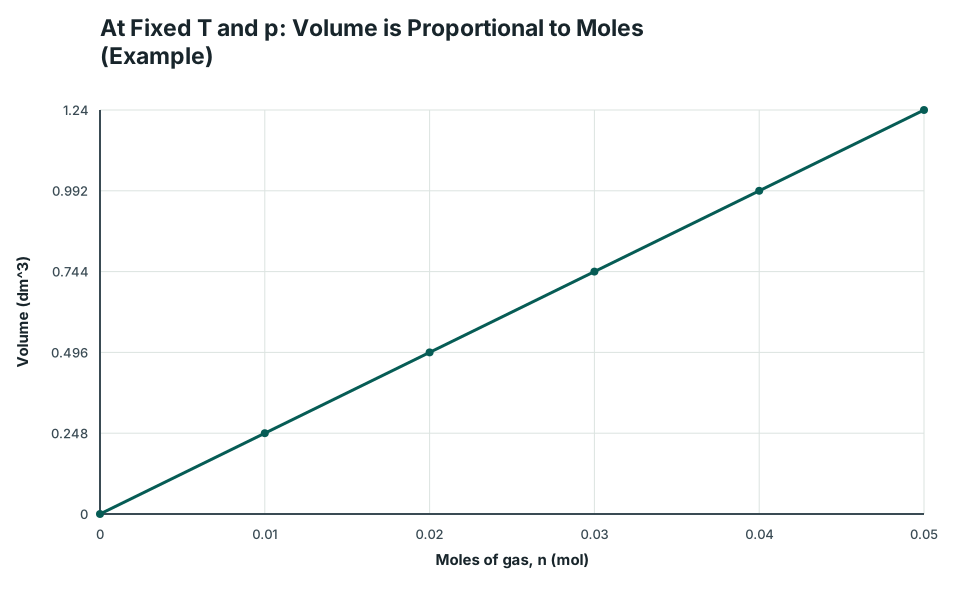
At Fixed T and p: Volume is Proportional to Moles (Example)
At Fixed T and p: Volume is Proportional to Moles (Example). V vs n plotted as Volume against Moles of gas, n.
Scroll across the graph to read all labels.
View figure data
| Moles of gas, n (mol) | V vs n |
|---|---|
| 0 | 0 |
| 0.01 | 0.248 |
| 0.02 | 0.496 |
| 0.03 | 0.744 |
| 0.04 | 0.992 |
| 0.05 | 1.24 |
Detailed Explanations
A. Choosing R (unit match)
Two common consistent sets (same “8.31” value):
| Use this R | If you use these units |
|---|---|
| R = 8.31 J mol⁻¹ K⁻¹ | p in Pa, V in m³, T in K |
| R = 8.31 kPa dm³ mol⁻¹ K⁻¹ | p in kPa, V in dm³, T in K |
If you want the full unit-logic explanation, see Ideal Gas Model and pV = nRT. For mixed gases or “collected over water” setups, route through Dalton’s Law and Partial Pressures before substitution.
B. Workflow (gas stoichiometry)
- Convert T to K.
- Convert p and V to match your R.
- Solve for n: n = pV/RT.
- If a reaction is involved, use the balanced equation to convert moles of one species to another.
- Convert to what the question asks (mass / volume / concentration).
Mini example:
- At 298 K, p = 100 kPa, V = 2.00 dm³: n = pV/RT = (100 × 2.00)/(8.31 × 298) = 0.0807 mol
C. Finding molar mass, M, of a gas using pV = nRT
- Use pV = nRT to calculate moles: n = pV/RT.
- Use M = m/n, so: M = mRT/pV
Worked Examples
Modelled example 1
Calculate Amount from Gas Conditions
Problem
A gas occupies 2.00 dm³ at 298 K and 100 kPa. Find the number of moles. Use R = 8.31 kPa dm³ mol⁻¹ K⁻¹.
Study the worked solution
Check the unit system
Method
Keep pressure in kilopascals, volume in cubic decimetres and temperature in kelvin.
Reason
Those units match the stated value and units of R.
Working
p = 100 kPa, V = 2.00 dm ³ and T = 298 K
Rearrange for amount
Method
Make n the subject of pV = nRT.Reason
Amount is the requested unknown.Working
n = pV/RT
Substitute and calculate
Working
n = 100(2.0)/8.31(298) = 0.0807 mol
Guided practice 2
Determine Molar Mass from Gas Data
Problem
A gas sample has mass 0.440 g and occupies 248 cm³ at 298 K and 100 kPa. Find its molar mass. Use R = 8.31 kPa dm³ mol⁻¹ K⁻¹.
Try this before viewing the solution
Hints
Hint 1: match the volume unit
Convert the gas volume from cubic centimetres to cubic decimetres before using the stated R.
Hint 2: connect amount to mass
First calculate n = pV/(RT), then use M = m/n.
View solution step by step
Convert the volume
Method
Divide the cubic-centimetre value by 1000.Reason
The stated R uses cubic decimetres.Working
248 cm³ = 0.248 dm³Calculate the gas amount
Reason
The gas equation gives the amount before mass can be converted to molar mass.Working
n = pV/RT = (100)(0.248)/(8.31)(298) = 0.0100 molCalculate molar mass
Method
Divide the sample mass by its amount.Reason
Molar mass is mass per mole.Working
M = m/n = 0.440/0.0100 = 44.0 g mol⁻¹
Common misconception 3
Correct an Incorrect Rearrangement
Learner attempt
0.500 mol of a gas is at 298 K and 100 kPa. A learner tries to find its volume using V = np/(RT). Identify the first error and calculate the correct volume.
Choose the correct rearrangement
View solution step by step
Isolate volume
Method
Divide both sides of pV = nRT by p.Reason
The learner has moved R and T to the wrong side of the expression.
Working
V = nRT/p
Calculate the volume
Working
V = 0.5(8.31)(298)/100 = 12.4 dm ³
Examiner practice 4
Calculate Carbon Dioxide Volume
Problem
1.00 g of calcium carbonate reacts with excess hydrochloric acid: CaCO₃(s) + 2HCl(aq) → CaCl₂(aq) + CO₂(g) + H₂O(l) Calculate the volume of CO₂ produced at 298 K and 100 kPa. [4 marks]
Try this before viewing the solution
View solution step by step
Calculate calcium carbonate amount
1 markMethod
Divide mass by molar mass.Reason
The equation ratio applies to amounts in moles, not directly to masses.
Working
n(CaCO₃) = 1.00/100 = 0.0100 mol
Use the equation ratio
1 markReason
The equation has a 1:1 ratio between CaCO₃ and CO₂.
Working
n(CO₂) = 0.0100 mol
Apply the ideal gas equation
1 markMethod
Rearrange to V = nRT/p and use the given conditions.
Reason
The carbon dioxide amount, temperature and pressure are now known.
Working
V = 0.01(8.31)(298)/100 = 0.248 dm ³
State a suitable final volume
1 markWorking
V = 0.248 dm ³ = 248 cm ³
Self-mark with the mark scheme
Compare your response with each mark point. Select a point only when your response contains that evidence.
Credit the reactant amount, equation ratio, ideal-gas substitution and final volume separately.
Challenge 5
Transfer a Gas Sample to New Conditions
Problem
The 2.00 dm³ gas sample from Example 1 is sealed, heated from 298 K to 350 K and compressed to 1.50 dm³. No gas escapes. Calculate its new pressure. Use R = 8.31 kPa dm³ mol⁻¹ K⁻¹.
Try this before viewing the solution
Hints
Hint 1: identify what stays fixed
Because the sample is sealed, its amount remains the 0.0807 mol found in Example 1.
Hint 2: use the new state
Apply p = nRT/V using 350 K and 1.50 dm ³.
View solution step by step
Carry the amount into the new state
Method
Use the amount already calculated for the sealed sample.
Reason
Heating and compression change its conditions, not the number of gas particles.
Working
n = 0.0807 molCalculate the new pressure
Method
Rearrange the ideal gas equation to p = nRT/V.Working
p = 0.0807(8.31)(350)/1.5 = 157 kPa
Common Mistakes
- Using T in °C directly.
- Mixing cm³ with dm³ (or m³) without converting.
- Using an R value that doesn’t match your units.
Exam Tips
- Write the unit set you are using before substituting.
- If using Pa and m³: remember 1 dm³ = 1.0 × 10⁻³ m³.
Mind Stretchers
Mind stretcher 1Extension
0.500 g of CaCO₃ reacts with 25.0 cm³ of 0.300 mol dm⁻³ HCl: CaCO₃(s) + 2HCl(aq) → CaCl₂(aq) + CO₂(g) + H₂O(l) (a) Identify the limiting reagent. (b) Calculate the volume of CO₂ formed at 298 K and 100 kPa.
Show Hint
Choose one consistent pressure-volume unit system, convert temperature to kelvin, and rearrange only after writing the equation.
Show Answer
Mark scheme:
- n(CaCO₃) = 0.500/100 = 0.00500 mol
- n(HCl) = cV = 0.300 × (25.0/1000) = 0.00750 mol
- Need 2 mol HCl per 1 mol CaCO₃, so 0.00500 mol CaCO₃ would need 0.0100 mol HCl → HCl is limiting.
- From the equation: 2 mol HCl gives 1 mol CO₂, so n(CO₂) = 0.00750/2 = 0.00375 mol.
- V = nRT/p = (0.00375 × 8.31 × 298)/100 = 0.0928 dm³ (= 92.8 cm³).
Mind stretcher 2: Using gas density to determine molar massExtension
Question. A gas has density 1.84 g dm⁻³ at 100 kPa and 298 K. Determine its molar mass using R = 8.31 kPa dm³ mol⁻¹ K⁻¹.
Show Hint
Take a 1.00 dm³ sample, so its mass is 1.84 g.
Show Answer
For 1.00 dm³, n = pV/RT = 100(1.00)/(8.31 × 298) = 0.0404 mol. Hence M = m/n = 1.84/0.0404 = 45.5 g mol⁻¹.
Syllabus and review details
- GCE A-Level H2 Chemistry 9476-2027 · 9476-2027
9476 (2027), complete syllabus
Last reviewed: