How to Determine if a Substance is Pure
Purity tests: use melting-point and boiling-point data to identify substances and assess purity, and explain why purity matters in food and drugs.
Continue where you stopped
The core idea
On this page
Learning objectives
- interpret paper chromatograms including comparison with ‘known’ samples and the use of Rf values
- deduce from given melting point and boiling point data the identities of substances and their purity.
- explain the importance of measuring the purity in substances used in everyday life, e.g. foodstuffs and drugs.
Purity evidence is useful only when you connect the observation to a conclusion. Compare a measured melting or boiling behaviour with the expected pure value, or interpret the number of chromatogram spots.
1. Definition
A pure substance consists of only one element or one compound. An impurity is an unwanted substance mixed into the sample.
A mixture contains two or more substances mixed together but not chemically combined.
Purity can be tested by comparing results with known data:
- Melting point (for solids)
- Boiling point (for liquids)
- Chromatography (to check if there is more than one substance present)
2. Key Ideas
- A pure solid has a sharp melting point: it melts at one fixed temperature.
- An impure solid usually starts melting at a lower temperature and melts over a range of temperatures.
- A pure liquid has a sharp boiling point: it boils at one fixed temperature (at a stated pressure).
- An impure liquid boils over a range of temperatures (and in most exam questions the boiling point is higher than the pure value).
- One chromatogram spot shows one visible component under those conditions; two or more spots prove that the sample is a mixture.
- Purity must be checked where impurities could change safety, effectiveness or quality, especially in food and medicines.
3. Detailed Explanations
- Sharp melting/boiling point = one fixed temperature.
- Range of temperatures (e.g., 117°C to 121°C) = impure.
- If a data-book value is given, compare explicitly: “lower/higher than the data-book value → therefore impure”.
A. Melting Point (Solids)
Use melting point data in this comparison:
| Observation | Conclusion |
|---|---|
| Melts at one fixed temperature | Sample is pure (or very close to pure) |
| Starts melting below the data-book value | Sample is impure |
| Melts over a range (e.g., 117°C to 121°C) | Sample is impure |
The key idea: an impurity changes how particles pack in the solid, so the sample usually starts melting below the known value and melts over a range rather than at one sharp temperature.
Same idea shown as a labelled graph (axes + units):
Heating Curve: Pure vs Impure Solid (Melting)
Example heating curves showing a pure substance with a flat melting plateau and an impure substance melting over a range.
Scroll across the graph to read all labels.
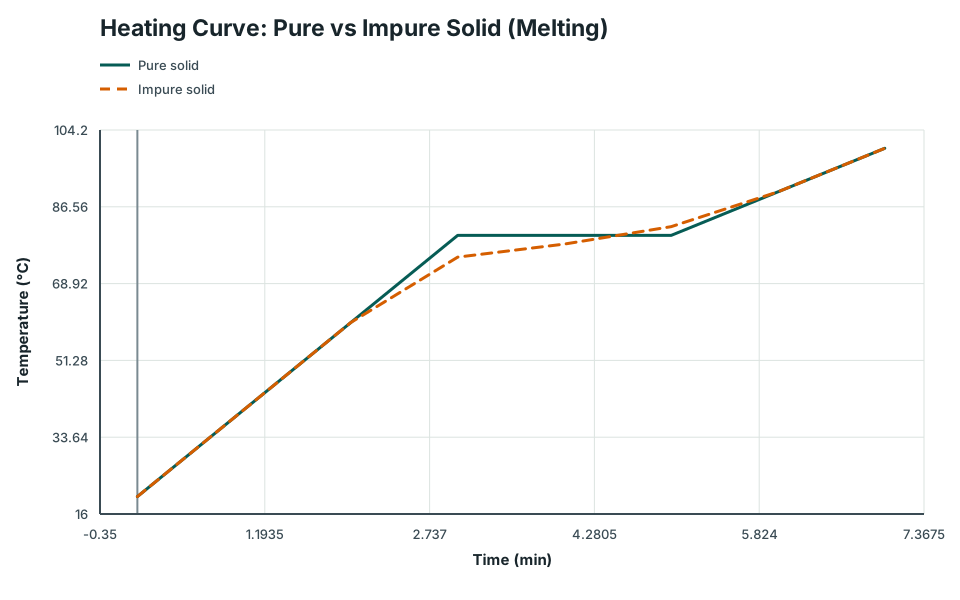
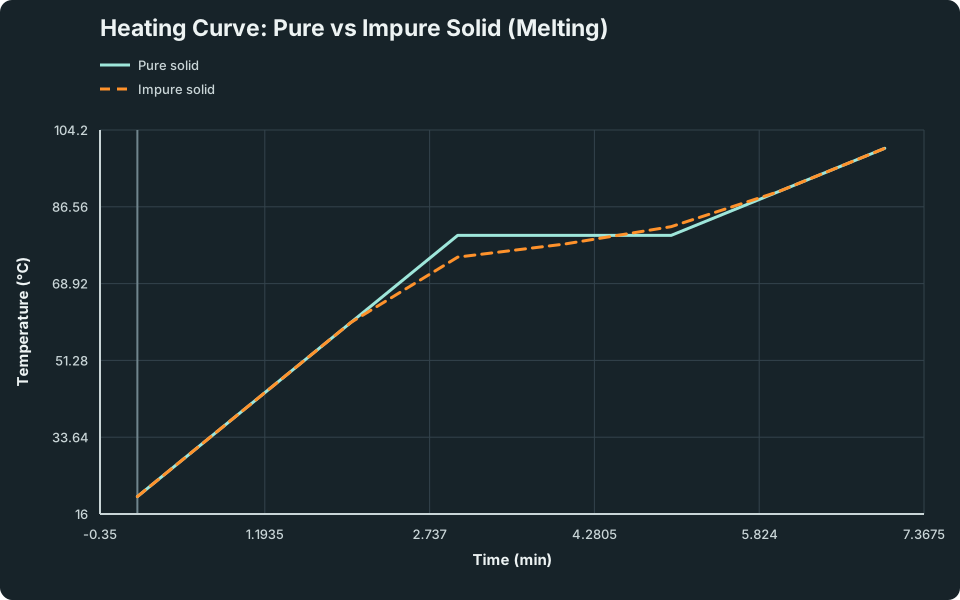
View figure data
| Time (min) | Pure solid | Impure solid |
|---|---|---|
| 0 | 20 | 20 |
| 1 | 40 | 40 |
| 2 | 60 | 60 |
| 3 | 80 | 75 |
| 4 | 80 | 78 |
| 5 | 80 | 82 |
| 6 | 90 | 90 |
| 7 | 100 | 100 |
B. Boiling Point (Liquids)
A pure liquid boils at a fixed temperature (at a stated pressure). An impure liquid boils over a range because the composition of the liquid changes during boiling.
Boiling point depends on atmospheric pressure. Compare a measured value with reference data only when the pressure is the same, unless the question tells you how to account for a pressure difference.
Most O-Level questions assume the impurity is non-volatile (it does not boil easily). In that case, the boiling point is usually higher than the pure value and occurs over a range.
C. Chromatography (Checking for More Than One Substance)
In paper chromatography, a chromatogram is the paper after the solvent has moved up and the spots have separated.
- One spot: could be a pure substance, or a mixture whose components happen to travel the same distance.
- Two or more spots: the sample is a mixture.
For the method (start line in pencil, solvent level below the line, etc.), see Separation Techniques.
“One spot” means “only one visible component under these conditions”. It does not guarantee purity because different substances can have the same spot position in the same solvent.
D. Why Measuring Purity Matters
Purity is not only a laboratory label. The acceptable level depends on how a substance will be used.
| Context | Why purity is measured |
|---|---|
| Medicines | The dose of the active ingredient must be reliable, and harmful contaminants must be controlled. |
| Foodstuffs | Contaminants or undeclared substances can make food unsafe or reduce its quality. |
| Chemical manufacture | Impurities can change reaction results, damage equipment or make the product unsuitable. |
“Purity is important” is incomplete. State the consequence: an impurity may make a medicine unsafe or give an unreliable dose, or may make food unsafe to consume.
4. Common Mistakes
- Writing “pure substances melt at a fixed point” but forgetting the keyword sharp / “one fixed temperature”.
- Saying “impurities always increase boiling point” without stating the exam assumption (usually non-volatile impurity).
- Ignoring pressure when comparing boiling points (especially altitude questions).
- Claiming “one spot = pure” with no qualification.
- Using ink for the start line in chromatography (it dissolves and gives a fake result).
5. Exam Tips
Use “melts at a fixed temperature” for pure solids and “melts over a range of temperatures” for impure solids. For liquids, use “boils at a fixed temperature” vs “boils over a range”.
If you are given a data-book melting/boiling point, you must compare your result to it: “lower than the data-book value” or “higher than the data-book value”, then state “therefore impure”.
6. Worked Examples
Modelled example 1
Interpreting a Melting Range
Problem
Study the worked solution
Inspect the melting behaviour
Method
Identify a four-degree melting range.Reason
A pure solid should melt sharply at one fixed temperature under the same conditions.Working
Observed: 117–121°C, not a sharp point.Compare with reference data
Method
State that the sample is impure.Reason
It melts over a range and begins below the 125°C reference value.Working
Conclusion: impure Z; pure Z melts sharply at 125°C.
Guided practice 2
Boiling Point Range (Purity Conclusion)
Problem
Compare the observation with pure-liquid behaviour
Hints
Hint 1: keyword
Hint 2: compare
View solution step by step
Describe the data
Method
State that boiling occurs over 78–82°C.Reason
The thermometer does not remain at one sharp temperature.Working
Boiling range: 4°C.Infer purity
Method
Conclude that the liquid is impure.Reason
A pure liquid boils at one fixed temperature at the same pressure.Working
Range of boiling temperatures → impure sample.
Common misconception 3
Chromatography Conclusion
Learner conclusion
Interpret the number of separated components
View solution step by step
Interpret the spots
Method
Count at least three visible components.Reason
Chromatography separates substances that travel differently under the chosen conditions.Working
Three separated spots → at least three components.Classify the sample
Method
Conclude that the dye is a mixture.Reason
A pure substance contains only one element or compound, whereas this sample gives multiple components.Working
Mixture, not pure.
Examiner practice 4
Explaining Why Medicine Purity Matters
Examination question
Link purity to dose and safety
View solution step by step
Dose reliability
1 markMethod
Link purity to the amount of active ingredient in a stated tablet mass.Reason
Incorrect purity can make the delivered dose ineffective or unsafe.Working
Known purity helps ensure a reliable active-ingredient dose.Contaminant safety
1 markMethod
State that harmful contaminants must be detected or controlled.Reason
Even a correct nominal dose may be unsafe if unwanted substances are present.Working
Purity measurement reduces contaminant risk.
Self-mark with the mark scheme
Compare your response with each mark point. Select a point only when your response contains that evidence.
Self-mark the dose and contaminant consequences.
Challenge 5
Identifying a Liquid From Boiling Point
Identity transfer
Use sharpness, reference match and evidential caution
Hints
Hint 1: sharpness
Hint 2: identity
View solution step by step
Use fixed-temperature evidence
Method
State that the constant value supports a pure or nearly pure liquid.Reason
A pure liquid boils sharply at one temperature at fixed pressure.Working
Observed: constant 100°C.Compare reference values
Method
Identify the sample as likely pure water.Reason
The observed temperature matches water rather than ethanol at the same pressure.Working
Data support pure water; use another test if confirmation is required.
7. Mind Stretchers
Mind stretcher 1: Conflicting EvidenceExtension
Question: Sample P gives one spot on a chromatogram. However, it melts over a range 122°C to 126°C. Is P pure? Explain.
Show Answer
No. The melting data shows impurity because it melts over a range of temperatures. The chromatogram having one spot does not prove purity (different substances can have the same spot position in one solvent).
Mind stretcher 2: Planning a Purity TestExtension
Question: You are given a soluble white solid X and reference data for pure X. Describe two tests that could provide evidence about its purity.
Show Answer
- Melting point test: measure the melting point and compare it with the reference value. A pure sample melts sharply at the reference temperature; an impure sample usually melts over a range and starts below that value.
- Paper chromatography: dissolve a small amount in a suitable solvent and run it alongside a known sample of pure X. Two or more spots prove that the sample is a mixture. One spot aligned with pure X supports the result but does not prove purity on its own.
8. Quiz
Practise using melting points, boiling points and chromatograms to identify substances and assess purity.
Start purity quiz