Errors, Limitations & Improvements (ACE)
ACE (Paper 3): identify random vs systematic errors, explain limitations, and suggest specific, realistic improvements that score marks.
Continue where you stopped
The core idea
On this page
Learning objectives
- interpret and evaluate observations and experimental results;
- evaluate methods and suggest possible improvements.
ACE marks are about scientific thinking: what could have made your results wrong, how confident you are, and what specific changes would improve the method.
1. Definition
Evaluation (ACE) is using results to make a conclusion, then identifying limitations/errors and suggesting specific improvements.
2. Key Ideas
- Random error: unpredictable variation (repeats help).
- Systematic error: a consistent bias (repeats do not fix it).
- Accuracy: closeness to true value. Precision: closeness of repeats.
- Improvements must be specific and linked to the error.
3. Detailed Explanations
- Accuracy: close to true value. Precision: repeats close to each other.
- Reliability: consistent repeats (improve by repeating + mean).
- Validity: fair test (only the IV changes).
- Anomalous result: far from the pattern; repeat and justify ignoring it.
A. Random vs Systematic Error
| Type | What it looks like | Example | Best improvement |
|---|---|---|---|
| Random | repeats scatter around a value | reaction start time varies | repeat + mean; better timing |
| Systematic | all results too high/low | balance reads +0.10 g always | calibrate/zero; check instrument |
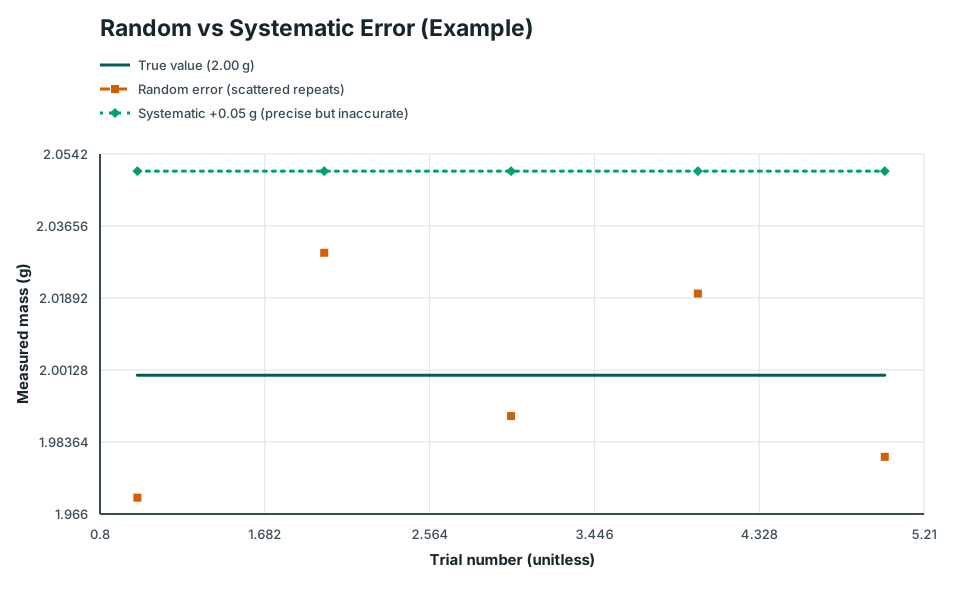
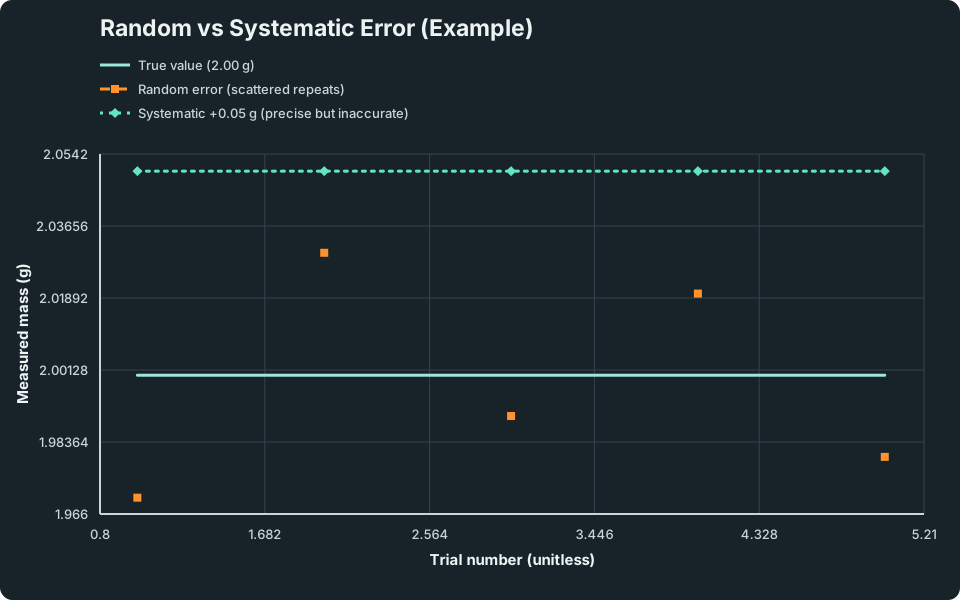
Visual example (random scatter vs systematic offset):
Random vs Systematic Error (Example)
Example data showing random scatter around a true value versus systematic error with a consistent offset.
Scroll across the graph to read all labels.
View figure data
| Series | Trial number (unitless) | Trial number uncertainty | Measured mass (g) | Measured mass uncertainty |
|---|---|---|---|---|
| True value (2.00 g) | 1 | 2 | ||
| True value (2.00 g) | 5 | 2 | ||
| Random error (scattered repeats) | 1 | 1.97 | ||
| Random error (scattered repeats) | 2 | 2.03 | ||
| Random error (scattered repeats) | 3 | 1.99 | ||
| Random error (scattered repeats) | 4 | 2.02 | ||
| Random error (scattered repeats) | 5 | 1.98 | ||
| Systematic +0.05 g (precise but inaccurate) | 1 | 2.05 | ||
| Systematic +0.05 g (precise but inaccurate) | 2 | 2.05 | ||
| Systematic +0.05 g (precise but inaccurate) | 3 | 2.05 | ||
| Systematic +0.05 g (precise but inaccurate) | 4 | 2.05 | ||
| Systematic +0.05 g (precise but inaccurate) | 5 | 2.05 |
B. “Limitation” vs “Mistake”
- A limitation is a weakness in the method (even if you followed it correctly).
- A mistake is you did something wrong (often not rewarded as “evaluation” unless you explain impact and fix).
C. What Counts as a “Good Improvement”
Bad: “reduce human error”.
Good (specific + linked):
- “Use a gas syringe instead of observing bubbles so volume can be measured accurately.”
- “Repeat each trial 3 times and calculate a mean; ignore anomalies.”
- “Use a burette instead of a measuring cylinder to measure volume more precisely.”
Write “repeat 3 times and calculate the mean” (not just “repeat the experiment”).
4. Common Mistakes
- Writing “human error” with no specific cause.
- Suggesting impossible improvements (e.g., “use a more accurate stopwatch” without explaining timing method).
- Confusing accuracy with precision.
- Not stating the direction of bias when it is obvious (e.g., “gas leaked → volume too low”).
5. Exam Tips
“A limitation is … therefore the results may be … (too high/too low).”
“To improve accuracy/precision, … because …”
“Repeat readings and calculate a mean to improve reliability.”
6. Worked Examples
Modelled example 1
Leak in Gas Syringe Setup
Problem
Study the worked solution
Trace the lost gas
Method
State that some product gas escapes through the leak.Reason
Escaped gas never enters the syringe barrel.Working
Collected volume is less than the volume actually produced.State the bias and fix
Method
Conclude that readings are too low and make the apparatus airtight.Reason
A tight-fitting bung and checked tubing prevent systematic gas loss.Working
Bias: volume too low. Improvement: secure and leak-test all connections before starting.
Common misconception 2
Accuracy vs Precision
Learner claim
Judge agreement separately from truth
View solution step by step
Judge precision
Method
Call both sets precise.Reason
Each student’s repeated readings agree closely with one another.Working
A: precise; B: also precise.Judge accuracy
Method
Identify A as more accurate and B as systematically high.Reason
Accuracy compares with the true 2.00 g value; B is offset by + 0.05 g every time.Working
A is precise and accurate; B is precise but inaccurate.
Challenge 3
Inconsistent End-Point (Cross Disappears)
Evaluation transfer
Link the subjective observation to improvements
Hints
Hint 1: endpoint
Hint 2: consistency
View solution step by step
Identify the random source
Method
Attribute scatter to subjective endpoint judgement and reaction time.Reason
The precise stopping instant varies unpredictably from trial to trial.Working
Random error in observing and timing the cross disappearance.Improve consistency and reliability
Method
Use the same observer, viewing distance and lighting; repeat at least three times and calculate a mean.Reason
Controlled viewing reduces variation, while repeats reveal anomalies and reduce the influence of random error.Working
Standardise observation + repeat and mean.
7. Mind Stretchers
Mind stretcher 1: Spot the Systematic ErrorExtension
Question: A thermometer reads 2°C too high for every measurement. Are repeats enough to fix this? What should you do?
Show Answer
Answer: Repeats do not fix a systematic error. You should calibrate/replace the thermometer or correct every reading by subtracting 2°C (if instructed/justified).
Mind stretcher 2: Weak ImprovementExtension
Question: A student writes: “Use a different method.” Why is this not a good evaluation answer, and what is a better one?
Show Answer
Answer: It is too vague and does not show understanding. A better answer states a specific method change, e.g., “Use a burette instead of a measuring cylinder to reduce reading uncertainty.”
8. Quiz
Ready to check your understanding? Try the interactive quiz, then review any questions you missed.