Alkane Reactions
Explain methane combustion and UV chlorine substitution, balance combustion equations, and use products to identify incomplete combustion.
On this page
Methane does not react readily with many reagents under ordinary conditions. Two useful exceptions are burning it in oxygen and reacting it with chlorine in UV light. Follow the atoms to distinguish these reactions.
Combustion
With sufficient oxygen and suitable mixing, complete combustion turns a hydrocarbon’s carbon into carbon dioxide and its hydrogen into water:
The water is shown as a liquid after cooling. It is water vapour in the hot flame. Fuel combustion is exothermic: forming the product bonds releases more energy than breaking reactant bonds requires.
Limited oxygen or poor mixing can lead to incomplete combustion. Carbon monoxide and soot can form, along with water. These equations model particular products; a real flame can produce a mixture:
Carbon dioxide can still be present during incomplete combustion. Finding some carbon dioxide does not prove that all the fuel’s carbon was fully oxidised.
Carbon monoxide is toxic because it reduces the blood’s ability to carry oxygen. Soot is solid carbon. These are different products with different hazards; see Air Pollutants.
Chlorine substitution
In UV light, methane reacts with chlorine. The UV light provides energy to initiate the reaction. One hydrogen on the carbon is replaced by chlorine; the removed hydrogen and another chlorine form hydrogen chloride:
This is substitution, not addition: one atom replaces another. Chloromethane is not a hydrocarbon because it contains chlorine as well as carbon and hydrogen.
Replace one hydrogen, keep carbon's four bonds
Compare the groups bonded to carbon. Methane has four hydrogens; chloromethane has three hydrogens and one chlorine. Carbon has four single bonds in both.
Scroll across the graph to read all labels.
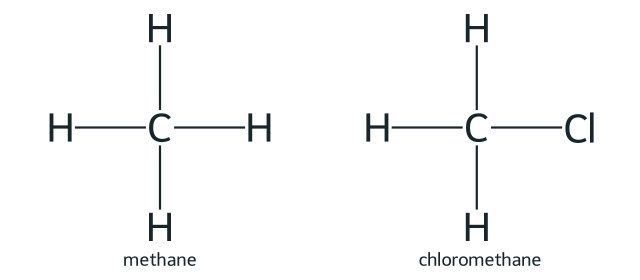
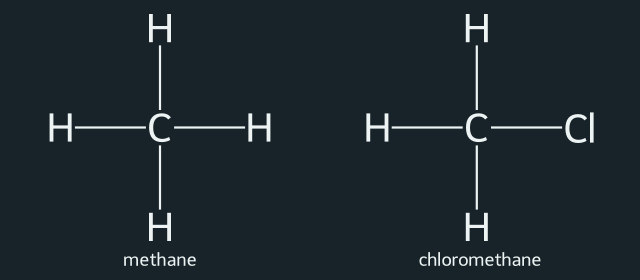
View figure data
| Molecule | Molecular formula | Atoms bonded to carbon |
|---|---|---|
| methane | CH4 | 4 H |
| chloromethane | CH3Cl | 3 H and 1 Cl |
The equation shows one hydrogen replacement. Further substitution can replace more hydrogens when the reaction continues; the product is not necessarily only chloromethane. The required example focuses on the first replacement, not the detailed reaction mechanism.
Balance and explain
Guided practice 1
Complete combustion equation (balancing)
Problem
Balance C, then H, then O
Hints
Hint 1: products
Hint 2: order
View solution step by step
Balance carbon and hydrogen
Method
Use three CO₂ and four H₂O.Reason
These coefficients account for three C atoms and eight H atoms in propane.Working
C₃H₈ + O₂ → 3CO₂ + 4H₂O.Balance oxygen
Method
Use five oxygen molecules.Reason
The products contain 3(2) + 4(1) = 10 O atoms.Working
C₃H₈(g) + 5O₂(g) → 3CO₂(g) + 4H₂O(l).
Examiner practice 2
Substitution (condition + product)
Examination question
Give the condition, products and balanced equation
View solution step by step
State the condition
1 markMethod
State UV light.Reason
UV light initiates the alkane–halogen substitution reaction.Working
Condition: UV light.Form the substituted products
1 markMethod
Replace one H atom in methane with Cl and pair the removed H with the other Cl.Reason
A substitution replaces a hydrogen atom; it does not add chlorine across a double bond.Working
Products: CH₃Cl and HCl.Write the balanced equation
1 markMethod
Use a 1:1:1:1 coefficient ratio.Reason
The equation then conserves C, H and Cl atoms.Working
CH₄(g) + Cl₂(g) → [UV] CH₃Cl(g) + HCl(g).
Self-mark with the mark scheme
Compare your response with each mark point. Select a point only when your response contains that evidence.
Self-mark the condition, products and balanced equation.
Try without prompts
Mind stretcher 1: Carbon dioxide is not the whole storyExtension
Two model reactions burn the same quantity of butane:
Check the atom totals in both equations. Identify which shows incomplete combustion and explain why “both produce carbon dioxide, so both are complete” is wrong. State the additional gaseous hazard in the second reaction.
Show answer
Both equations conserve eight C and twenty H atoms. The first has twenty-six O atoms on each side; the second has twenty-two. The first models complete combustion. The second is incomplete: some carbon forms CO, even though some forms CO2. It uses less oxygen for the same fuel quantity. Carbon monoxide is toxic and reduces the blood’s oxygen-carrying ability.
Mind stretcher 2: Identify the incomplete-combustion hazardExtension
A faulty fuel-burning heater is operating in a poorly ventilated room. A learner names carbon dioxide as the toxic gas associated with incomplete combustion. Correct the gas and explain its effect on the body.
Show answer
The gas is carbon monoxide, CO. It binds to haemoglobin and reduces the blood’s ability to carry oxygen. Carbon dioxide may also be present, but it is not the carbon-monoxide hazard caused by incomplete combustion.
Bring the reactions together
Combustion reacts a hydrocarbon with oxygen: oxygen supply and mixing affect its carbon-containing products. UV chlorine substitution replaces a hydrogen atom and also forms hydrogen chloride. In either reaction, use the equation to check every type of atom.
Practise and check
Use the Organic Chemistry topic check to practise and check your understanding.
Syllabus and review details
- SEC G3 Pure Chemistry 2027 · 2027
Content structure and subject content, PDF pages 9–24
Last reviewed: