Successive Ionisation Energies
Deduce valence electrons and group from the jumps in successive ionisation energies.
On this page
Successive ionisation energy questions are data questions: spot the big jump, translate it into “valence electrons”, then link the jump to inner-shell removal.
Use your course’s Atomic Structure topic navigation to review electron configurations first. Then connect successive ionisation energies to trends in the Periodic Table topic.
Definitions (Must Know)
A. Successive ionisation energies
The successive ionisation energies are the energies required to remove one mole of electrons, one electron at a time, from one mole of gaseous atoms/ions.
X(g) → X⁺(g) + e⁻ X⁺(g) → X²⁺(g) + e⁻ X²⁺(g) → X³⁺(g) + e⁻
B. Valence (outer-shell) electrons
Valence electrons are the electrons in the highest occupied shell (outer shell). These are removed first.
Key Ideas (What Earns Marks)
- Each successive ionisation energy is larger than the previous (electron removed from a more positive ion → greater attraction).
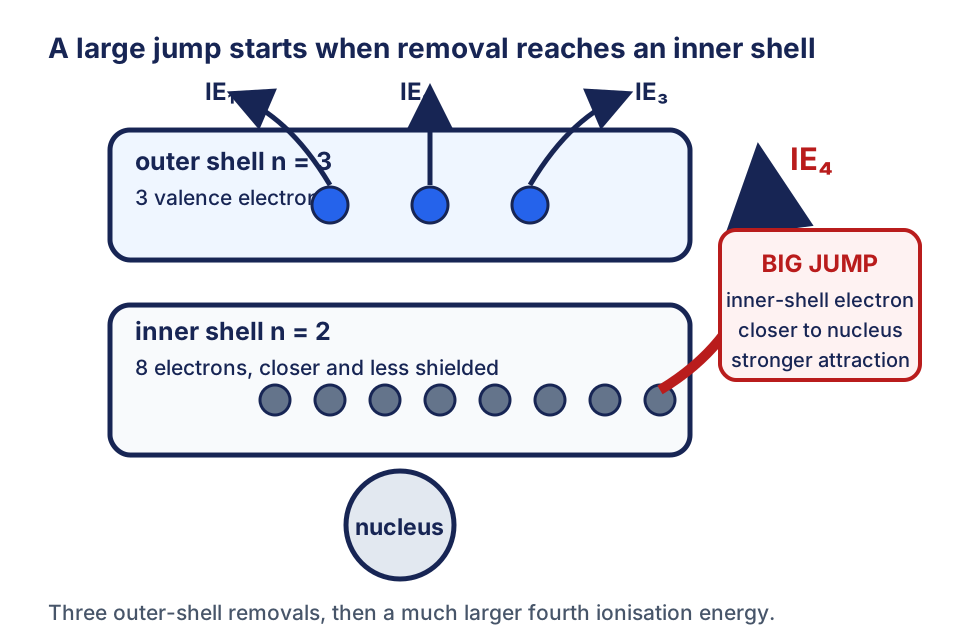
- A large jump indicates removal of an electron from an inner shell (closer to nucleus, less shielding).
- The number of electrons removed before the first big jump equals the number of valence electrons.
Data table
| Ionisation number | Energy |
|---|---|
| IE₁ | 578 |
| IE₂ | 1817 |
| IE₃ | 2745 |
| IE₄ | 11577 |
Detailed Explanations
A. How to deduce group (workflow)
- Look for the first big jump in values.
- Count how many electrons were removed before that jump.
- That count is the number of valence electrons → group (for main-group elements).
Mini example: a big jump between IE₃ and IE₄ means 3 valence electrons → Group 13 (main group).
B. Why a “big jump” happens
Successive ionisation energies rise because the ion becomes more positive each time, so the remaining electrons are attracted more strongly.
The first large jump happens when you move from removing valence electrons to removing an inner-shell electron. Inner-shell electrons are closer to the nucleus and experience less shielding, so the attraction is much greater and much more energy is needed.
Successive ionisation energies tell you how many valence electrons an atom has (so you can deduce its group for main-group elements). To identify the exact element, you usually combine this with other given information (e.g. period / atomic number / Aᵣ).
C. Deducing position and electron configuration
For a main-group element, the first large jump locates the boundary between the valence shell and the next inner shell. This gives the number of valence electrons and hence the group.
To deduce a fuller electron configuration or the exact position of an element, combine the jump pattern with all the supplied information:
- period given + number of valence electrons → position in the Periodic Table;
- complete successive-ionisation series → shell populations, because large jumps mark changes to lower principal quantum numbers;
- proton number given → exact electron count and configuration.
For example, large jumps after the 1st and 9th electrons in a complete series are consistent with shell populations 2,8,1: one valence electron, eight in the next shell and two in the innermost shell. The element is in Period 3, Group 1.
Remove an element’s electrons one at a time and plot each measured ionisation energy; switch to “Across periods” to compare first ionisation energies.
11 protons and 12 neutrons in the nucleus, 11 electrons in shells 2, 8, 1: a sodium-23 atom. No electrons removed yet.
- Nucleon number
- 23
- Charge
- 0
- Ar
- 22.99
- Configuration
- 1s² 2s² 2p⁶ 3s¹
- Energy to remove the last electron
- — kJ/mol
- First ionisation energy
- 496 kJ/mol
Try this
0 of 4 doneBuild an atom of carbon-12, then change it into carbon-14. (not done yet)
Both have 6 protons, so both are carbon. Carbon-14 has 2 more neutrons: atoms of one element with different numbers of neutrons are isotopes.
Make a sodium ion, Na⁺, and a chloride ion, Cl⁻. (not done yet)
An ion has more or fewer electrons than protons. The protons, and so the element, stay the same.
In the mass spectrum of chlorine, make the two peaks the same height. (not done yet)
Ar is the mean mass of the isotopes, weighted by abundance. Real chlorine is 76 % chlorine-35, so its Ar of 35.45 is nearer 35 than 37.
Remove sodium's electrons one at a time until the energy needed jumps. (not done yet)
The second electron comes from a full shell much closer to the nucleus, so it needs far more energy. One electron before the jump puts sodium in Group 1.
Worked Examples
Modelled example 1
Deduce Group from a Large Jump
Problem
An element shows a large jump between IE₂ and IE₃. Deduce its group for a main-group element.
Study the worked solution
Locate the jump
Method
Count the ionisations completed before the large increase.
Reason
The electrons removed before the jump belong to the outer shell.
Working
Two electrons are removed before IE₃.Infer the valence count
Method
Assign two electrons to the outer shell.Reason
The next electron requires much more energy because it comes from an inner shell.
Working
Valence-electron count = 2.State the group
Working
The element is in Group 2.
Guided practice 2
Interpret a Successive-Ionisation Data Row
Problem
Successive ionisation energies for an element are shown in kJ mol⁻¹.
| IE₁ | IE₂ | IE₃ | IE₄ |
|---|---|---|---|
| 578 | 1817 | 2745 | 11577 |
(a) Deduce the group. (b) Explain why there is a large jump where it occurs.
Try this before viewing the solution
Hints
Hint 1: compare adjacent values
Find the first increase that is much larger than the preceding increases.
Hint 2: count outer electrons
Count how many electrons have been removed before that jump.
View solution step by step
Find the first large jump
Method
Compare each adjacent pair of values.Reason
The increase from 2745 to 11577 is much larger than the earlier increases.
Working
The first large jump is between IE₃ and IE₄.
Deduce the group
Method
Count the three electrons removed before the jump.
Reason
A main-group atom with three valence electrons is in Group 13.
Working
Group 13.Explain the large jump
Method
Contrast the fourth electron with the first three.
Reason
After three outer electrons are removed, the fourth comes from a lower-n inner shell, closer to the nucleus and with less shielding.
Working
Much stronger attraction → much higher energy required.
Common misconception 3
Correct a Jump-Index Error
Learner claim
A learner says, “A large jump between IE₂ and IE₃ means the element is in Group 3 because the jump ends at the third ionisation energy.” Identify the error and give the correct group.
Count the relevant electrons
View solution step by step
Count completed removals
Method
Count IE₁ and IE₂, which occur before the jump.
Reason
The jump appears when IE₃ attempts to remove the first inner-shell electron.
Working
Two valence electrons were removed.Correct the group
Method
Map two valence electrons to the main-group position.
Reason
The group is based on the outer-electron count, not the later ionisation-energy index.
Working
Group 2, not Group 3.
Examiner practice 4
Explain a Jump after the First Electron
Problem
An element has a large jump between IE₁ and IE₂. Deduce its group for a main-group element and explain what the jump means in terms of electron shells. [4 marks]
Try this before viewing the solution
View solution step by step
Interpret the jump position
1 markMethod
Recognise that only one electron is removed before the jump.
Reason
IE₂ is the first ionisation to remove an inner-shell electron.
Working
One valence electron.Deduce the group
1 markReason
A main-group atom with one valence electron belongs to Group 1.
Working
Group 1.Compare the electron environment
1 markMethod
State that the second electron is in an inner shell.
Reason
It is closer to the nucleus and experiences less shielding.
Working
The inner electron is much more strongly attracted.
Link attraction to the jump
1 markMethod
State that much more energy is needed for the second removal.
Reason
More energy is required to overcome the much stronger attraction.
Working
IE₂≫ IE₁.
Self-mark with the mark scheme
Compare your response with each mark point. Select a point only when your response contains that evidence.
Credit the valence count, group and two-part inner-shell explanation separately.
Challenge 5
Predict the Jump from a Configuration
Problem
An element has electron configuration 1s² 2s² 2p⁶ 3s² 3p². Predict where the first large jump in its successive ionisation energies occurs and explain your prediction.
Try this before viewing the solution
Hints
Hint 1: count the outer-shell electrons
Only the n = 3 electrons are removed before the first inner-shell electron.
Hint 2: name both indices
Four electrons are removed as IE₁ through IE₄.
View solution step by step
Count the valence electrons
Method
Add the 3s and 3p electron counts.Reason
The n = 3 shell is the outer occupied shell.Working
3s² 3p² gives four valence electrons.Predict the jump
Method
Place the jump after those four electrons have been removed.
Reason
The fifth electron is the first to come from the n = 2 inner shell.
Working
The first large jump is between IE₄ and IE₅.
Explain the energy increase
Method
Compare the inner-shell electron with the removed valence electrons.
Reason
It is closer to the nucleus and less shielded, so it experiences much stronger attraction.
Working
Inner-shell removal requires much more energy.
Common Mistakes
- Using the jump position as “number of shells” (it’s about valence vs inner-shell electrons).
- Forgetting that the first big jump corresponds to moving to a lower principal quantum number (inner shell).
- Naming an exact element from one jump without enough information about its period or proton number.
Use the topic check in Practise and check below to practise and check your understanding.
Exam Tips
- In explanations, use keywords: “inner shell”, “less shielding”, “closer to nucleus”, “greater attraction”.
- If asked to identify the element, combine the group deduction with given data (e.g. atomic number / mass / period).
- The “big jump → group” shortcut is for main-group elements. Transition-metal patterns require their actual configurations: 4s electrons are removed before 3d electrons.
Mind Stretchers
Mind stretcher 1Extension
An element in Period 3 shows a large jump between IE₂ and IE₃. Identify the element and write its electron configuration.
Show Answer
Mark scheme:
- A big jump after removing 2 electrons means 2 valence electrons → Group 2.
- Period 3, Group 2 is magnesium, Mg.
- Electron configuration: 1s² 2s² 2p⁶ 3s².
Mind stretcher 2Extension
Explain why IE₄ is usually much larger than IE₃ when the first big jump is between IE₃ and IE₄.
Show Answer
Mark scheme:
- The first three electrons removed are valence electrons (outer shell).
- After three electrons are removed, the next electron comes from an inner shell (lower n), closer to the nucleus and with less shielding.
- Attraction is much stronger, so the energy required is much larger.
Syllabus and review details
- GCE A-Level H2 Chemistry 9476-2027 · 9476-2027
9476 (2027), complete syllabus
Last reviewed: