Solids: Structure and Physical Properties
Learn and apply Solids: Structure and Physical Properties in the published Chemistry course sequence.
Continue where you stopped
The core idea
On this page
Solids: Structure and Physical Properties: Orientation
Structure–property questions are “chain” questions: structure type → particles/forces → what can move → property. This lesson gives you the templates to write those chains quickly and safely.
Treat this as an extension of Atomic Structure (A Level), then use the Chemical Bonding hub to compare models across the topic.
Definitions (Must Know)
A. Ionic lattice (giant ionic structure)
An ionic lattice is a giant structure of alternating ions held by ionic bonding in all directions.
B. Metallic lattice
A metallic lattice is a giant structure of positive ions in a “sea” of delocalised electrons.
C. Simple molecular substance
A simple molecular substance contains molecules held together by intermolecular forces.
D. Giant covalent structure (network)
A giant covalent structure is a network of atoms linked by covalent bonds throughout the structure.
E. Hydrogen-bonded structure
A hydrogen-bonded structure is a lattice of molecules held together by hydrogen bonds (e.g. ice).
Detailed Explanations
A. Quick structure–property links
| Structure | Why melting point is high/low | Conductivity | Typical example |
|---|---|---|---|
| Ionic lattice | strong ionic bonding throughout lattice → high | solid: no (ions fixed); molten/aq: yes (mobile ions) | NaCl |
| Metallic lattice | strong attraction between ions and delocalised electrons → high | yes (delocalised electrons) | Cu |
| Simple molecular | weak intermolecular forces between molecules → low | no (no mobile charged particles) | iodine, I₂ |
| Hydrogen-bonded (molecular) | hydrogen bonds between molecules → higher than similar Mᵣ molecules | no (no mobile ions/electrons) | ice, H₂O |
| Giant covalent | many covalent bonds throughout network → very high | graphite: yes; diamond: no | C (graphite/diamond) |
Data table
| Substance | Melting point |
|---|---|
| I2 | 114 |
| NaCl | 801 |
| Cu | 1085 |
| SiO2 | 1710 |
B. Identifying structure from properties (workflow)
- Look at conductivity:
- conducts as a solid → metallic or graphite (delocalised electrons)
- does not conduct as a solid → could be ionic, simple molecular, or diamond-like giant covalent
- Look at melting point:
- very high → ionic/metallic/giant covalent
- low → simple molecular
- If it is ionic, check conductivity when molten/aqueous:
- conducts when molten/aqueous → mobile ions
Mini example: “high melting point + conducts as a solid” strongly points to a metallic lattice (mobile delocalised electrons).
Do not identify a structure from a single property if several models fit. For example, high melting point alone could indicate ionic, metallic or giant molecular structure. Combine all available evidence.
C. What each specified lattice looks like
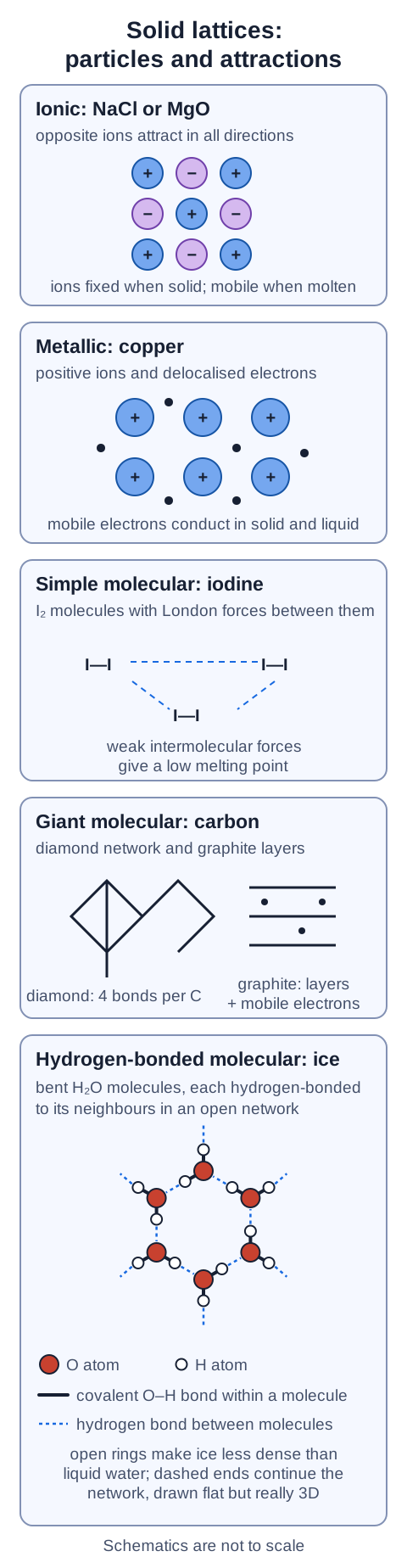
- Ionic — NaCl and MgO: a repeating three-dimensional arrangement of oppositely charged ions. Ionic attractions act in all directions; these are not discrete molecules.
- Simple molecular — iodine: discrete I₂ molecules occupy lattice positions, with London forces between molecules and covalent I–I bonds within them.
- Giant molecular — diamond: each C is covalently bonded to four others in a three-dimensional tetrahedral network; there are no mobile electrons.
- Giant molecular — graphite: each C is bonded to three others in planar layers. One electron per C is delocalised; weak attractions between layers allow them to slide.
- Hydrogen-bonded — ice: water molecules form an open lattice held by hydrogen bonds; each molecule remains a discrete H₂O molecule.
- Metallic — copper: positive metal ions form a lattice surrounded by mobile delocalised electrons.
D. Melting/boiling point
- ionic/giant covalent/metallic: generally high (strong bonding in lattice)
- simple molecular: generally low (weak intermolecular forces)
E. Electrical conductivity
- ionic: conducts when molten/aqueous (mobile ions), not when solid
- metallic: conducts as solid (delocalised electrons)
- simple molecular: usually does not conduct (no mobile charges)
- giant covalent:
- graphite conducts (delocalised electrons)
- diamond does not (no free electrons)
F. Solubility
- “like dissolves like” is a starting idea:
- ionic compounds often dissolve in water (ion–dipole attraction)
- non-polar molecules dissolve in non-polar solvents (London forces)
Worked Examples
Modelled example 1
Explain Sodium Chloride Conduction
Problem
Study the worked solution
Analyse the solid
Method
State that the ions occupy fixed lattice positions.Reason
Charged particles must be mobile to carry current through the sample.Working
Solid NaCl: ions present but fixed; no conduction.Analyse the melt
Method
State that melting frees the ions to move.Reason
Mobile Na⁺ and Cl⁻ ions transport charge to the electrodes.Working
Molten NaCl: mobile ions; conducts.
Guided practice 2
Compare Graphite and Diamond Conduction
Problem
Try this before viewing the solution
Hints
Hint 1: compare carbon bonding
Hint 2: find a mobile carrier
View solution step by step
Analyse graphite
Method
State that each carbon makes three covalent bonds in a layer.Reason
One electron per carbon remains delocalised and mobile through the layer.Working
Graphite has mobile delocalised electrons and conducts.Analyse diamond
Method
State that each carbon makes four covalent bonds.Reason
All four valence electrons are localised in bonds, leaving no mobile charge carrier.Working
Diamond has no delocalised electrons and does not conduct.
Common misconception 3
Correct an Ice-Conduction Claim
Learner claim
Classify the particles
View solution step by step
Classify the solid
Method
Identify ice as a hydrogen-bonded molecular solid.Reason
Hydrogen bonds are intermolecular attractions between discrete H₂O molecules, not reservoirs of free ions.Working
Ice lattice particles: neutral H₂O molecules.Apply the carrier test
Method
State that there are no mobile ions or delocalised electrons.Reason
Without mobile charged particles, electrical current cannot flow.Working
Ice does not conduct electricity.
Examiner practice 4
Compare Iodine and Diamond Melting Points
Problem
Try this before viewing the solution
View solution step by step
Describe iodine
1 markMethod
Identify discrete I₂ molecules in a simple molecular lattice.Reason
The covalent I–I bonds remain within each molecule during melting.Working
Iodine melts by overcoming London forces between molecules.Explain iodine's melting point
1 markMethod
State that intermolecular London forces are relatively weak.Reason
Only modest energy is needed to separate the molecules.Working
Solid iodine has a comparatively low melting point.Describe diamond
1 markMethod
Identify a giant covalent three-dimensional network.Reason
Carbon atoms are linked by strong covalent bonds throughout the structure.Working
Diamond has no discrete molecules to separate.Explain diamond's melting point
1 markMethod
State that many strong covalent bonds must be overcome.Reason
This requires far more energy than overcoming intermolecular forces.Working
mp(diamond)≫ mp(I₂).
Self-mark with the mark scheme
Compare your response with each mark point. Select a point only when your response contains that evidence.
Credit each structure and its force-to-melting link.
Challenge 5
Explain Two Graphite Properties
Problem
Try this before viewing the solution
Hints
Hint 1: within each layer
Hint 2: between layers
View solution step by step
Explain conduction
Method
Identify mobile delocalised electrons within the layers.Reason
Each carbon bonds to three neighbours, leaving one electron able to move and carry charge.Working
Delocalised electrons → conduction along layers.Explain softness
Method
Contrast strong covalent bonding within layers with weak attraction between layers.Reason
The weak interlayer attractions allow whole layers to slide without breaking the covalent network inside a layer.Working
Weak interlayer forces → layers slide.
Mind Stretchers
Mind stretcher 1Extension
A solid has a high melting point, conducts electricity as a solid and is malleable. Deduce the structure type and justify using bonding and particles.
Show Answer
Mark scheme:
- Metallic lattice.
- High melting point: strong attraction between metal ions and delocalised electrons.
- Conducts as a solid: delocalised electrons are mobile.
- Malleable: layers of positive ions can slide while remaining attracted to the non-directional sea of delocalised electrons.
Mind stretcher 2Extension
Solid X has a high melting point, does not conduct electricity as a solid, but conducts when molten. Deduce its structure and explain each observation.
Show Answer
Mark scheme:
- X has a giant ionic lattice.
- Strong electrostatic attractions between oppositely charged ions require much energy to overcome, giving a high melting point.
- In the solid, ions are fixed and cannot carry charge.
- When molten, ions are mobile and carry charge.