Measurement uncertainty: estimates and limits
Key idea: Uncertainty gives a measurement's possible range; bias can shift repeats together. For small reading bounds, differences add absolute uncertainties and products or quotients add relative ones.
Offline pages
Saved on this device only. Connect at least once every 30 days to confirm Premium. Sign-out or a change of account removes saved copies.
Loading guide controls…
Guided lessons · coming soon
Guided lesson
Guided steps
- Tell display resolution, repeated scatter and accuracy apart.
- Compare absolute uncertainty with the measured value.
- Predict whether the common balance offset cancels.
- Follow the conservative bound for two burette readings.
- Calculate the mass’s percentage uncertainty.
- Find the mass loss and its relative uncertainty.
- Read how relative contributions combine for a quotient.
- Calculate the rate and combine its uncertainty contributions.
- Compare percentage reading bounds for the two volumes.
- Explain why smaller reading uncertainty can still accompany bias.
- Read what overlapping intervals can tell you.
- Explain the balance offset and how to address it.
On this page
You stopped at:
ContinueA measured result needs a value and an indication of how uncertain it is. A small uncertainty helps you interpret the measurement, but a biased method can still give a small quoted uncertainty. First identify the quantity actually calculated, then use the uncertainty model stated in the question.
Separate resolution, precision and accuracy
Resolution is the smallest change the instrument can display or distinguish. Precision describes the closeness of repeated measurements under the same conditions. Accuracy describes closeness to an accepted reference or true value. These are different properties.
Repeating a measurement reveals scatter. Averaging suitable repeats can reduce the effect of random variation, but it does not remove a persistent calibration error. For example, a balance that reads 0.20 g high can give tightly clustered readings that are all high. A small spread shows closely repeated readings; all of them can still share the same offset.
An instrument’s display resolution is only one contribution to uncertainty. Calibration, reading technique and the measurement method can also matter. Use the uncertainty supplied by the question or specified method; do not assume that every balance has uncertainty equal to its last displayed digit.
Absolute and percentage uncertainty
If a result is reported as V = (25.00±0.10) cm³, the absolute uncertainty is 0.10 cm³. The percentage uncertainty compares that magnitude with the measured value:
Use the same units in the numerator and denominator. For the volume above, the percentage uncertainty is 0.40%. Keep extra digits during calculation, then round the final uncertainty sensibly, usually to one or two significant figures unless instructed otherwise. Match the reported value’s decimal place to the absolute uncertainty.
A zero or very small measured difference needs care: percentage uncertainty is undefined at zero and can be large near zero, even when each original reading has a small absolute uncertainty.
Check your understanding 1 A common balance offset
Both flask readings are 0.20 g too high because of the same balance zero offset. Predict how that offset affects the calculated mass loss, initial mass minus final mass.
Show answer
If the true readings are a and b, the measured difference is (a + 0.20) − (b + 0.20) = a − b. A common zero offset cancels; separate reading errors need a different calculation.
Differences: why two reading bounds can add
For the conservative school-level estimate used here, treat each stated uncertainty as a possible reading bound. If d = a-b, the largest possible error in the difference occurs when one reading is high and the other low, so the bounds add:
This is a worst-case reading estimate, not a universal rule for every statistical uncertainty. A shared constant zero offset in both readings cancels in the difference; other effects may not. Follow the question’s model rather than treating every uncertainty contribution as a separate reading error.
Worked example 1
Find the absolute uncertainty in a titre
Problem
Show full solution
Identify the operation
Method
Write the titre as final reading minus initial reading.Reason
A delivered volume depends on two separate burette readings.Working
Answer
Vₜᵢₜᵣₑ = Vf-Vᵢ.Combine absolute uncertainties
Method
Add the two reading uncertainties.Reason
For this conservative bound, the two reading errors could act in opposite directions.Working
Answer
0.05 + 0.05 = 0.10 cm³.
Quick check
Compare uncertainty relative to the result
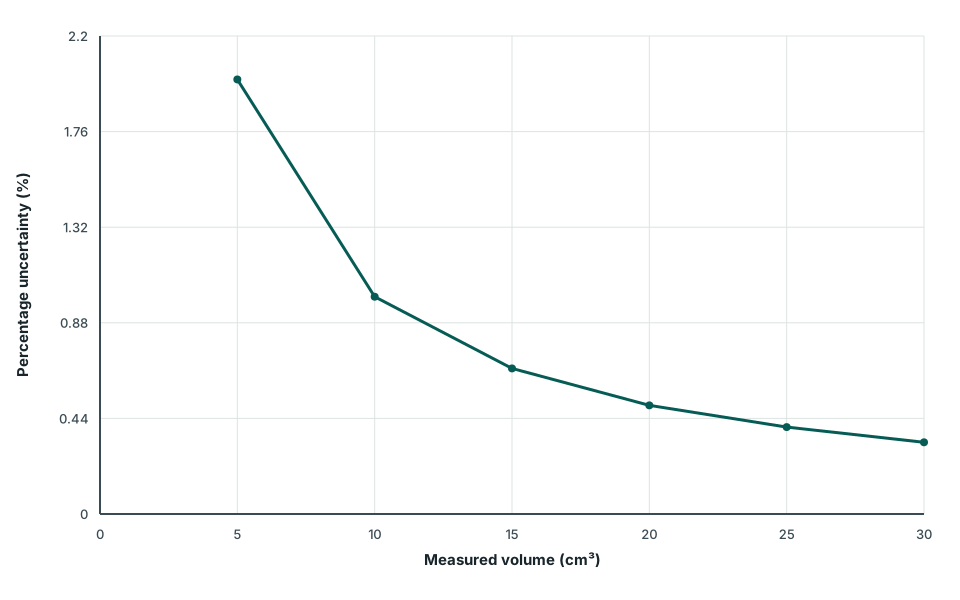
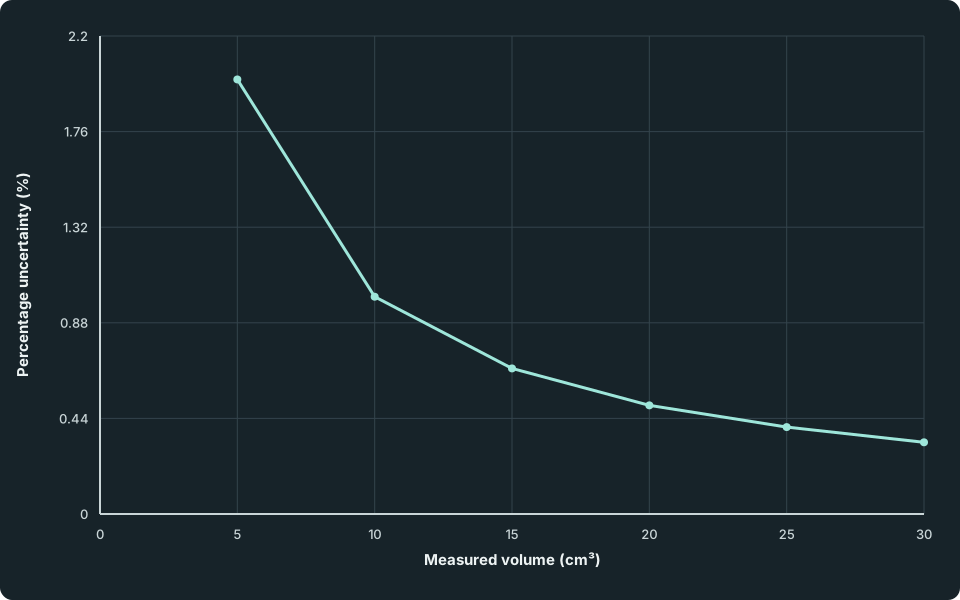
A fixed absolute reading bound becomes a smaller percentage of a larger measured volume. The plot shows representative values, not a claim that you should make every experiment as large as possible. The apparatus range, reaction scale and given method still matter.
Percentage Uncertainty vs Measured Volume (Fixed ±0.10 cm³)
Percentage Uncertainty vs Measured Volume (Fixed ±0.10 cm³). ±0.10 cm³ plotted as Percentage uncertainty against Measured volume.
Scroll across the figure to read all labels.
View figure data
| Measured volume (cm³) | ±0.10 cm³ |
|---|---|
| 5 | 2.00 |
| 10 | 1.00 |
| 15 | 0.67 |
| 20 | 0.50 |
| 25 | 0.40 |
| 30 | 0.33 |
Guided practice 2
Convert mass uncertainty to a percentage
Problem
Try this before viewing the solution
Hints
Hint 1
fraction
Divide absolute uncertainty by the measured value.Hint 2
percentage
Multiply the uncertainty fraction by 100%.Show solution step by step
Use the stated absolute uncertainty
Method
Take the absolute uncertainty as ±0.01 g.Reason
The question states the uncertainty to use; resolution alone does not define total measurement uncertainty.Working
Answer
Δ m = 0.01 g.Form a percentage
Method
Divide by the measured mass and multiply by 100.Reason
Percentage uncertainty expresses the uncertainty relative to the size of the measurement.Working
Answer
0.01/1.24 × 100% = 0.81%.
Quick check
Try it yourself 3
Find the uncertainty in a mass loss
Problem
Try this before viewing the solution
Show the steps Optional working
Hints
Hint 1
difference
The mass loss is initial minus final mass.Hint 2
two readings
Add absolute reading uncertainties before converting to a percentage of the mass loss.Show solution step by step
Calculate the difference
Method
Subtract the final mass from the initial mass.Reason
The mass loss is the observed decrease in the flask reading. Its cause requires the experimental context.Working
Answer
18.46-18.11 = 0.35 g.Combine reading uncertainties
Method
Add the two balance-reading uncertainties.Reason
Opposite reading errors give the largest difference error in this conservative model.Working
Answer
Δ m = 0.01 + 0.01 = 0.02 g.Express relative uncertainty
Method
Divide the absolute uncertainty by the mass loss and multiply by 100.Reason
The relevant measured result is the 0.35 g difference, not either flask mass.Working
Answer
0.02/0.35 × 100% = 5.71%.
Quick check
Products and quotients: combine relative contributions
For small reading bounds, the usual conservative first-order estimate for a product or quotient adds relative uncertainties. If r = V/t:
Multiplying by 100 gives the percentage rule. It is an approximation appropriate to small relative uncertainties; if the question supplies a different model, use it. A precisely defined constant adds no measurement uncertainty of its own.
Check your understanding 2 Estimate uncertainty in an average rate
A gas volume is 24.6 cm³ with uncertainty ±0.2 cm³. The elapsed time is 12.4 s with uncertainty ±0.2 s. Use r = V/t and the conservative first-order model to find the average rate and its percentage uncertainty.
Show hint
Show the steps Optional working
Show answer
The average rate is 24.6/12.4 = 1.98 cm³ s⁻¹ to 3 significant figures. The volume and time contributions are 0.813% and 1.613%, so the estimated percentage uncertainty is 2.43% before final rounding, or about 2.4%. This corresponds to an absolute uncertainty of about 0.05 cm³ s⁻¹; a consistent final report is (1.98±0.05) cm³ s⁻¹.
Check your understanding 3 Compare reading contributions and possible bias
Methods A and B use the same burette and two readings to deliver 8.00 cm³ and 40.00 cm³ respectively. Each reading has uncertainty ±0.05 cm³. Compare the conservative percentage reading uncertainties. Calculate each percentage to two significant figures. Consider possible bias in the next question.
Show answer
The conservative absolute reading uncertainty is ±0.10 cm³ for either difference. The percentage values are 1.3% for A (1.25% unrounded) and 0.25% for B. B has a smaller relative reading contribution. B can still have a larger calibration or method bias: calibration bias and method effects still need consideration, and a larger volume must remain suitable for the given experiment.
Check your understanding 4 Does the larger volume remove bias?
Methods A and B above have percentage reading uncertainties of 1.3% and 0.25%. Explain why these values alone cannot tell you which whole method is more accurate.
Show answer
B has a smaller reading-bound contribution relative to its delivered volume. That does not remove calibration or method bias, such as a repeated endpoint overshoot. Compare those effects as well, and check that the larger volume suits the experiment. Include the difference between a reading contribution and total method accuracy.
Compare reported intervals cautiously
If two uncertainty intervals overlap, the results are compatible within those quoted bounds; overlap can occur when true values differ, and both measurements may share a bias. If they do not overlap, investigate the difference and the uncertainty estimates rather than declaring one method wrong without evidence.
Check your understanding 5 Decide how to address an offset
A balance measures a certified 10.00 g reference as 10.20, 10.21 and 10.20 g. A learner says that taking 20 repeats will remove the error. Explain what the existing readings suggest and what action would address the offset.
Show answer
The small spread suggests good repeatability, while the readings are consistently above the reference. More repeats can characterise scatter and refine a mean, but they do not remove the common offset. Check the balance’s zero, calibration and specified correction procedure against the reference; then consider uncertainty in the corrected result.
Spotted an error? Report a correction
Syllabus and review details
- GCE A-Level H2 Chemistry 2027 · 9476-2027
9476 (2027), complete syllabus
Last reviewed: