Planning: Variables, Controls, Risk
Learn and apply Planning: Variables, Controls, Risk in the published Chemistry course sequence.
Continue where you stopped
The core idea
On this page
Planning: Variables, Controls and Risk: Orientation
Planning questions are one of the easiest ways to gain (or lose) marks. The mark scheme rewards clarity: measurable variables, real control methods, and credible risk management.
Use this with Paper 4 Skills: Planning, MMO, PDO, ACE and the Practical and QA (A Level) hub so method, data, and evaluation marks stay aligned.
Definitions (Must Know)
A. Independent variable (IV)
The independent variable is the quantity you deliberately change.
B. Dependent variable (DV)
The dependent variable is the quantity you measure to see the effect of the IV.
C. Controlled variables (CV)
Controlled variables are quantities you keep constant (using a stated method) so the test is fair.
D. Hazard, risk, control measure
- Hazard: what can cause harm (e.g. corrosive acid).
- Risk: what could happen (e.g. splash burns).
- Control measure: what you do to reduce the risk (e.g. goggles, small volumes, immediate rinsing).
Detailed Explanations
A. Workflow: write IV, DV, CV in one minute
- Write the IV with a range and how you set it (e.g. dilution with volumetric glassware).
- Write the DV with instrument + unit (what reading, how measured).
- List 3–6 CV and give a control method for each.
Mini example (rate experiment):
- IV: concentration of HCl(aq) from 0.50 to 2.00 mol dm⁻³ (prepared by dilution in volumetric flasks)
- DV: time for a fixed visual change / fixed gas volume (s, measured with stopwatch)
- CV: temperature (298 K water bath), total volume (fixed), mass/surface area of solid (same chips/sieved), mixing (same swirling), start/stop point definition
Because changing more than one factor changes the DV for multiple reasons, therefore you must state control methods to isolate the IV’s effect.
B. Writing variables properly (what examiners accept)
Better than “temperature”:
- “temperature of the reaction mixture maintained at 298 K using a water bath”
Better than “amount of reactant”:
- “volume of acid used (25.0 cm³ measured with a pipette)”
C. Controlling variables (methods that earn marks)
Common control methods:
- temperature: water bath + thermometer, allow equilibration time
- volumes: pipette/burette rather than a measuring cylinder
- mass of solid: balance to 0.01 g, same particle size (sieve) if relevant
- mixing: stirrer or consistent swirling pattern
- timing: same start point definition (e.g. start stopwatch at acid addition)
D. Risk and safety (what to include)
A good risk paragraph typically includes:
- hazard (what is dangerous)
- risk (what could happen)
- control (what you do to reduce it)
Examples:
- acids/alkalis: splash risk → goggles, immediate rinsing, small volumes
- flammables: ignition risk → keep away from flames, use water bath not Bunsen
- toxic gases: inhalation risk → work in fume cupboard, small scale
In Paper 4, don’t write a generic safety paragraph. Write the hazards that match the reagents in the question (corrosive, toxic, flammable, oxidising) and give a specific control measure.
E. Repeats, means, and anomalies (PDO + ACE marks)
- Plan for ≥3 repeats at each IV value.
- If you use a mean, state the rule (e.g. “ignore an anomalous result with a stated reason, then calculate the mean of the remaining values”).
- If a graph is required, plan it in the method: “plot DV against IV and draw a line of best fit”.
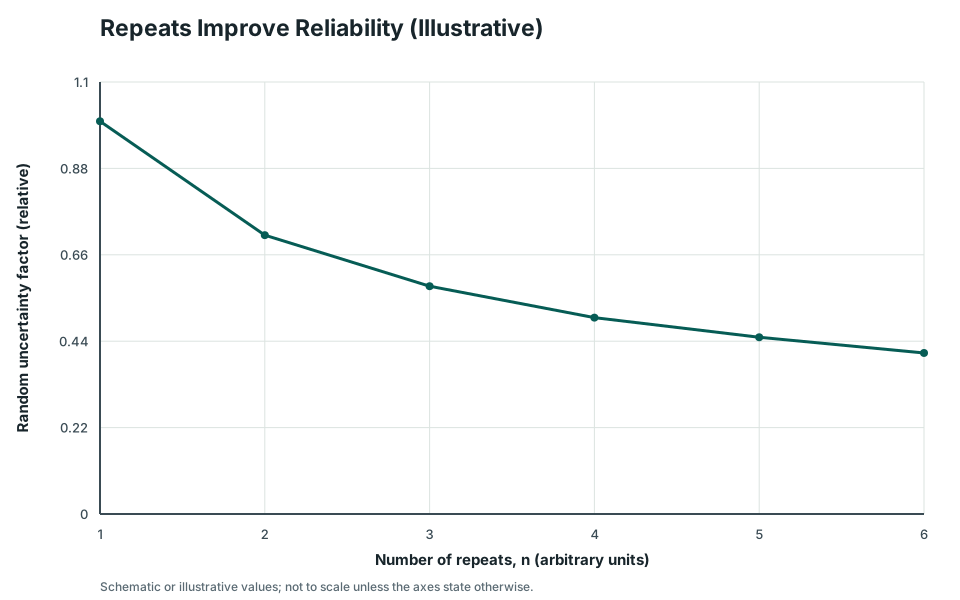
Repeats Improve Reliability (Illustrative)
Repeats Improve Reliability (Illustrative). 1/sqrt(n) plotted as Random uncertainty factor against Number of repeats, n.
Scroll across the graph to read all labels.
View figure data
| Number of repeats, n (arbitrary units) | 1/sqrt(n) |
|---|---|
| 1 | 1 |
| 2 | 0.71 |
| 3 | 0.58 |
| 4 | 0.5 |
| 5 | 0.45 |
| 6 | 0.41 |
Worked Examples
Modelled example 1
Turn “Keep Temperature Constant” into a Method
Problem
Study the worked solution
Set the value
Method
State the controlled temperature, for example 298 K.Reason
A named value makes the control reproducible across every trial.Working
Controlled variable: reaction-mixture temperature at 298 K.Name the control method
Method
Place the reactants in a 298 K water bath and monitor them with a thermometer.Reason
The bath transfers heat to or from the reactants while the thermometer checks the actual temperature.Working
Water bath + thermometer.Define when to begin
Method
Allow the reactants to equilibrate before mixing and starting the measurement.Reason
Otherwise their initial temperatures may differ despite using the same bath.Working
Start only after both reactants reach 298 K.
Guided practice 2
Manage an Inhalation Risk
Problem
Try this before viewing the solution
Hints
Hint 1: route
Hint 2: hierarchy
View solution step by step
State hazard and risk
Method
State that the gas is harmful by inhalation and may escape into the breathing zone.Reason
A risk statement links the hazardous property to a credible exposure route.Working
Hazard: harmful gas; risk: inhalation if released.Control exposure
Method
Carry out the small-scale reaction in a functioning fume cupboard.Reason
The cupboard removes escaped gas, while small quantities reduce the possible exposure.Working
Control = fume cupboard + minimum practicable scale.
Common misconception 3
Correct “Repeats Improve Accuracy”
Learner claim
Try this before viewing the solution
View solution step by step
State what repeats show
Method
Use repeats to reveal random variation, identify anomalies and calculate a mean.Reason
Random deviations may average in different directions.Working
Repeats primarily improve reliability of the estimate.Separate systematic error
Method
Calibrate or replace biased apparatus, or change the flawed procedure.Reason
A systematic offset acts in the same direction on every repeat and remains in their mean.Working
Repeating a biased method reproduces the bias.
Examiner practice 4
Write Operational Variables for a Rate Plan
Examination question
Try this before viewing the solution
View solution step by step
Independent variable
1 markMethod
Vary the initial reaction temperature over a stated range using thermostatically controlled water baths.Reason
The method must deliberately set the variable being investigated.Working
Example range: 288–318 K in 10 K intervals.Dependent variable
1 markMethod
Measure the time in seconds to collect a fixed gas volume in a gas syringe.Reason
This gives an operational rate measure with an instrument, endpoint and unit.Working
DV: time for 20.0 cm³ gas.Controlled reactant quantities
2 marksMethod
Use the same acid concentration and pipetted volume, and the same mass and particle-size range of solid in every trial.Reason
Reactant amount, concentration and surface area also affect rate.Working
Fixed acid by pipette; fixed solid mass by balance and size by sieving.
Self-mark with the mark scheme
Compare your response with each mark point. Select a point only when your response contains that evidence.
Self-mark only variables that include a workable setting or measurement method.
Challenge 5
Plan a Surface-Area Investigation by Mass Loss
Planning transfer
Try this before viewing the solution
Hints
Hint 1: operationalise size
Hint 2: connect mass to gas
View solution step by step
Set the surface-area variable
Method
Use equal masses of calcium carbonate in distinct sieved particle-size ranges.Reason
This changes surface area while controlling the amount of solid.Working
IV: sieve fraction; control: same m(CaCO₃).Define measurement and controls
Method
Record flask mass at fixed time intervals; keep acid concentration and volume, temperature, flask and mixing method constant.Reason
Mass loss tracks escaping CO₂ only if other rate factors are controlled.Working
DV: mass loss against time; derive initial rate from the early gradient.Plan reliable evidence
Method
Repeat each size range, identify anomalies, compare mean rate curves and use eye protection for acid splash risk.Reason
Repeats support reliability and the safety control matches the reagent hazard.Working
One coherent plan covers P, MMO, PDO and ACE.
Mind Stretchers
Mind stretcher 1Extension
You are asked to plan an experiment to investigate how the concentration of Na₂S₂O₃(aq) affects the rate of reaction with HCl(aq) using the “disappearing cross” method. Write the IV, DV, and four CV (with control methods).
Show Hint
Write the variable name, the operational method used to set or measure it, and a chemical-specific control.
Show Answer
Mark scheme (example):
- IV: concentration of Na₂S₂O₃(aq) (prepare by dilution to a range, e.g. 0.020–0.100 mol dm⁻³ using volumetric pipettes/flasks).
- DV: time for the cross to disappear (s), start timing on acid addition and stop when cross is no longer visible.
- CV: temperature (298 K water bath; check with thermometer), total volume of mixture (keep constant), concentration/volume of HCl(aq) (fixed using pipette/measuring cylinder stated), depth of solution / same flask (same conical flask), mixing method (same swirling pattern), lighting/background (same paper cross and lighting).
Mind stretcher 2: Planning when two variables change togetherExtension
Question. A proposed rate experiment increases acid concentration by adding more stock acid while keeping the water volume unchanged. Explain why the plan is confounded and rewrite the preparation so concentration is the only intended variable.
Show Hint
Write the variable name, the operational method used to set or measure it, and a chemical-specific control.
Show Answer
Adding more stock acid changes both concentration and total reaction volume, so collision frequency and reactant amount are not isolated. Prepare equal total volumes using measured complementary volumes of stock acid and water, then add the same amount and surface area of the other reactant at the same controlled temperature. State the concentration series, apparatus and repeat strategy.