Initial Rates Method
Learn and apply Initial Rates Method in the published Chemistry course sequence.
Continue where you stopped
The core idea
On this page
Method of Initial Rates: Orientation
Initial rates questions look scary because they’re a table of numbers, but the logic is always the same: compare two experiments to isolate one reactant’s effect, deduce the order, then write the full rate equation and solve for k.
Link this page to Rate Equations, Orders, and Rate Constant and the Reaction Kinetics hub to keep mechanism and data interpretation consistent.
Definitions (Must Know)
A. Initial rate
The initial rate is the rate measured at (or very near) time t = 0, before concentrations change significantly.
B. Method of initial rates
The method of initial rates deduces reaction orders by comparing initial rates from experiments with different starting concentrations.
C. Order with respect to a reactant
The order with respect to A is the power of [A] in the rate equation.
D. Rate equation (rate law)
rate = k[A]^m[B]ⁿ
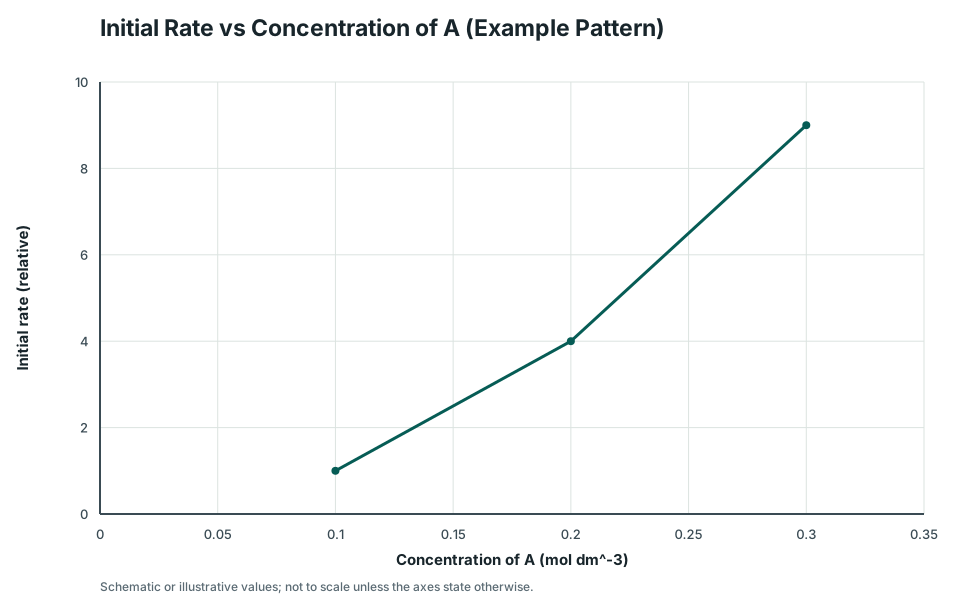
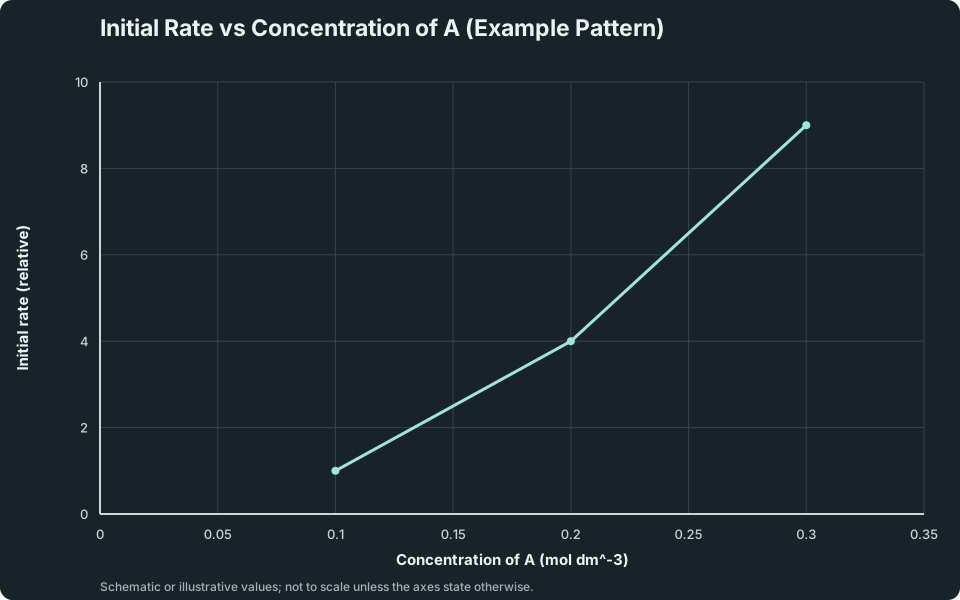
Quick visual (example where B is constant):
Initial Rate vs Concentration of A (Example Pattern)
Initial Rate vs Concentration of A (Example Pattern). Example data plotted as Initial rate against Concentration of A.
Scroll across the graph to read all labels.
View figure data
| Concentration of A (mol dm^-3) | Example data |
|---|---|
| 0.1 | 1 |
| 0.2 | 4 |
| 0.3 | 9 |
Detailed Explanations
A. Workflow (always works)
- Write the general form: rate = k[A]^m[B]ⁿ.
- Pick two experiments where only [A] changes: rate₂/rate₁ = ([A]₂/[A]₁)^m Solve for m.
- Pick two experiments where only [B] changes and solve for n.
- Write the full rate equation with your m and n.
- Substitute one experiment to find k (and units).
B. Full example (two reactants)
Data:
| Experiment | [A] / mol dm⁻³ | [B] / mol dm⁻³ | Initial rate / mol dm⁻³ s⁻¹ |
|---|---|---|---|
| 1 | 0.10 | 0.10 | 2.0 × 10⁻³ |
| 2 | 0.20 | 0.10 | 8.0 × 10⁻³ |
| 3 | 0.10 | 0.30 | 6.0 × 10⁻³ |
Find order in A (compare 1 → 2; B constant):
So 4 = 2^m ⇒ m = 2.
Find order in B (compare 1 → 3; A constant):
So 3 = 3ⁿ ⇒ n = 1.
Rate equation: rate = k[A]²[B]
Find k (use experiment 1):
Overall order is 3, so k units are dm⁶ mol⁻²s⁻¹.
C. How initial rates are measured
Choose a measurable property that changes as the reaction proceeds, such as gas volume, mass, colour intensity, pH or concentration. Keep temperature and every starting concentration except the one being investigated constant.
- Prepare the reactant mixtures and bring them to the chosen temperature.
- Start the reaction in a repeatable way, mix promptly and start timing immediately.
- Record the chosen property at short, regular intervals near t = 0.
- Plot the measured quantity against time. Draw a tangent at t = 0; its gradient gives the initial rate after applying any required stoichiometric conversion.
- Repeat the experiment and compare the initial gradients. Investigate an anomalous run instead of silently discarding it.
For a clock reaction, a fixed visual endpoint can compare relative initial rates when only a small, constant amount has reacted. Then initial rate ∝ 1/t. This shortcut is only valid when the same endpoint and total conditions are used each time.
Match the method to the chemistry. A gas syringe is useful only when a gas is formed and retained; mass loss works only when material leaves the apparatus; colorimetry needs a coloured species and a suitable calibration or absorbance relationship.
Worked Examples
Modelled example 1
Deduce an order from factor data
Problem
Study the worked solution
Write the factor equation
Method
Raise the concentration factor 2 to the unknown order m.Reason
Only A changes, so its rate-law term accounts for the full rate factor.Working
2^m = 8.Match powers
Method
Express 8 as a power of 2.Reason
8 = 2³.Working
m = 3: the reaction is third order in A.
Guided practice 2
Deduce a fractional order
Problem
Try this before viewing the solution
Hints
Hint 1: translate the factors
Hint 2: use a common base
View solution step by step
Set up the relationship
Method
Equate B’s concentration factor raised to n with the rate factor.Reason
Only B changes.Working
4ⁿ = 2.Solve
Method
Rewrite 4ⁿ as 2²ⁿ.Reason
Equal bases allow their powers to be equated.Working
2n = 1, so n = 1/2.
Common misconception 3
Correct an uncontrolled row comparison
Learner method
Assess the evidence
View solution step by step
Expose the confounding
Method
Write the rate factor as 2^m2ⁿ.Reason
Both concentration changes contribute to the observed factor 8.Working
2^(m + n) = 8, so only m + n = 3 follows.Request isolating evidence
Method
Compare a pair where A changes while B is constant, or vice versa.Reason
Holding one variable fixed allows the other order to be assigned independently.Working
The individual order in A is not determined by the mixed comparison alone.
Examiner practice 4
Deduce a rate equation from initial-rate data
Problem
Try this before viewing the solution
View solution step by step
Choose A comparison
1 markMethod
Compare experiments 1 and 2, where B is constant.Reason
Only A’s concentration term can explain the rate change.Working
A doubles while rate becomes four times larger.Deduce A order
1 markMethod
Solve 2^m = 4.Reason
The concentration factor raised to the order equals the rate factor.Working
m = 2.Choose B comparison
1 markMethod
Compare experiments 1 and 3, where A is constant.Reason
This isolates B’s effect.Working
B doubles while rate doubles.Deduce B order
1 markMethod
Solve 2ⁿ = 2.Reason
The observed factors match directly.Working
n = 1.Write the equation
1 markMethod
Insert both experimentally deduced powers.Reason
A complete rate equation includes k.Working
rate = k[A]²[B].
Self-mark with the mark scheme
Compare your response with each mark point. Select a point only when your response contains that evidence.
Credit controlled comparisons, both orders and the complete rate equation.
Challenge 5
Predict a new initial rate
Problem
Try this before viewing the solution
Hints
Hint 1: calibrate k
Hint 2: apply the calibrated law
View solution step by step
Calculate k
Method
Rearrange and substitute the calibration experiment.Reason
The established orders make k the only unknown.Working
k = (1.20 × 10⁻³)/(0.100)²(0.200) = 0.600 dm⁶ mol⁻²s⁻¹.Predict the new rate
Method
Insert the new concentrations into the same rate law.Reason
k is unchanged at the same temperature.Working
rate = 0.600(0.150)²(0.300) = 4.05 × 10⁻³ mol dm⁻³s⁻¹.
Mind Stretchers
Mind stretcher 1Extension
The rate equation has the form rate = k[A]^m[B]ⁿ. Between two experiments, [A] increases by a factor of 2.0 and [B] decreases by a factor of 2.0, but the rate stays the same. Deduce the relationship between m and n.
Show Hint
Use pairs that isolate one changing concentration; do not compare a row where two reactants change at once.
Show Answer
Mark scheme:
- Rate ratio is 1: 1 = ([A]₂/[A]₁)^m([B]₂/[B]₁)ⁿ = (2)^m(1/2)ⁿ
- So 2^m = 2ⁿ ⇒ m = n.
Mind stretcher 2: Resolving a mixed comparisonExtension
Question. From experiment 1 to 2, [A] doubles at fixed [B] and rate quadruples. From 2 to 3, [A] halves and [B] triples while rate changes by a factor 3/4. Deduce both orders.
Show Hint
Find the order in A first, then remove its factor of (1/2)² from the second comparison.
Show Answer
A is second order because doubling it quadruples rate. In the second comparison A contributes 1/4; the observed factor is 3/4, so B contributes 3 when tripled and is first order.