Activation Energy and Boltzmann Distribution
Explain temperature effects and catalyst action.
On this page
Temperature and catalysts are the two “rate boosters” examiners love to test. The mark-scheme phrases are very specific: you must talk about the fraction of molecules with E ≥ Eₐ and the area beyond Eₐ on a Maxwell–Boltzmann distribution.
Use your course’s Reaction Kinetics topic navigation to connect the distribution to collision theory and catalysts. For further H2 study, Rate Equations, Orders, and Rate Constant connects rate measurements to quantitative models.
Definitions (Must Know)
A. Activation energy, Eₐ
The activation energy, Eₐ, is the minimum energy required for reactant particles to react successfully (reach the transition state).
B. Successful collision
A successful collision is a collision with energy at least Eₐ (and correct orientation, where relevant).
C. Maxwell–Boltzmann distribution
A Maxwell–Boltzmann distribution shows how the energies of particles are distributed at a given temperature. The area under the curve represents the total number (or fraction) of particles.
D. Catalyst (in kinetics)
A catalyst increases reaction rate by providing an alternative pathway with a lower activation energy, Eₐ.
Key Ideas (What Earns Marks)
- Increasing temperature increases average kinetic energy and collision frequency, but the main mark is:
- a larger fraction of molecules have E ≥ Eₐ
- so there are more successful collisions per unit time
- On the Maxwell–Boltzmann curve, higher temperature:
- shifts the distribution to higher energies and flattens it
- increases the area to the right of Eₐ
- A catalyst:
- lowers Eₐ (moves the Eₐ threshold left)
- increases the fraction with E ≥ Eₐ
- does not change the Maxwell–Boltzmann distribution at a fixed temperature
- Higher T → larger fraction of molecules have E ≥ Eₐ → more successful collisions → faster rate. - Catalyst → alternative pathway with lower Eₐ → larger fraction exceed Eₐ → faster rate.
Detailed Explanations
A. What to say about the distribution
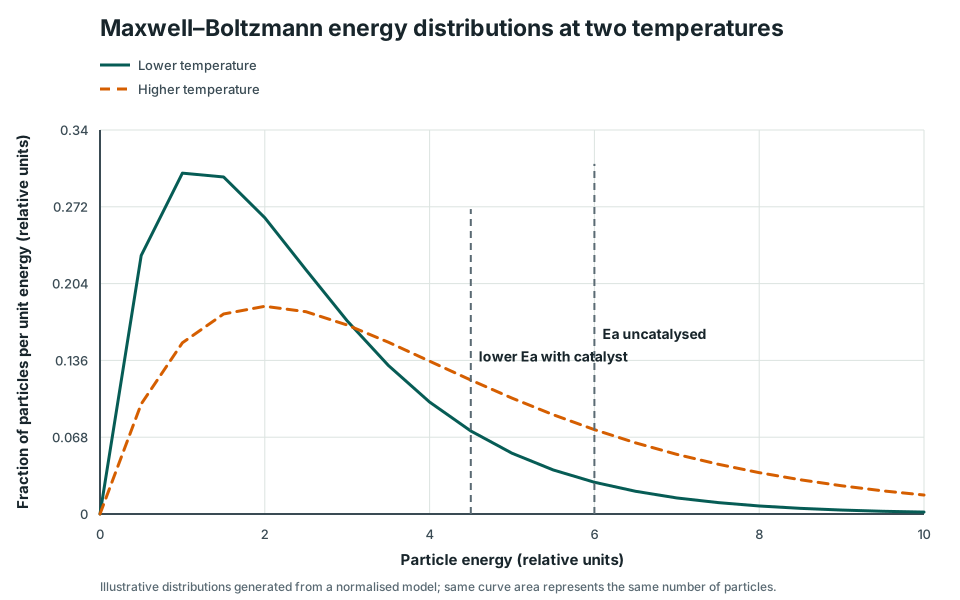
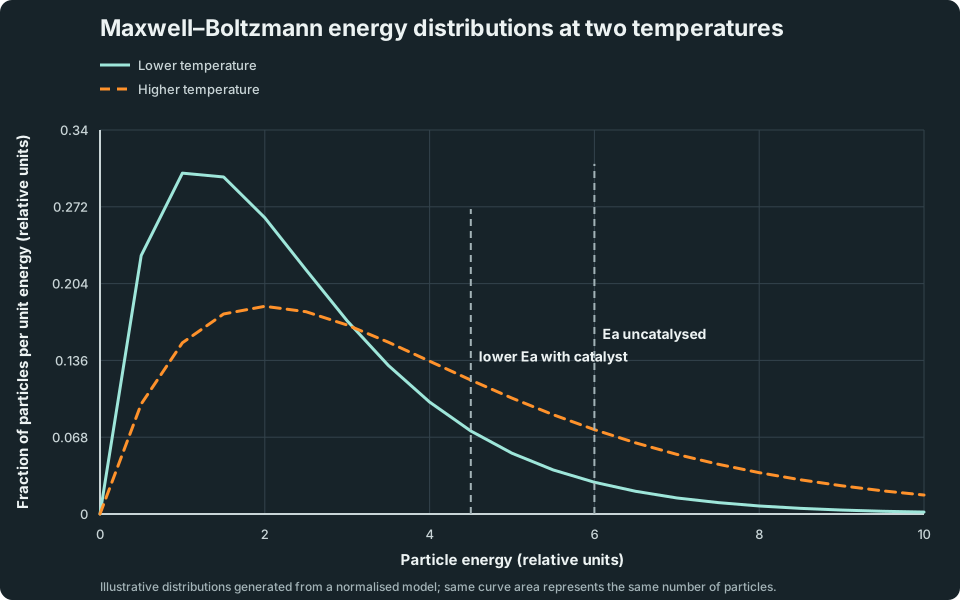
With higher temperature, the most probable energy moves to the right, the curve becomes broader and its peak becomes lower. The total area stays the same for the same number of particles, but the area beyond Eₐ increases.
Maxwell–Boltzmann energy distributions at two temperatures
A lower-temperature curve has a taller peak at lower energy. A higher-temperature curve is lower and broader. Uncatalysed and catalysed activation-energy thresholds mark the fractions energetic enough to react.
Scroll across the graph to read all labels.
View figure data
| Particle energy (relative units) | Lower temperature | Higher temperature |
|---|---|---|
| 0 | 0 | 0 |
| 0.5 | 0.2289 | 0.0974 |
| 1 | 0.3018 | 0.1516 |
| 1.5 | 0.2984 | 0.1771 |
| 2 | 0.2623 | 0.1839 |
| 2.5 | 0.2162 | 0.1791 |
| 3 | 0.171 | 0.1673 |
| 3.5 | 0.1315 | 0.1521 |
| 4 | 0.0991 | 0.1353 |
| 4.5 | 0.0735 | 0.1186 |
| 5 | 0.0538 | 0.1026 |
| 5.5 | 0.039 | 0.0879 |
| 6 | 0.0281 | 0.0747 |
| 6.5 | 0.0201 | 0.063 |
| 7 | 0.0142 | 0.0528 |
| 7.5 | 0.0101 | 0.0441 |
| 8 | 0.0071 | 0.0366 |
| 8.5 | 0.005 | 0.0303 |
| 9 | 0.0035 | 0.025 |
| 9.5 | 0.0024 | 0.0205 |
| 10 | 0.0017 | 0.0168 |
B. Why the area statement matters
Temperature does not increase every molecule’s energy by the same amount. Some particles lose energy in collisions while others gain it. The key change is that the fraction in the tail beyond Eₐ grows, so more particles are energetic enough to react.
C. Catalyst on the distribution
At the same temperature, the distribution curve stays the same, but the catalyst lowers Eₐ, so the “Eₐ line” moves left and the area beyond Eₐ increases.
Test these statements on moving particles: the simulation counts every collision and how many have at least Eₐ, beside the distribution for the same temperature.
B as a gas, 1.00 mol/dm³ of A at 25 °C, without a catalyst (Eₐ = 10 kJ/mol). Press play to start the particles moving.
- A–B collisions
- — /s
- Successful collisions
- — /s
- Fraction successful
- — %
- AB formed
- 0
- Exposed B particles
- 0
Try this
0 of 4 doneRun for 30 s at two concentrations, with everything else the same. (not done yet)
More particles in the same space collide more often, so there are more successful collisions each second. The fraction that succeeds does not change.
Run for 30 s, then raise the temperature by at least 40 °C and run again. (not done yet)
Collisions become only a little more frequent, but a larger fraction of them have energy ≥ Eₐ: the shaded area grows. That is the main reason the rate rises.
Run for 30 s without the catalyst and 30 s with it, at the same temperature. (not done yet)
The catalyst gives a pathway with a lower Eₐ. The particles have the same energies, but more of their collisions now have enough energy to react.
Compare one lump of B with the powder, running each for 30 s. (not done yet)
Only particles on the surface can be hit. The powder exposes more of the same solid, so there are more collisions, and more successful ones, each second.
Worked Examples
Modelled example 1
Explain the strong temperature effect on rate
Problem
Explain why raising temperature can increase reaction rate substantially even if collision frequency increases only slightly.
Study the worked solution
Describe the energy distribution
Method
State that higher temperature shifts the distribution toward higher energies.
Reason
Particle energies are redistributed rather than every particle receiving the same energy increase.
Working
A larger fraction of particles lies in the high-energy tail.
Compare with Ea
Method
Identify the increased area where E ≥ Eₐ.Reason
Those particles have enough energy for successful collisions.
Working
Fraction with E ≥ Eₐ increases significantly.
Link to rate
Method
State that successful collisions per unit time increase.
Reason
The energetic-fraction effect can be much larger than the modest collision-frequency increase.
Working
More successful collisions → faster reaction.
Guided practice 2
Describe a higher-temperature distribution
Problem
State the principal changes to a Maxwell–Boltzmann distribution when temperature increases, then link the changed area beyond Eₐ to reaction rate.
Try this before viewing the solution
Hints
Hint 1: describe the curve
The most probable energy moves right; the distribution becomes broader and its peak becomes lower.
Hint 2: preserve and partition area
For the same number of particles, total area stays constant, but more area lies to the right of the unchanged Eₐ line.
View solution step by step
Describe the new curve
Method
State that the curve broadens, lowers and shifts toward higher energies.
Reason
Higher temperature changes the spread and most probable particle energy.
Working
Lower peak; broader curve; most probable energy further right.
Track the relevant area
Method
State that the area beyond the fixed Eₐ line increases.
Reason
A larger fraction of particles now has at least the activation energy.
Working
Fraction with E ≥ Eₐ increases.Conclude
Method
Link that fraction to successful collisions per unit time.
Reason
More collisions meet the energy requirement.Working
Successful-collision frequency and reaction rate increase.
Common misconception 3
Correct a temperature–Ea claim
Learner claim
A learner says, “Heating speeds the reaction because temperature lowers the activation energy, moving the Eₐ line left.” Diagnose the error and describe the correct diagram change.
Choose what changes
View solution step by step
Keep the threshold fixed
Method
State that Eₐ is unchanged when only temperature changes.
Reason
The reaction pathway has not been replaced.Working
The Eₐ line stays in the same energy position.
Change the distribution
Method
Broaden and lower the curve, shifting its most probable energy right.
Reason
This increases the area beyond the unchanged threshold.
Working
Larger fraction with E ≥ Eₐ → faster rate.
Examiner practice 4
Explain a catalyst on a Boltzmann diagram
Problem
Try this before viewing the solution
View solution step by step
Preserve the distribution
1 markMethod
State that the Maxwell–Boltzmann curve remains unchanged.Reason
Temperature and particle number are unchanged.Working
Same distribution curve.Lower the threshold
1 markMethod
Move the activation-energy line left.Reason
The catalyst provides an alternative pathway with lower Eₐ.Working
E_(a,cat) < E_(a,uncat).Increase successful fraction
1 markMethod
Identify the larger area beyond the lower threshold.Reason
More particles now meet the energy requirement.Working
Fraction with E ≥ E_(a,cat) increases.Link to rate
1 markMethod
State that successful collisions per unit time increase.Reason
A larger eligible fraction can react.Working
Reaction rate increases.
Self-mark with the mark scheme
Compare your response with each mark point. Select a point only when your response contains that evidence.
Credit the unchanged curve, lower Ea, larger energetic fraction and rate link.
Challenge 5
Separate cooling and catalyst effects
Problem
A reacting mixture is cooled while a catalyst is added. Explain the separate changes on a Maxwell–Boltzmann diagram and decide whether the overall rate change can be predicted qualitatively without further data.
Try this before viewing the solution
Hints
Hint 1: separate curve and threshold
Cooling changes the distribution; the catalyst changes the activation-energy threshold.
Hint 2: compare directions
Cooling reduces the energetic fraction, while lowering Eₐ increases it. No sizes are supplied.
View solution step by step
Analyse cooling
Method
Shift the distribution toward lower energies, making it narrower with a higher peak.
Reason
A smaller fraction lies beyond the original Eₐ.
Working
Cooling alone lowers the successful-collision fraction and rate.
Analyse the catalyst
Method
Move the activation-energy threshold left without attributing that move to temperature.
Reason
The alternative pathway has lower Eₐ.Working
Catalyst alone increases the fraction above the threshold and rate.
Judge the combined outcome
Method
State that the two changes have opposing rate effects.
Reason
The qualitative diagram does not quantify which change dominates.
Working
The net rate change cannot be determined without further quantitative information.
Common Mistakes
- Saying ‘temperature increases Eₐ’ (it doesn’t; it changes the fraction above Eₐ).
- Saying catalysts increase collision frequency as the main mechanism (the key mark is lower Eₐ pathway).
- Describing Maxwell–Boltzmann curves without mentioning ‘area beyond Eₐ’.
Use the topic check in Practise and check below to practise and check your understanding.
Exam Tips
- For Maxwell–Boltzmann, don’t say ‘molecules have more energy’ — say ‘a larger fraction has E ≥ Eₐ’.
- Catalyst questions: catalyst lowers Eₐ; it does not change Δ H or the position of equilibrium.
- Temperature increase shifts the distribution to higher energies and increases collision frequency.
Mind Stretchers
Mind stretcher 1Extension
Two reactions at the same temperature have different activation energies: E_(a,1) > E_(a,2). Without doing calculations, explain which reaction is faster and why, using Maxwell–Boltzmann language.
Show Hint
Temperature changes the distribution; a catalyst changes the threshold. Distinguish those two diagrams.
Show Answer
Mark scheme:
- For the lower Eₐ reaction (E_(a,2)), the Eₐ threshold is smaller.
- Therefore the area under the distribution curve with E ≥ Eₐ is larger.
- A larger fraction of molecules have enough energy for successful collisions, so the rate is higher.
Mind stretcher 2: Same rate increase, different causeExtension
Question. Two changes each increase rate. Change X moves the Eₐ line left without changing the distribution; change Y broadens and lowers the distribution peak while keeping Eₐ fixed. Identify each change and explain the larger successful fraction.
Show Hint
A catalyst changes the pathway. Temperature changes the particles’ energy distribution.
Show Answer
X is adding a catalyst: its alternative pathway has lower Eₐ. Y is increasing temperature: a larger area lies beyond the unchanged Eₐ. In both cases a larger fraction of collisions can overcome the activation barrier.
Syllabus and review details
- GCE A-Level H2 Chemistry 9476-2027 · 9476-2027
9476 (2027), complete syllabus
Last reviewed: