Alkane Structures and Isomers
Draw and name the C1–C4 alkanes, use their general formula, explain physical trends, and distinguish the two C4 structural isomers.
On this page
How can two compounds have the same numbers of carbon and hydrogen atoms but different structures? Build the first four alkanes, then compare their connections rather than the way a drawing is turned on the page.
Recognise a saturated hydrocarbon
Alkanes
Alkanes are open-chain saturated hydrocarbons. They contain carbon and hydrogen only, with single bonds between the carbon atoms. “Open-chain” means the carbon skeleton contains no ring; it may be unbranched or branched.
What saturated means
A saturated hydrocarbon has no carbon–carbon multiple bonds. Methane has one carbon atom and four hydrogen atoms, so it has no carbon–carbon bond at all; it is still saturated and belongs to the alkane series.
Count atoms, then check connections
Alkanes follow CₙH₂ₙ₊₂, where n is the carbon count. This formula counts atoms; it does not specify how the carbons are connected.
When drawing an alkane, give each carbon four bonds and each hydrogen one bond. A line between two atoms represents one shared pair of electrons: a single covalent bond.
Build the C1–C4 structures
Methane, ethane and propane
Build the first three alkanes
Methane has one carbon bonded to four hydrogens. Ethane has two carbons joined by a single bond, each carrying three hydrogens. Propane has three carbons in one chain, with CH3 ends and a CH2 middle.
Scroll across the graph to read all labels.
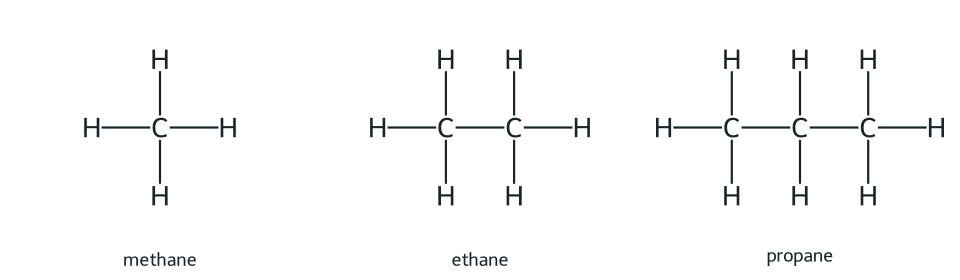
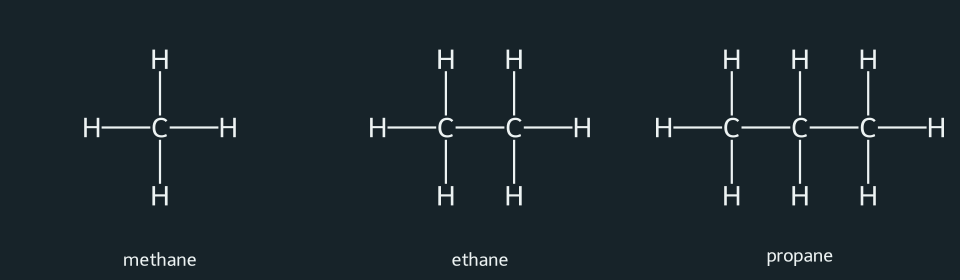
View figure data
| Alkane | Molecular formula | Carbon–carbon bonds | Hydrogen atoms |
|---|---|---|---|
| methane | CH4 | none | 4 |
| ethane | C2H6 | 1 single | 6 |
| propane | C3H8 | 2 single | 8 |
| Carbon atoms | Name | Molecular formula | Condensed structural formula |
|---|---|---|---|
| 1 | Methane | CH₄ | CH₄ |
| 2 | Ethane | C₂H₆ | CH₃-CH₃ |
| 3 | Propane | C₃H₈ | CH₃-CH₂-CH₃ |
For propane, n = 3 gives 2n + 2 = 8 hydrogens. Adding one carbon and two hydrogens gives the next molecular formula, C₄H₁₀.
Butane and its branched isomer
Two ways to connect four carbon atoms
Butane has a single path of four carbons, with CH3 ends and two CH2 middle groups. Methylpropane has a central CH bonded to three CH3 groups.
Scroll across the graph to read all labels.
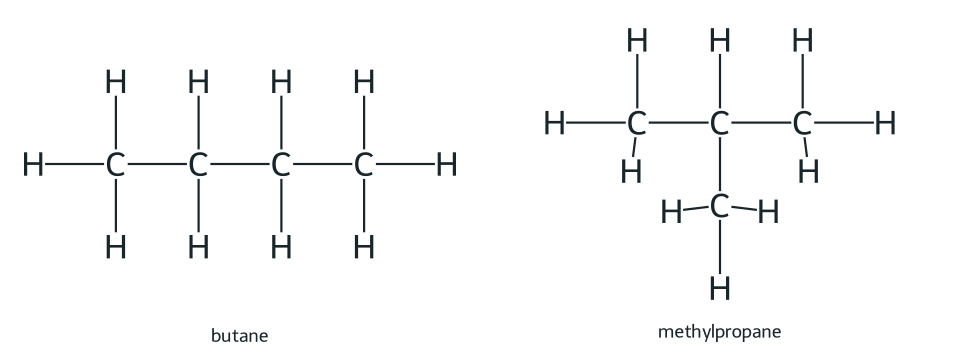
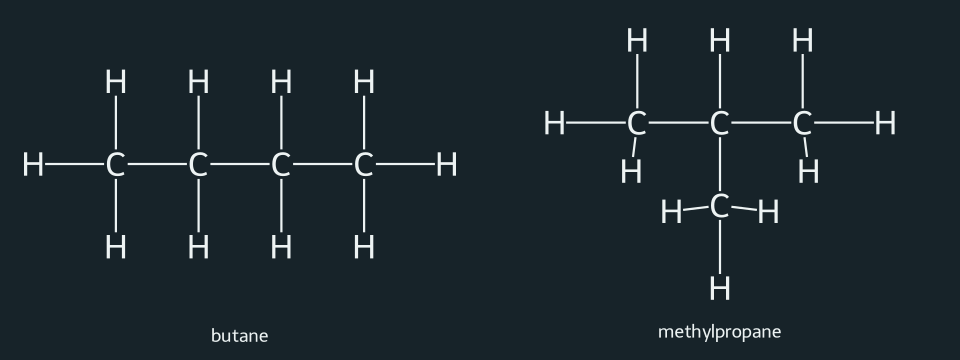
View figure data
| Molecule | Molecular formula | Carbon skeleton | Hydrogens on carbon groups |
|---|---|---|---|
| butane | C4H10 | One path of four carbons | Two CH3 and two CH2 groups |
| methylpropane | C4H10 | Central carbon joined to three outer carbons | One CH and three CH3 groups |
Butane’s condensed formula is CH₃-CH₂-CH₂-CH₃. The branched structure can be written CH₃-CH(CH₃)-CH₃: the bracketed CH₃ is attached to the middle carbon, not added to the end.
Learn the unbranched names methane, ethane, propane and butane. The branched name, methylpropane, is supplied here to distinguish the pair. “Straight-chain” often means unbranched; a zigzag drawing can still represent an unbranched chain.
Read the physical trend
Normal Boiling Points of the First Four Alkanes
Approximate normal boiling points at one atmosphere: methane −161.5 °C, ethane −88.6 °C, propane −42.1 °C and butane −0.5 °C. Carbon count is plotted horizontally.
Scroll across the graph to read all labels.


View figure data
| Number of carbon atoms (unitless) | Unbranched alkanes |
|---|---|
| 1 | -161.5 |
| 2 | -88.6 |
| 3 | -42.1 |
| 4 | -0.5 |
The graph uses approximate normal boiling points from the NIST Chemistry WebBook for methane, ethane, propane and butane, converted to degrees Celsius and rounded. The pressure is one atmosphere.
Boiling point rises across these unbranched alkanes. Larger molecules generally have stronger intermolecular attractions, so separating the molecules requires more energy. Boiling does not break their carbon–carbon covalent bonds.
All four boiling points are below ordinary room temperature, so these substances are gases at room temperature and atmospheric pressure. For liquid members farther along the series, viscosity also generally rises with molecular size. Do not describe gaseous methane as a thick or runny liquid.
Add one CH₂ at a time to watch the formula and boiling point change along the series. Then try the alcohols with the same chain lengths.
Methane, CH₄, structural formula CH₄. It boils at −161.5 °C.
- Molecular formula
- CH4
- General formula
- CnH2n+2
- Boiling point
- −161.5 °C
- Isomers seen
- 0 of 3
- Stereoisomers
- none
Try this
0 of 4 doneStep through the alkanes from one carbon atom to six. (not done yet)
Each member adds one CH₂. The general formula CₙH₂ₙ₊₂ fits them all, and the boiling point rises as the molecules get bigger.
Compare an alcohol with the alkane that has the same number of carbon atoms. (not done yet)
Alcohol molecules attract each other more strongly, through hydrogen bonds between their –OH groups, so an alcohol boils far higher than the alkane of the same size.
Find all the isomers of C₅H₁₂. (not done yet)
Pentane, 2-methylbutane and 2,2-dimethylpropane share C₅H₁₂. More branching means less contact between molecules, so the boiling point falls: 36 °C, 28 °C, 10 °C.
Find all the alkene isomers of C₄H₈. (not done yet)
The double bond can move along the chain, or the chain can branch. At A Level, but-2-ene also has cis and trans forms, because the C=C bond cannot rotate. C₄H₈ also forms two rings, cyclobutane and methylcyclopropane, which are not alkenes.
Same formula, different connectivity
Structural isomers have the same molecular formula but different structural formulae: their atoms are connected differently. Butane and methylpropane are isomers because both contain four C and ten H atoms, while their carbon skeletons differ.
Turning a drawing around, bending its layout, or writing a chain from the other end does not change which atoms are connected. It does not create another isomer.
Combustion belongs with the reactions
Study oxygen supply, products and balancing in Alkane Reactions.
Substitution belongs with the reactions
Alkane Reactions shows how UV light enables a hydrogen in methane to be replaced by chlorine.
Check the molecule, not its outline
- A bent carbon chain is not necessarily branched. Check whether a carbon is attached to more than two other carbons.
- A branch still counts towards the total number of carbon atoms.
- Equal molecular formulae are necessary for isomerism, but the connectivity must also differ.
A drawing check you can use
Count carbons, give each carbon four bonds, fill the remaining bonds with hydrogen, and total the atoms. Then compare the total with CₙH₂ₙ₊₂. Finally check whether another drawing shows new connections or just a new orientation.
Apply formulae and connectivity
Modelled example 1
Identify an alkane from formula
Problem
Study the worked solution
Substitute the carbon number
Method
Set n = 4 in CₙH₂ₙ₊₂.Reason
The subscript on carbon gives the value of n.Working
2n + 2 = 2(4) + 2 = 10.Compare the formula
Method
Compare the predicted and given hydrogen subscripts.Reason
A matching molecular formula is consistent with the alkane homologous series.Working
C₄H₁₀ fits CₙH₂ₙ₊₂; therefore it is an alkane.
Common misconception 2
Correct an isomer claim
Learner claim
Compare molecular and structural formulae
View solution step by step
Compare atom counts
Method
Show that both compounds have molecular formula C₄H₁₀.Reason
Isomers must contain the same numbers of each type of atom.Working
Butane: C₄H₁₀; methylpropane: C₄H₁₀.Compare connectivity
Method
State that their structural formulae are different.Reason
Butane is unbranched while methylpropane has a branched carbon skeleton.Working
Same molecular formula + different structural formulae → structural isomers.
Guided practice 3
Draw the two C4 alkane isomers
Guided drawing
Keep the formula while changing the carbon skeleton
Hints
Hint 1: straight then branched
Hint 2: count atoms
View solution step by step
Draw and name the straight chain
Method
Place all four carbon atoms in one continuous chain.Reason
The required unbranched name for C₄H₁₀ is butane.Working
butane: CH₃-CH₂-CH₂-CH₃.Draw the branched structure
Method
Use a three-carbon chain with the fourth carbon attached to the middle carbon.Reason
The atoms are connected differently while the molecular formula remains C₄H₁₀.Working
CH₃-CH(CH₃)-CH₃; this is the branched isomer.
Balance combustion in the reaction lesson
The propane-combustion example has moved beside the combustion explanation.
Explain substitution in the reaction lesson
The chlorine-substitution example has moved beside the substitution explanation.
Try without prompts
Mind stretcher 1: Which structures form an isomer pair?Extension
Compare A: CH₃CH₂CH₃, B: CH₃CH(CH₃)CH₃ and C: CH₃CH₂CH₂CH₃. Work out each molecular formula, identify an isomer pair, and explain why the remaining compound is not an isomer of that pair. Would writing C from right to left create a fourth compound?
Show answer
A is C₃H₈; B and C are both C₄H₁₀. B and C are structural isomers: B has a branched carbon skeleton and C is unbranched. A has a different molecular formula, so it is not their isomer. Reversing C’s drawing gives the same atom connections and the same butane molecule.
Mind stretcher 2: Spot the wrong testExtension
Question: A student says: “Propane decolourises bromine water because it is a hydrocarbon.” Explain why this is wrong.
Show answer
Propane is saturated: it has no C = C double bond. Being a hydrocarbon is not enough to decolourise bromine water. In the usual test, away from UV light, propane does not decolourise it.
Check the combustion hazard
The carbon-monoxide question is now with the reaction explanation.
Practise and check
Use the Organic Chemistry topic check to practise and check your understanding.
Syllabus and review details
- SEC G3 Pure Chemistry 2027 · 2027
Content structure and subject content, PDF pages 9–24
Last reviewed: