Atomic Orbitals: Energies and Shapes
Compare s, p and d orbitals by number, energy and shape, including the order of 4s and 3d.
On this page
At A Level, an orbital is not a circular electron path. Orbital questions test (i) how many s, p and d orbitals exist, (ii) their relative energies and (iii) their shapes—including the exceptional d_z² shape. Use those ideas next in orbital filling and electron configuration. Return to the Atomic Structure hub when you need the full lesson sequence.
Definitions (Must Know)
A. Orbital
An orbital is a region of space around the nucleus in which there is a high probability of finding an electron. Each orbital can hold up to two electrons with opposite spins.
B. Shell (principal quantum number, n)
A shell is an energy level labelled by n = 1, 2, 3, ….
C. Subshell (s, p, d)
A subshell is a set of orbitals of the same type within a shell (e.g. 3p is a subshell inside the n = 3 shell).
Key Ideas (What Earns Marks)
- s, p, d subshells contain 1, 3, 5 orbitals respectively.
- Each orbital holds a maximum of 2 electrons → s holds 2, p holds 6, d holds 10.
- For the same shell (n): s < p < d in energy (s is lowest energy).
- For atomic structure questions you must know the relative order: 1s < 2s < 2p < 3s < 3p < 4s < 3d < 4p.
Detailed Explanations
A. How many orbitals exist in each subshell?
| Subshell | Number of orbitals | Maximum electrons |
|---|---|---|
| s | 1 | 2 |
| p | 3 | 6 |
| d | 5 | 10 |
So for principal quantum numbers 1–3 (and the required 4s/4p):
| Shell (n) | Subshells present (A Level) | Total orbitals in shell | Maximum electrons in shell |
|---|---|---|---|
| 1 | 1s | 1 | 2 |
| 2 | 2s, 2p | 4 | 8 |
| 3 | 3s, 3p, 3d | 9 | 18 |
You also need to know that 4s and 4p orbitals exist, and their relative energies appear in the common filling order used for electron configurations (see below).
B. Relative energies (what you need to memorise)
Two exam-safe rules for the multi-electron atoms considered here:
- Higher n generally means higher energy.
- For the same n: s < p < d.
The common energy order you use for electron configurations (up to 4p) is: 1s < 2s < 2p < 3s < 3p < 4s < 3d < 4p
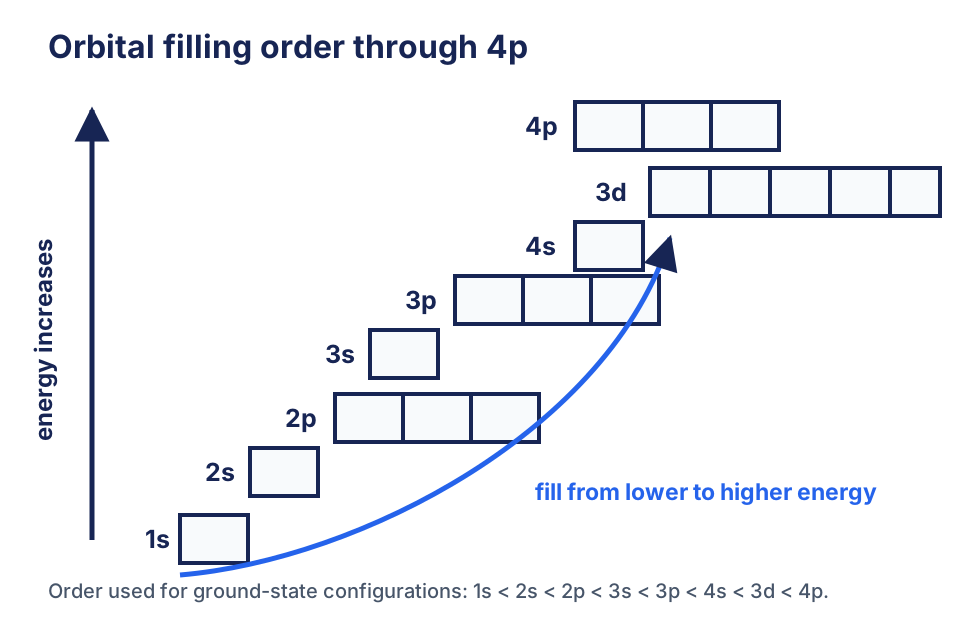
Use 4s before 3d when building the configurations of neutral atoms. Once 3d is occupied, the relative energies change; transition-metal cations therefore lose 4s electrons before 3d electrons. Apply the configuration rules in Orbitals and Electron Configuration rather than assuming 4s is always lower in energy.
C. Shapes (what to write in “describe the shape” questions)
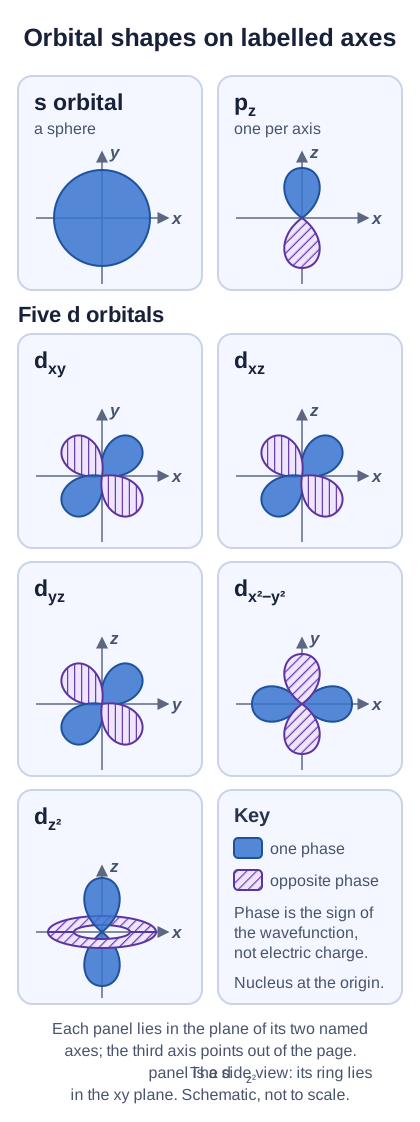
- s orbital: spherical.
- p orbital: two-lobed “dumbbell” (three orientations in space, so there are 3 p orbitals in a p subshell).
- d orbitals: d_xy, d_xz, d_yz and d_(x²-y²) have four-lobed shapes. The fifth, d_z², has two lobes with a torus (ring) around the centre.
The different orientations do not create extra orbitals: a p subshell has three orbitals in total, and a d subshell has five.
Worked Examples
Modelled example 1
State p-Subshell Capacity
Problem
State (a) the number of orbitals and (b) the maximum number of electrons in a p subshell.
Study the worked solution
Recall the orbital count
Method
State that a p subshell contains three orbitals.Reason
The three p orbitals have different spatial orientations.
Working
Number of p orbitals = 3.Calculate the capacity
Method
Multiply the orbital count by two electrons per orbital.
Reason
Each orbital holds a maximum of two electrons.Working
Maximum electrons = 3 × 2 = 6.
Guided practice 2
Build the Capacity of the Third Shell
Problem
List the subshells present in the n = 3 shell and state the maximum number of electrons that can occupy the n = 3 shell.
Try this before viewing the solution
Hints
Hint 1: list the subshell types
For n = 3, include s, p and d subshells.
Hint 2: sum their capacities
Use capacities 2, 6 and 10.
View solution step by step
List the subshells
Method
Attach the principal-shell number to s, p and d.Reason
Those are the subshell types present in the n = 3 shell.
Working
3s, 3p and 3d.Add their capacities
Method
Add the maximum electron counts for one s, one p and one d subshell.
Reason
The shell capacity is the sum of all its subshell capacities.
Working
2 + 6 + 10 = 18 electrons.
Common misconception 3
Correct an Orbital-Energy Order
Learner attempt
Asked to put 3p, 4s, 3d and 4p in increasing energy order for a neutral atom, a learner writes 3p < 3d < 4s < 4p because every orbital with n = 3 must be lower than every orbital with n = 4. Identify the error and give the required order.
Choose the required middle order
View solution step by step
Reject the single-number rule
Method
Use the memorised multi-electron energy ladder rather than sorting only by n.Reason
Subshell type also affects relative energy, and 4s fills before 3d in the required neutral-atom sequence.Working
3p < 4s < 3d < 4p.
Examiner practice 4
Describe the Five d Orbitals
Problem
Describe the shapes of the five d orbitals without drawing them. [3 marks]
Try this before viewing the solution
View solution step by step
Identify the four-lobed set
2 marksMethod
Name d_xy, d_xz, d_yz and d_(x ⁽2 - y) ²) as four-lobed.
Reason
These four share the required four-lobed description, with different orientations.
Working
d_xy, d_xz, d_yz, d_(x ⁽2 - y) ²): four lobes.
Describe the exception
1 markMethod
Describe d_(z ²) as two lobes along the z-axis with a torus around the centre.
Reason
This distinguishes its required shape from the other four d orbitals.
Working
d_(z ²): two axial lobes plus a central ring.
Self-mark with the mark scheme
Compare your response with each mark point. Select a point only when your response contains that evidence.
Credit the four-lobed family, its membership and the complete dz² description.
Challenge 5
Infer a Shell from Its Orbital Count
Problem
Within the required n = 1 to n = 3 shells, a complete shell contains nine orbitals in total. Deduce the subshells present, identify the shell and state its maximum electron capacity.
Try this before viewing the solution
Hints
Hint 1: build nine orbitals
Use s, p and d orbital counts of 1, 3 and 5.
Hint 2: convert orbitals to capacity
Each of the nine orbitals holds at most two electrons.
View solution step by step
Reconstruct the subshell set
Method
Combine one s, three p and five d orbitals.Reason
1 + 3 + 5 = 9, matching the total orbital count.Working
The shell contains s, p and d subshells.Identify the shell
Method
Choose the first required shell that contains s, p and d.
Reason
The n = 3 shell contains 3s, 3p and 3d.Working
The shell is n = 3.Find the capacity
Method
Multiply nine orbitals by two electrons per orbital.
Reason
Every orbital has the same maximum occupancy.Working
9 × 2 = 18 electrons.
Common Mistakes
- Treating every orbital in one shell as identical. The shell label n = 3 groups 3s, 3p and 3d, but it does not give them one energy or shape. In a many-electron atom, these subshells have different relative energies: a 3s orbital is spherical, a 3p orbital is two-lobed, and 3d orbitals have the d shapes shown above. Orbitals within one subshell, such as the three 3p orbitals, have the same energy but point in different directions. Compare the subshell letters as well as n before describing an orbital.
- Describing orbitals as circular “electron orbits” around the nucleus.
- Saying p has 2 orbitals (p has 3 orbitals) or d has 4 orbitals (d has 5 orbitals).
- Drawing every d orbital as a four-lobed clover and forgetting the d_z² two-lobes-plus-torus shape.
- Forgetting that a d subshell exists starting at n = 3 (3d is part of the n = 3 shell).
- Mixing up filling order (4s before 3d) with removal from transition ions (4s removed first).
Check the distinction with n = 2: would a 2s orbital and a 2p orbital have the same energy and shape? Explain your answer before opening the check.
Check your answer
No. They share the n = 2 shell, but 2s and 2p are different subshells. In a many-electron atom, 2s is lower in energy than 2p; 2s is spherical while 2p is two-lobed. The three 2p orbitals have equal energy within that subshell and differ in orientation.
Then use the worked examples and practice below to apply orbital counts, shapes and energy order without relying on the shell number alone.
Exam Tips
- If the question says “state the number”, just write: s = 1 orbital, p = 3, d = 5.
- For “shape” questions, state spherical for s and two-lobed for p. For d, distinguish the four four-lobed orbitals from d_z² (two lobes and a torus).
- If you use the energy order in a configuration answer, always write it from low → high energy (don’t invent a new order).
Mind Stretchers
Mind stretcher 1Extension
Explain why the 3p subshell contains three orbitals, but the 3s subshell contains only one orbital.
Show Answer
Mark scheme:
- A p subshell consists of 3 orbitals (three orientations in space), while an s subshell consists of 1 orbital.
- Therefore 3p has 3 orbitals but 3s has 1.
Mind stretcher 2Extension
A student says: “The 3d subshell is part of the 4th shell because 4s fills first.” Explain why this statement is wrong.
Show Answer
Mark scheme:
- The label 3d means principal quantum number n = 3, so 3d belongs to the 3rd shell.
- The fact that 4s fills before 3d is about relative energy, not which shell the subshell belongs to.
Syllabus and review details
- GCE A-Level H2 Chemistry 9476-2027 · 9476-2027
9476 (2027), complete syllabus
Last reviewed: