Bond Energy, Bond Length and Bond Polarity
Relate bond energy, length and electronegativity to bond polarity, molecular polarity and reactivity.
On this page
When examiners ask “compare reactivity”, they often want you to talk about how easy it is to break a specific covalent bond. Three keywords do most of the work: bond energy, bond length, and bond polarity. Connect bond polarity to whole-particle behaviour in intermolecular forces and properties in your course’s topic navigation.
Definitions (Must Know)
A. Bond energy
The bond energy is the energy required to break one mole of a particular covalent bond in gaseous molecules (units: kJ mol⁻¹).
B. Bond length
The bond length is the distance between the nuclei of two bonded atoms (usually in pm).
C. Electronegativity
Electronegativity is the ability of an atom to attract the bonding pair of electrons in a covalent bond.
D. Bond polarity
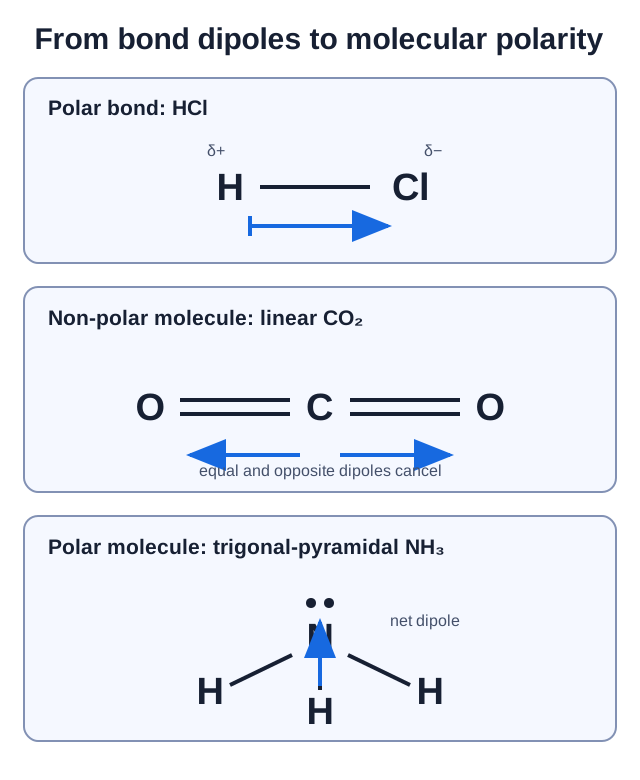
A polar covalent bond is a covalent bond where electrons are shared unequally due to an electronegativity difference, giving partial charges δ⁺ and δ⁻.
E. Molecular polarity
A molecule is polar when its bond dipoles have a non-zero resultant. Both bond polarity and three-dimensional molecular shape must be considered.
Key Ideas (What Earns Marks)
- Higher bond energy → bond is stronger → harder to break → generally less reactive (for reactions that require bond breaking).
- Longer bond length → poorer orbital overlap → bond is weaker → easier to break → generally more reactive.
- Higher bond order (triple > double > single) → shorter bond length and higher bond energy.
- Bond polarity matters in reactions involving heterolytic bond breaking and attack by polar reagents (partial charges guide which end is attacked).
- Molecular polarity is the vector sum of all bond dipoles; shape determines whether they cancel.
Bond energies are often tabulated as mean (average) bond enthalpies (gaseous). For calculations, see Bond Enthalpy Calculations in your course’s topic navigation.
Detailed Explanations
A. Bond order, bond length, bond energy (the core link)
More shared electron density between two nuclei usually means:
- the bond is shorter (nuclei can sit closer),
- the bond is stronger (more attraction),
- the bond energy is higher.
Typical order for the same two atoms:
| Bond type | Bond length | Bond energy |
|---|---|---|
| single | longest | lowest |
| double | shorter | higher |
| triple | shortest | highest |
B. Why a longer bond is usually weaker
If the bonded atoms are further apart, the orbital overlap is less effective, so the attraction between the nuclei and the bonding electrons is weaker. Therefore less energy is needed to break the bond.
C. Bond polarity and “which end reacts”
If one atom is more electronegative, it pulls the bonding pair towards itself:
- more electronegative atom becomes δ⁻
- less electronegative atom becomes δ⁺
In many reactions (especially in organic chemistry), a nucleophile is attracted to a δ⁺ atom, and an electrophile is attracted to a δ⁻ / electron-rich region. So bond polarity can help you predict where a reagent attacks.
D. Deducing molecular polarity
Use this two-stage test:
- Decide whether the bonds are polar from electronegativity differences.
- Use the molecular shape to decide whether the bond-dipole vectors cancel.
Examples:
- CO₂ is linear: the two equal C = O dipoles oppose and cancel, so the molecule is non-polar.
- BF₃ is trigonal planar and symmetrical: the three B–F dipoles cancel, so the molecule is non-polar.
- NH₃ is trigonal pyramidal: its N–H dipoles do not cancel, so the molecule is polar.
- H₂O is bent: its O–H dipoles do not cancel, so the molecule is polar.
Turn each molecule to see its bond dipoles add up. Compare CCl₄ with CHCl₃: one bond changes and the dipoles no longer cancel.
CHCl₃, trichloromethane: 4 bond pairs, 0 lone pairs around C. The electron-pair geometry is tetrahedral; the shape is tetrahedral with a bond angle of 111.5°. The bond dipoles do not cancel: the molecule is polar.
- Around the central atom
- 4 bond pairs, 0 lone pairs
- Electron-pair geometry
- tetrahedral
- Shape
- tetrahedral
- Bond angle
- 111.5°
- Molecule
- polar
Try this
0 of 4 doneTurn NH₃ so that its lone pair points straight at you. (not done yet)
The lone pair takes the fourth corner of a tetrahedron, so the three N–H bonds point away from it like the legs of a tripod.
Compare CH₄, NH₃ and H₂O. (not done yet)
Each has four electron pairs. Lone pairs repel more strongly than bond pairs, so every lone pair squeezes the bonds closer: 109.5°, 107°, 104.5°.
Turn BF₃ to look at it edge on. (not done yet)
Edge on, BF₃ is a straight line: all four atoms lie in one plane, with the three bond pairs 120° apart.
Find a molecule with polar bonds and no net dipole, and one with a net dipole. (not done yet)
Polar bonds make a polar molecule only when the shape does not let their dipoles cancel.
Worked Examples
Modelled example 1
Define Bond Length and Bond Energy
Problem
State what is meant by (a) bond length and (b) bond energy.
Study the worked solution
Define bond length
Method
State the measured separation between the two nuclei.
Reason
The definition concerns nuclear positions in a bonded pair, not atom size alone.
Working
Bond length: distance between the nuclei of two bonded atoms.
Define bond energy
Method
Include energy, one mole, the specified covalent bond and gaseous molecules.
Reason
Each qualifier is part of the operational definition.
Working
Bond energy: energy required to break one mole of a particular covalent bond in gaseous molecules.
Guided practice 2
Compare Carbon Dioxide and Water Polarity
Problem
CO₂ and H₂O both contain polar bonds. Deduce the polarity of each molecule.
Try this before viewing the solution
Hints
Hint 1: name each shape
Carbon dioxide is linear; water is bent.
Hint 2: combine the dipoles
Ask whether the bond-dipole vectors cancel in each geometry.
View solution step by step
Analyse carbon dioxide
Method
Place two equal C=O dipoles in opposite directions along a line.
Reason
The linear symmetrical geometry makes their vector sum zero.
Working
CO₂: dipoles cancel; molecule is non-polar.
Analyse water
Method
Place the two O–H dipoles in a bent geometry.Reason
The vectors are not opposite and therefore do not cancel.
Working
H₂O: non-zero resultant dipole; molecule is polar.
Common misconception 3
Correct a Carbon–Carbon Bond Comparison
Learner claim
Asked which is shorter and stronger, C - C or (C = C), a learner says, “The double bond is longer because it contains more electron density between the atoms.” Identify the error and give the correct comparison.
Choose the correct comparison
View solution step by step
Correct the effect of bond order
Method
State that the double bond has more shared electron density and higher bond order.
Reason
This produces stronger attraction between the bonded nuclei and the shared electrons.
Working
Higher bond order → stronger bond.
Correct the length
Method
State that the stronger attraction pulls the nuclei closer.
Reason
Greater bonding attraction reduces the equilibrium internuclear separation.
Working
(C = C) is shorter and stronger than C - C.
Examiner practice 4
Explain Iodoalkane Reactivity
Problem
Explain why iodoalkanes generally react faster than chloroalkanes in reactions that involve breaking the C–X bond. [3 marks]
Try this before viewing the solution
View solution step by step
Compare bond lengths
1 markMethod
State that C–I is longer than C–Cl.Reason
Iodine is larger than chlorine, increasing internuclear separation.Working
l(C-I) > l(C-Cl).Compare bond energies
1 markMethod
State that the longer C–I bond is weaker and has lower bond energy.Reason
Poorer overlap at greater separation makes the bond easier to break.Working
E(C-I) < E(C-Cl).Link to reaction rate
1 markMethod
Conclude that C–I breaks more readily.Reason
The reactions in question require carbon–halogen bond breaking.Working
Iodoalkanes generally react faster.
Self-mark with the mark scheme
Compare your response with each mark point. Select a point only when your response contains that evidence.
Credit the length comparison, energy comparison and kinetic conclusion separately.
Challenge 5
Transfer Dipole Reasoning to BF₃ and NH₃
Problem
BF₃ and NH₃ each contain three polar bonds. BF₃ is trigonal planar and NH₃ is trigonal pyramidal. Deduce the molecular polarity of each and explain the difference.
Try this before viewing the solution
Hints
Hint 1: test the planar vectors
Three equal B–F dipoles are arranged symmetrically at 120°.
Hint 2: test the pyramidal vectors
The three N–H dipoles in a trigonal-pyramidal molecule do not lie in one cancelling plane.
View solution step by step
Analyse boron trifluoride
Method
Use its symmetrical trigonal-planar shape.Reason
The three equal B–F dipole vectors cancel to zero.Working
BF₃ is non-polar.Analyse ammonia
Method
Use its trigonal-pyramidal shape.Reason
The three N–H dipoles do not cancel in that geometry.
Working
NH₃ has a non-zero resultant dipole.State the comparison
Method
Contrast molecular symmetry rather than merely bond polarity.
Reason
Both contain polar bonds, but only the planar symmetrical set cancels.
Working
BF₃ is non-polar; NH₃ is polar.
Common Mistakes
- Mixing up bond energy (breaking bonds) with intermolecular forces (boiling/melting of molecular substances).
- Saying “polar bonds are always weaker” (polarity and bond energy are different ideas).
- Writing “more reactive because bond energy is higher” (higher bond energy means harder to break).
- Assuming that a molecule is polar whenever it contains polar bonds; check whether its bond dipoles cancel in the molecular shape.
Exam Tips
- If the question says “compare reactivity of covalent bonds”, use this chain:
- bond length / bond energy → “easier/harder to break”
- bond polarity → “partial charges / where attack happens” (only if relevant)
- Always link your final point back to the command word (“therefore reacts faster / is more reactive”).
- For molecular polarity, name the shape and state explicitly whether the bond dipoles cancel.
Mind Stretchers
Mind stretcher 1Extension
HF has a very high boiling point compared to HCl, even though both are simple molecules. Explain this without confusing covalent bond energy with intermolecular forces.
Show Answer
Mark scheme:
- Boiling separates molecules, so it overcomes intermolecular forces, not the H–F or H–Cl covalent bond inside each molecule.
- HF forms hydrogen bonds (H attached to F and F has lone pairs), so intermolecular forces are much stronger → higher boiling point.
- HCl does not form hydrogen bonds; its intermolecular forces are weaker → much lower boiling point.
Mind stretcher 2Extension
In HCl, identify which atom is δ⁺ and which is δ⁻. Then explain how this relates to bond polarity.
Show Answer
Mark scheme:
- Cl is more electronegative than H, so the bonding pair is attracted towards Cl.
- Therefore Cl is δ⁻ and H is δ⁺.
- This charge separation is what is meant by a polar covalent bond.
Syllabus and review details
- GCE A-Level H2 Chemistry 9476-2027 · 9476-2027
9476 (2027), complete syllabus
Last reviewed: