Common Ion Effect and Complex Ions
Explain how a common ion or complex formation shifts a solubility equilibrium.
On this page
Solubility shifts in aqueous chemistry often involve two linked equilibria: dissolution (with Kₛₚ) plus either a common ion or complex formation. This lesson shows how to explain the direction of change correctly and how to do quick common-ion calculations without claiming Kₛₚ changes.
If the acid-base foundations feel rusty, revisit Acids and Bases (Theories) and keep the Aqueous Equilibria hub open for linked methods.
Definitions (Must Know)
A. Common ion effect
The common ion effect is the decrease in solubility (or dissociation) when an ion already present in solution is added.
B. Complex ion formation
A complex ion forms when a metal ion binds to ligands (e.g. NH₃), often reducing the free metal-ion concentration in solution.
C. Free (uncomplexed) ion concentration
The free ion concentration is the concentration of the ion not tied up in a complex (e.g. “free [Ag⁺]” means Ag⁺ not in [Ag(NH₃)₂]⁺).
Key Ideas (What Earns Marks)
- Common ion effect shifts an equilibrium left by increasing a product concentration.
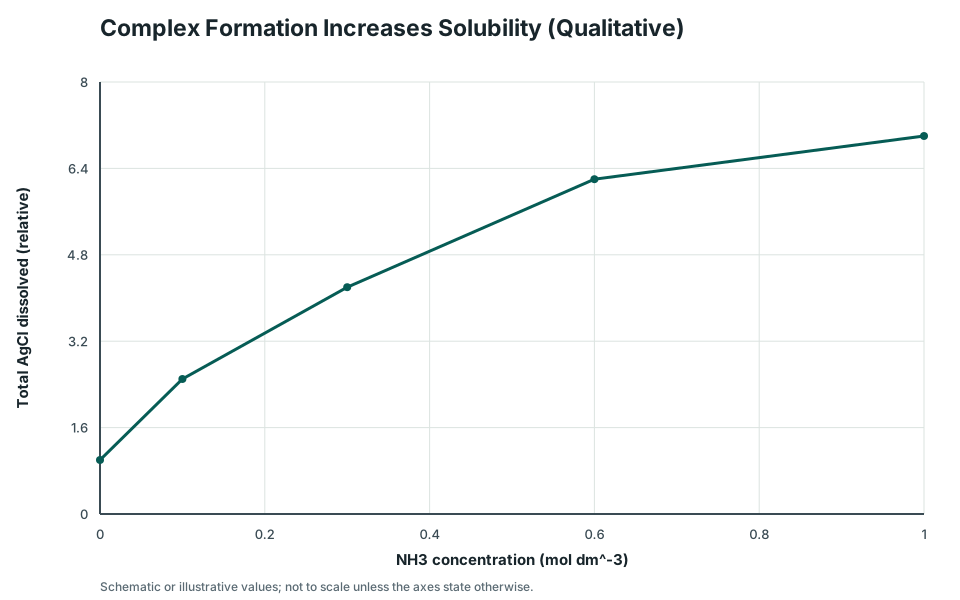
- Complex formation can increase solubility by removing free metal ions from solution.
- Typical example:
- AgCl(s) ⇌ Ag + (aq) + Cl-(aq)
- Ag + (aq) + 2NH₃(aq) ⇌ [Ag(NH₃)₂] + (aq)
- Kₛₚ does not change unless temperature changes (but solubility can change).
For complex-ion solubility questions: always write both equilibria (dissolution + complex formation), then state which species is being removed from solution.
Quick visuals (common ion vs complex ion):
Data table
| Added Cl− concentration | Ag+ |
|---|---|
| 0.001 | 180 |
| 0.01 | 18 |
| 0.1 | 1.8 |
Complex Formation Increases Solubility (Qualitative)
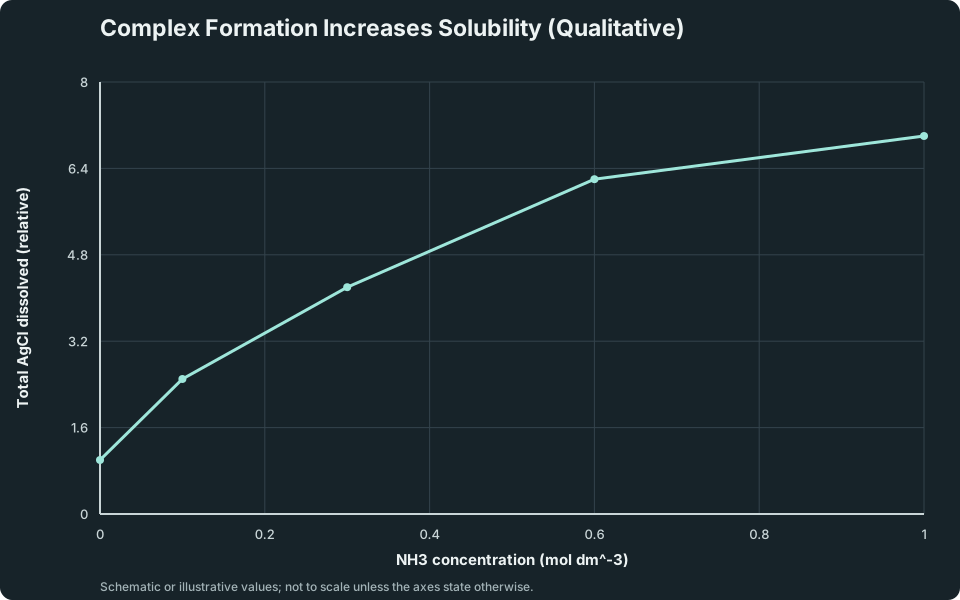
Complex Formation Increases Solubility (Qualitative). AgCl solubility (relative) plotted as Total AgCl dissolved against NH3 concentration.
Scroll across the graph to read all labels.
View figure data
| NH3 concentration (mol dm^-3) | AgCl solubility (relative) |
|---|---|
| 0 | 1 |
| 0.1 | 2.5 |
| 0.3 | 4.2 |
| 0.6 | 6.2 |
| 1 | 7 |
Detailed Explanations
A. Common ion effect on solubility (linked to Kₛₚ)
For: MX(s) ⇌ M + (aq) + X-(aq) Kₛₚ = [M⁺][X⁻]
If [X⁻] is increased by adding a soluble salt containing X⁻, then because Kₛₚ must stay constant at that temperature, therefore the free [M⁺] at equilibrium must decrease. This is achieved by shifting the dissolution equilibrium left, so solubility decreases.
Workflow (explain questions):
- Write the dissolution equilibrium.
- State the added ion is a product of the dissolution equilibrium (common ion).
- State the shift direction (left) to oppose the increase.
- Conclude solubility decreases (less solid dissolves).
Mini example: Adding NaCl(aq) increases [Cl⁻] in AgCl(s) ⇌ Ag⁺ + Cl⁻, so the equilibrium shifts left and AgCl becomes less soluble.
B. Complex ions can increase solubility (removing free metal ions)
When a ligand forms a stable complex with the metal ion, the free metal-ion concentration drops.
Example system: AgCl(s) ⇌ Ag + (aq) + Cl-(aq) (Kₛₚ) Ag + (aq) + 2NH₃(aq) ⇌ [Ag(NH₃)₂] + (aq)
Because complex formation removes free Ag⁺ from solution, therefore [Ag⁺][Cl⁻] becomes smaller than Kₛₚ. More AgCl(s) dissolves to restore Qₛₚ = Kₛₚ for the free ions, so overall solubility increases.
C. A useful calculation shortcut (common ion present in large excess)
If the added common ion concentration is much larger than the solubility, you can often assume it stays approximately constant.
Example: If AgCl is in 0.100 mol dm⁻³ Cl⁻, then:
so [Ag⁺] ≈ Kₛₚ/0.100 (this gives the solubility for a 1:1 salt).
Worked Examples
Modelled example 1
Explain the common-ion effect on AgCl
Problem
Study the worked solution
Write the relevant equilibrium
Method
Represent dissolution using free aqueous ions.Reason
The added ion must be located in the equilibrium before a shift is predicted.Working
AgCl(s) ⇌ Ag + (aq) + Cl-(aq).Identify the disturbance
Method
Recognise chloride from sodium chloride as a common ion.Reason
Added Cl⁻ directly increases the concentration of one dissolution product.Working
[Cl⁻] increases.Predict the response
Method
Shift the dissolution equilibrium to the left.Reason
Silver and chloride ions combine to oppose the increased product concentration while maintaining Kₛₚ at fixed temperature.Working
Less AgCl remains dissolved, so its solubility decreases.
Guided practice 2
Calculate solubility with excess chloride
Problem
Try this before viewing the solution
Hints
Hint 1: use the excess-ion approximation
Hint 2: solve for free silver
View solution step by step
Set the common-ion concentration
Method
Approximate free chloride by the sodium chloride concentration.Reason
The common ion is present in very large excess compared with the expected AgCl solubility.Working
[Cl⁻] ≈ 0.100 mol dm⁻³.Use the fixed Ksp
Method
Calculate the equilibrium free silver concentration.Reason
At saturation, the free-ion product equals Kₛₚ.Working
[Ag⁺] = (1.8 × 10⁻¹⁰)/0.100 = 1.8 × 10⁻⁹ mol dm⁻³.Convert to molar solubility
Method
Equate AgCl solubility with the silver concentration produced.Reason
One mole of dissolved AgCl releases one mole of Ag⁺.Working
s = 1.8 × 10⁻⁹ mol dm⁻³.
Common misconception 3
Separate Ksp from solubility
Learner claim
Choose what changes
View solution step by step
Keep the constant fixed
Method
Reject the claimed change in Kₛₚ.Reason
Kₛₚ for a specified dissolution equilibrium depends on temperature, which is unchanged here.Working
The equilibrium must still satisfy [Ag⁺][Cl⁻] = Kₛₚ.Change the composition instead
Method
Increase chloride and decrease the equilibrium free silver concentration and solubility.Reason
The dissolution equilibrium shifts left until the free-ion product again equals the same Kₛₚ.Working
Solubility decreases even though the equilibrium constant does not.
Examiner practice 4
Explain dissolution in aqueous ammonia
Problem
Try this before viewing the solution
View solution step by step
Show complex formation
1 markMethod
Write silver-ion coordination by ammonia.Reason
The ligand binds dissolved silver ions.Working
Ag + (aq) + 2NH₃(aq) ⇌ [Ag(NH₃)₂] + (aq).Identify the free-ion change
1 markReason
Complexed silver is not free Ag⁺ in the Kₛₚ expression.Working
Free [Ag⁺] decreases.Shift dissolution
1 markReason
The AgCl equilibrium responds by replacing removed free silver ions.Working
AgCl(s) ⇌ Ag + (aq) + Cl-(aq) shifts to the right.Conclude about solubility
1 markMethod
State the observable equilibrium consequence.Reason
Rightward dissolution consumes more solid.Working
More AgCl dissolves, so its total solubility increases.
Self-mark with the mark scheme
Compare your response with each mark point. Select a point only when your response contains that evidence.
Credit complex formation, lower free silver concentration, rightward dissolution and increased total solubility.
Challenge 5
Compare two opposing solubility interventions
Problem
Try this before viewing the solution
Hints
Hint 1: track chloride in sample A
Hint 2: track free silver in sample B
View solution step by step
Analyse sample A
Method
Treat added chloride as a common ion.Reason
Increasing a dissolution product shifts AgCl(s) ⇌ Ag⁺ + Cl⁻ to the left.Working
Less AgCl is dissolved in sample A, so its solubility decreases.Analyse sample B
Method
Use ammonia to form [Ag(NH₃)₂]⁺ from free Ag⁺.Reason
Removing free silver shifts AgCl dissolution to the right to replace it.Working
More AgCl dissolves in sample B, so total dissolved silver increases.Compare the directions
Method
State the opposing outcomes using the controlled variable.Reason
The common ion adds a free dissolution product, whereas complexation removes one.Working
NaCl decreases AgCl solubility; ammonia increases it, even though both treatments can lower free [Ag⁺] at their new equilibria.
Common Mistakes
- Saying “common ion effect increases solubility” (it decreases solubility).
- Saying “Kₛₚ increases/decreases” when a common ion or ligand is added (only temperature changes Kₛₚ).
- Confusing total dissolved metal with free metal ion concentration when complexes form.
Use the Aqueous Equilibria topic check to practise and check your understanding.
Exam Tips
- For common ion effect: explicitly reference Kₛₚ and “free ion concentration”.
- For complex ions: show the two linked equilibria and state which species is being removed from solution.
- If you assume a common ion concentration is constant, state the assumption (“common ion in large excess”).
Mind Stretchers
Mind stretcher 1Extension
Why does complex formation affect solubility but does not “change Kₛₚ” at a fixed temperature?
Show Answer
Mark scheme:
- Kₛₚ is defined for the dissolution equilibrium and depends only on temperature.
- Complex formation reduces free [Ag⁺], so more solid dissolves until the free-ion product [Ag⁺][Cl⁻] equals Kₛₚ again.
- Therefore the equilibrium composition (how much dissolves) changes, but the value of Kₛₚ does not.
Syllabus and review details
- GCE A-Level H2 Chemistry 9476-2027 · 9476-2027
9476 (2027), complete syllabus
Last reviewed: