Orbitals and Electron Configuration
Write electron configurations for atoms and ions, including chromium, copper and transition-metal ions.
On this page
Electron configuration questions are workflow questions: count electrons, fill orbitals in the correct energy order, then check the total. This lesson focuses on the exam-safe order and the common traps (ions, especially 4s vs 3d).
Definitions (Must Know)
A. Orbital
An orbital is a region of space around the nucleus in which there is a high probability of finding an electron. It can hold up to two electrons with opposite spins.
B. Subshells (s, p, d)
A subshell is a set of orbitals of the same type within a shell.
- s subshell: 1 orbital → holds 2 electrons
- p subshell: 3 orbitals → holds 6 electrons
- d subshell: 5 orbitals → holds 10 electrons
C. Shell (principal quantum number, n)
A shell is an energy level labelled by n = 1, 2, 3, ….
Key Ideas (What Earns Marks)
- Fill lowest-energy orbitals first.
- Maximum 2 electrons per orbital (opposite spins).
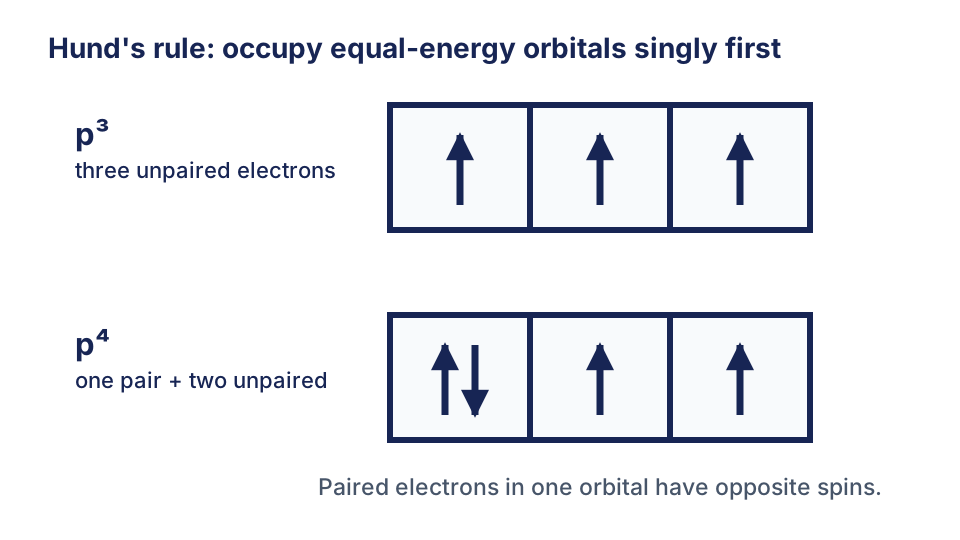
- In orbitals of the same energy (e.g. 2p/3p/3d), electrons occupy separate orbitals before pairing (Hund’s rule).
- Use the energy order (not just “highest shell number”), especially around 4s/3d.
If you’re unsure how many orbitals are in s/p/d subshells (or their shapes/relative energies), start with Atomic Orbitals: Energies and Shapes in your course’s topic navigation.
Common filling order (enough for H2 9476): 1s, 2s, 2p, 3s, 3p, 4s, 3d, 4p
Detailed Explanations
A. Writing a configuration (workflow)
- Count electrons (atomic number; adjust for charge if it is an ion).
- Fill orbitals using the energy order.
- Check the total electrons match what you started with.
If it is an ion, do the electron count first (e.g. Al³⁺ has 13-3 = 10 electrons).
Quick examples:
- O: 1s² 2s² 2p⁴
- Cl: 1s² 2s² 2p⁶ 3s² 3p⁵
B. Ions (what changes)
Use the charge to adjust the electron count:
-
Xⁿ⁺: the atom has lost n electrons → electrons = Z - n.
-
Xⁿ⁻: the atom has gained n electrons → electrons = Z + n.
-
Anions: add electrons (more negative).
-
Main-group cations: remove electrons from the outer shell (highest n).
-
Transition-metal cations: remove 4s electrons before 3d (the most common exam trap).
Mini example: S²⁻ has 16 + 2 = 18 electrons, so its configuration ends at 3p⁶.
C. 4s vs 3d removal (the exam rule)
In neutral atoms, 4s fills before 3d. But when transition metals form cations, the 4s electrons are removed first because (once 3d is occupied) the 4s electrons are higher in energy and more exposed.
So if you see a transition-metal ion, remove 4s electrons before 3d electrons.
D. Chromium and copper exceptions
The simple filling order predicts [Ar]3d⁴ 4s² for chromium and [Ar]3d⁹ 4s² for copper, but their observed ground-state configurations are:
- Cr: [Ar]3d⁵ 4s¹
- Cu: [Ar]3d¹⁰ 4s¹
Apply the ion rule after writing the correct neutral-atom configuration:
- Cr³⁺: remove the 4s electron, then two 3d electrons → [Ar]3d³
- Cu²⁺: remove the 4s electron, then one 3d electron → [Ar]3d⁹
Step through the elements, add or remove electrons, and tap the orbital boxes to see which arrangements are the ground state.
26 protons and 30 neutrons in the nucleus, 26 electrons in shells 2, 8, 14, 2: a iron-56 atom. Configuration 1s² 2s² 2p⁶ 3s² 3p⁶ 3d⁶ 4s², the ground state.
- Nucleon number
- 56
- Charge
- 0
- Ar
- 55.85
- Configuration
- [Ar] 3d⁶ 4s²
- Energy to remove the last electron
- — kJ/mol
- First ionisation energy
- 762 kJ/mol
Try this
0 of 4 doneBuild an atom of carbon-12, then change it into carbon-14. (not done yet)
Both have 6 protons, so both are carbon. Carbon-14 has 2 more neutrons: atoms of one element with different numbers of neutrons are isotopes.
Make a sodium ion, Na⁺, and a chloride ion, Cl⁻. (not done yet)
An ion has more or fewer electrons than protons. The protons, and so the element, stay the same.
In the mass spectrum of chlorine, make the two peaks the same height. (not done yet)
Ar is the mean mass of the isotopes, weighted by abundance. Real chlorine is 76 % chlorine-35, so its Ar of 35.45 is nearer 35 than 37.
Remove sodium's electrons one at a time until the energy needed jumps. (not done yet)
The second electron comes from a full shell much closer to the nucleus, so it needs far more energy. One electron before the jump puts sodium in Group 1.
Worked Examples
Modelled example 1
Write the Configuration of an Aluminium Ion
Problem
Write the electron configuration of Al³⁺.
Study the worked solution
Write the neutral-atom configuration
Method
Place all 13 electrons into subshells in energy order.Reason
The ion configuration is derived from the neutral atom.Working
Al: 1s² 2s² 2p⁶ 3s² 3p¹Remove the outer electrons
Method
Remove one electron from 3p, then two from 3s.Reason
A 3 + ion has three fewer electrons, removed from the highest occupied shell.Working
3p¹ → 3p⁰ and 3s² → 3s⁰.State the ion configuration
Working
Al³⁺: 1s² 2s² 2p⁶
Guided practice 2
Write the Configuration of a Sulfide Ion
Problem
Write the electron configuration of S²⁻.
Try this before viewing the solution
Hints
Hint 1: start from sulfur
Neutral sulfur has 16 electrons and ends in 3p⁴.
Hint 2: interpret the charge
A 2- charge means that two electrons have been added.
View solution step by step
Write neutral sulfur
Method
Fill 16 electrons into the available subshells.Reason
This establishes where the added electrons go.Working
S: 1s² 2s² 2p⁶ 3s² 3p⁴Add two electrons
Method
Complete the 3p subshell.Reason
The 2- ion contains 18 electrons.Working
3p⁴ → 3p⁶State the ion configuration
Working
S²⁻: 1s² 2s² 2p⁶ 3s² 3p⁶
Common misconception 3
Correct Reversed Ion Electron Counts
Learner attempt
Asked for the electron configurations of Na⁺ and Cl⁻, a learner assigns 12 electrons to Na⁺ and 16 electrons to Cl⁻. Identify the first error and write both correct configurations.
Correct the charge rule
View solution step by step
Correct the sodium ion
Method
Subtract one electron from neutral sodium.Reason
A 1 + ion has one fewer electron than proton.Working
Na⁺ has 11-1 = 10 electrons: 1s² 2s² 2p⁶.Correct the chloride ion
Method
Add one electron to neutral chlorine.Reason
A 1- ion has one more electron than proton.Working
Cl⁻ has 17 + 1 = 18 electrons: 1s² 2s² 2p⁶ 3s² 3p⁶.
Examiner practice 4
Compare Nitrogen and Oxygen
Problem
For the ground-state atoms N and O: (a) write their electron configurations; (b) state the number of unpaired electrons in each atom. [4 marks]
Try this before viewing the solution
View solution step by step
Write the nitrogen configuration
1 markMethod
Fill the subshells with nitrogen’s seven electrons.
Reason
Nitrogen has seven electrons.Working
N: 1s² 2s² 2p³Write the oxygen configuration
1 markReason
Oxygen has eight electrons.Working
O: 1s² 2s² 2p⁴Count nitrogen's unpaired electrons
1 markMethod
Place the three 2p electrons singly into the three orbitals.
Reason
Electrons occupy separate degenerate orbitals before pairing.
Working
N has three unpaired electrons.Count oxygen's unpaired electrons
1 markMethod
Pair the fourth 2p electron in one orbital.Reason
The other two 2p orbitals remain singly occupied.Working
O has two unpaired electrons.
Self-mark with the mark scheme
Compare your response with each mark point. Select a point only when your response contains that evidence.
Credit each configuration and each unpaired-electron count separately.
Challenge 5
Infer Periodic Position from a Configuration
Problem
An atom has electron configuration 1s² 2s² 2p⁶ 3s² 3p⁴. Identify the element, its period and its group.
Try this before viewing the solution
Hints
Hint 1: identify the atom
Add all subshell exponents to find the electron count.
Hint 2: read periodic position
Use the highest occupied principal shell for the period and the outer-shell electron count for the group.
View solution step by step
Identify the element
Method
Add the electron counts.Reason
A neutral atom has the same number of electrons and protons.
Working
2 + 2 + 6 + 2 + 4 = 16, so the element is sulfur, S.
Identify the period
Method
Find the highest occupied shell.Reason
The largest principal quantum number is 3.Working
Period 3.Identify the group
Method
Count the outer-shell s and p electrons.Reason
3s² 3p⁴ gives six valence electrons for a main-group element.
Working
Group 16.
Common Mistakes
- Writing more than 2 electrons in one orbital.
- Forgetting that p has three orbitals (so p can hold 6).
- For transition-metal ions, removing 3d electrons before 4s.
- Using the simple filling pattern for Cr and Cu instead of their ground-state exceptions.
Exam Tips
- Group number (main-group) matches valence electrons for neutral atoms (e.g. Group 17 → 7 valence electrons).
- Use noble gas shortcuts if allowed (e.g. [Ne]3s² 3p⁵), but full notation is always safe.
- For transition-metal ions, electrons are removed from 4s before 3d (for further H2 study, see Definition and Electron Configurations).
- Memorise the neutral-atom exceptions Cr: [Ar]3d⁵ 4s¹ and Cu: [Ar]3d¹⁰ 4s¹ before forming their ions.
Mind Stretchers
Mind stretcher 1Extension
Write the electron configuration of Fe²⁺ and Fe³⁺ using noble gas notation.
Show Answer
Mark scheme:
- Fe is [Ar]3d⁶ 4s².
- Remove electrons from 4s before 3d:
- Fe²⁺: [Ar]3d⁶
- Fe³⁺: [Ar]3d⁵
Mind stretcher 2Extension
Write the electron configurations of Cr, Cr³⁺, Cu and Cu²⁺ using noble-gas notation.
Show Answer
Mark scheme:
- Cr: [Ar]3d⁵ 4s¹; Cr³⁺: [Ar]3d³.
- Cu: [Ar]3d¹⁰ 4s¹; Cu²⁺: [Ar]3d⁹.
- For each cation, remove 4s before 3d.
Syllabus and review details
- GCE A-Level H2 Chemistry 9476-2027 · 9476-2027
9476 (2027), complete syllabus
Last reviewed: