Rate Equations, Orders, Rate Constant
Write rate equations and work out the units of the rate constant.
On this page
Rate laws are the bridge between experiment and explanation: data → orders → rate equation → units of k → mechanism check. This lesson builds the definitions and “rate-change” reflexes you’ll reuse across all kinetics questions.
Link this page to Activation Energy and Boltzmann Distribution and the Reaction Kinetics hub to keep mechanism and data interpretation consistent.
Definitions (Must Know)
A. Rate of reaction
The rate of reaction is the change in concentration per unit time.
- for a reactant A: rate = -Δ[A]/(Δ t)
- for a product P: rate = Δ[P]/(Δ t)
B. Rate equation (rate law)
A rate equation relates rate to reactant concentrations: rate = k[A]^m[B]ⁿ where m and n are the orders with respect to A and B.
C. Order of reaction (with respect to a reactant)
The order with respect to A is the power of [A] in the rate equation.
D. Overall order
The overall order is the sum of the powers in the rate equation (e.g. m + n for two reactants).
E. Rate constant, k
The rate constant, k, is a constant for a given reaction at a fixed temperature. Its units depend on the overall order.
Key Ideas (What Earns Marks)
- Orders are found experimentally (they do not have to match stoichiometric coefficients).
- The rate equation must be written with k: “rate ∝ …” is usually not enough on its own.
- A zero-order term means the rate does not change when that concentration changes.
- Rate comparisons are done by factors: rate₂/rate₁ = ([A]₂/[A]₁)^m([B]₂/[B]₁)ⁿ
- Units of k come from rearranging k = rate/[A]^m[B]ⁿ.
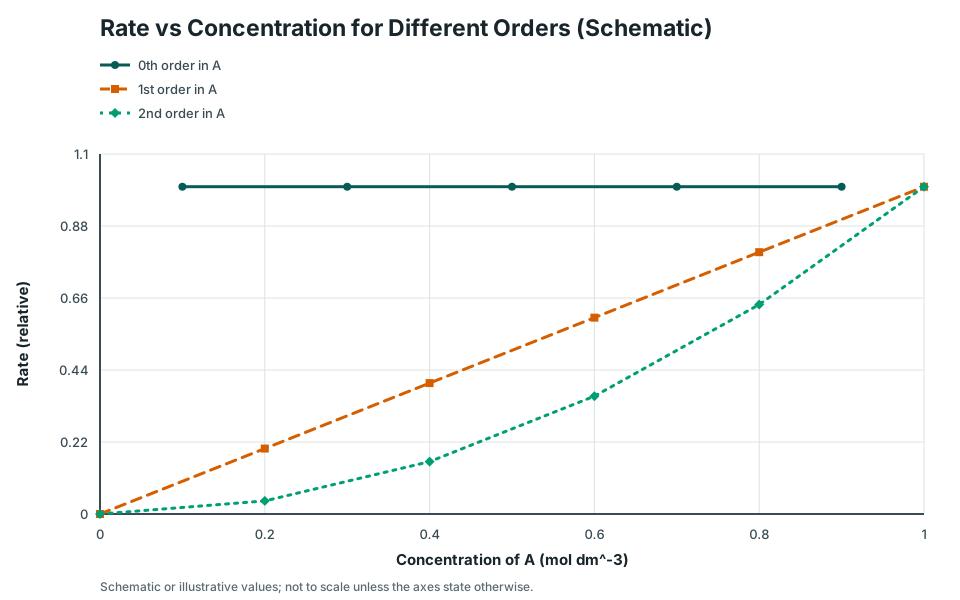
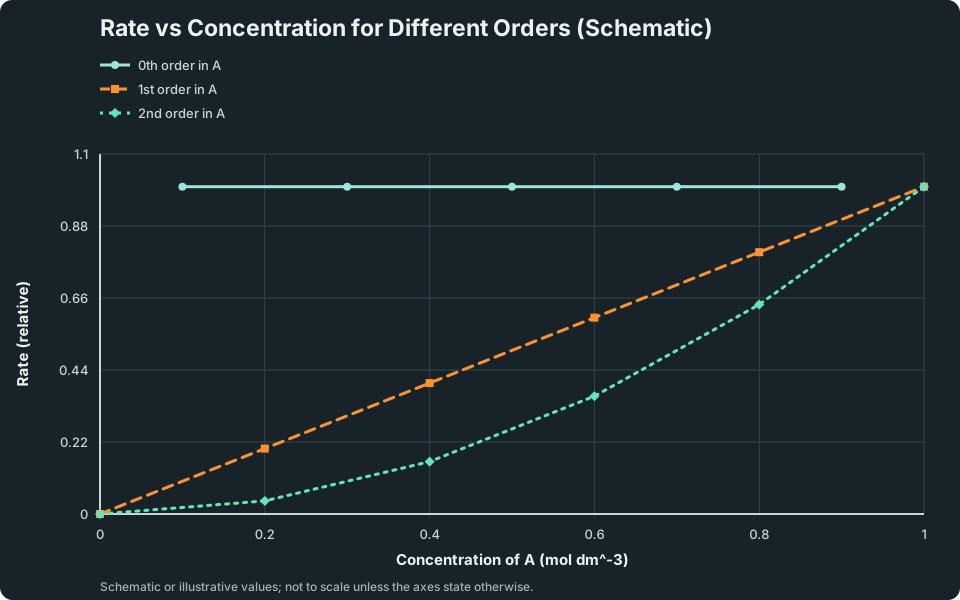
- First order in A: doubling [A] doubles the rate. - Second order in A: doubling [A] quadruples the rate. - Zero order in A: changing [A] does not change the rate.
Detailed Explanations
A. How orders control rate changes
If rate = k[A]^m (other factors constant), then multiplying [A] by a factor f multiplies the rate by f^m.
Mini example:
- if m = 2 and [A] doubles (f = 2), the rate increases by 2² = 4.
Quick visual (how order changes the rate–concentration shape):
Rate vs Concentration for Different Orders (Schematic)
Rate vs Concentration for Different Orders (Schematic). 0th order in A, 1st order in A, 2nd order in A plotted as Rate against Concentration of A.
Scroll across the graph to read all labels.
View figure data
| Series | Concentration of A (mol dm^-3) | Concentration of A uncertainty | Rate (relative) | Rate uncertainty |
|---|---|---|---|---|
| 0th order in A | 0.1 | 1 | ||
| 0th order in A | 0.3 | 1 | ||
| 0th order in A | 0.5 | 1 | ||
| 0th order in A | 0.7 | 1 | ||
| 0th order in A | 0.9 | 1 | ||
| 1st order in A | 0 | 0 | ||
| 1st order in A | 0.2 | 0.2 | ||
| 1st order in A | 0.4 | 0.4 | ||
| 1st order in A | 0.6 | 0.6 | ||
| 1st order in A | 0.8 | 0.8 | ||
| 1st order in A | 1 | 1 | ||
| 2nd order in A | 0 | 0 | ||
| 2nd order in A | 0.2 | 0.04 | ||
| 2nd order in A | 0.4 | 0.16 | ||
| 2nd order in A | 0.6 | 0.36 | ||
| 2nd order in A | 0.8 | 0.64 | ||
| 2nd order in A | 1 | 1 |
B. Units of k (safe method)
- Take the rate units from the question (commonly mol dm⁻³s⁻¹).
- Take concentration units (commonly mol dm⁻³).
- Rearrange: k = rate/[A]^m[B]ⁿ
- Substitute units and simplify.
Common results (if rate is in mol dm⁻³s⁻¹):
| Overall order | Typical rate law | Units of k |
|---|---|---|
| 0 | rate = k | mol dm⁻³s⁻¹ |
| 1 | rate = k[A] | s⁻¹ |
| 2 | rate = k[A]² | dm³ mol⁻¹s⁻¹ |
| 3 | rate = k[A]³ | dm⁶ mol⁻²s⁻¹ |
C. What changes (and what doesn’t)
- Changing concentration changes the rate.
- Changing temperature (or adding a catalyst) changes k.
- The balanced equation coefficients do not determine the orders unless the reaction is stated to be an elementary step.
Worked Examples
Modelled example 1
Read orders from a rate equation
Problem
For rate = k[A]²[B], state the order with respect to A, the order with respect to B and the overall order.
Study the worked solution
Read individual powers
Method
Use each concentration exponent as that reactant’s order.
Reason
Reaction order is defined by the experimentally established power in the rate equation.
Working
Order in A = 2; order in B = 1.Find overall order
Method
Add the individual orders.Reason
Overall order is the sum of all concentration powers.
Working
2 + 1 = 3: the reaction is third order overall.
Guided practice 2
Combine concentration-change factors
Problem
For rate = k[A]⁰[B]² at constant temperature, what happens to the rate if [A] doubles and [B] halves?
Try this before viewing the solution
Hints
Hint 1: treat each reactant separately
Raise A’s factor 2 to power 0 and B’s factor 1/2 to power 2.
Hint 2: combine multiplicatively
Multiply the two independent rate factors; do not add the orders to the concentration factors.
View solution step by step
Apply A's order
Method
Raise the factor 2 to power 0.Reason
A is zero order, so its concentration change contributes no rate change.
Working
2⁰ = 1.Apply B's order
Method
Square the factor 1/2.Reason
B is second order.Working
(1/2)² = 1/4.Combine
Method
Multiply the two rate factors.Reason
Both concentration effects act in the same rate-law product.
Working
1 × 1/4 = 1/4: the rate becomes one quarter of its original value.
Common misconception 3
Correct a coefficient-derived rate law
Learner claim
Identify the evidence
View solution step by step
Separate stoichiometry from kinetics
Method
State that the balanced equation records overall chemical amounts.Reason
It need not describe the elementary molecular events controlling the observed rate.Working
Coefficients 2 and 1 do not automatically become reaction orders.Name valid evidence
Method
Require experimentally measured rate changes as concentrations vary, unless the reaction is explicitly stated to be elementary.Reason
Those data determine the powers in the empirical rate equation.Working
The proposed law remains unproven without kinetic evidence.
Examiner practice 4
Calculate k and its units
Problem
Try this before viewing the solution
View solution step by step
Rearrange
1 markMethod
Make k the subject.Reason
Both concentration terms divide the measured rate.Working
k = rate/[A]²[B].Substitute
1 markMethod
Insert the rate and equilibrium concentrations with A squared.Reason
The rate-law powers must be preserved numerically.Working
k = (1.60 × 10⁻³)/(0.200)²(0.0500) = (1.60 × 10⁻³)/0.00200.Evaluate
1 markMethod
Complete the division.Reason
The data support three significant figures.Working
k = 0.800.Derive units
1 markMethod
Divide the rate unit by three concentration factors.Reason
The reaction is third order overall.Working
k = 0.800 dm⁶ mol⁻²s⁻¹.
Self-mark with the mark scheme
Compare your response with each mark point. Select a point only when your response contains that evidence.
Credit rearrangement, powered substitution, numerical value and derived units.
Challenge 5
Derive k units dimensionally
Problem
Try this before viewing the solution
Hints
Hint 1: rearrange symbols first
Hint 2: subtract unit powers
View solution step by step
Rearrange
Method
Make k the subject of the second-order rate law.Reason
Dimensional cancellation must follow the algebraic relationship.Working
k = rate/[A]².Insert and simplify units
Method
Divide the rate unit by two concentration units.Reason
One concentration factor cancels, leaving inverse concentration multiplied by inverse time.Working
[k] = (mol dm⁻³s⁻¹)/((mol dm⁻³)²) = dm³ mol⁻¹s⁻¹.
Common Mistakes
- Assuming orders equal stoichiometric coefficients without experimental evidence.
- Stating an order but not writing the full rate law (so the marker can’t see what you mean).
- Forgetting units of k or giving inconsistent units.
Use the Reaction Kinetics topic check to practise and check your understanding.
Exam Tips
- Rate equation is found from data, not from stoichiometric coefficients (unless stated as elementary step).
- When you state an order, link it to the power in the rate law (e.g. [A]² means second order in A).
- State units of k (they depend on overall order).
- When comparing rates, write a ratio line first (it prevents “mental arithmetic” errors).
Mind Stretchers
Mind stretcher 1Extension
A reaction has k units of dm⁶ mol⁻²s⁻¹ (assume rate is in mol dm⁻³s⁻¹ and concentrations are in mol dm⁻³). Doubling [A] increases the rate by a factor of 4. Deduce the orders in A and B for a rate law of the form rate = k[A]^m[B]ⁿ.
Show Hint
Separate the concentration factor from the rate factor before deciding the order.
Show Answer
Mark scheme:
- From the units of k: overall order is 3 (the 3rd-order unit pattern is dm⁶ mol⁻²s⁻¹).
- Doubling [A] gives rate ×4, so 2^m = 4 → m = 2.
- Overall order m + n = 3, so n = 1.
- Rate law: rate = k[A]²[B].
Mind stretcher 2: A dimensional auditExtension
Question. For rate = k[A]²[B], state the overall order and derive the units of k when rate is measured in mol dm⁻³ s⁻¹.
Show Hint
Divide the rate unit by three concentration factors.
Show Answer
The overall order is 3. Thus [k] = (mol dm⁻³ s⁻¹)/(mol dm⁻³)³ = dm⁶ mol⁻² s⁻¹.
Syllabus and review details
- GCE A-Level H2 Chemistry 9476-2027 · 9476-2027
9476 (2027), complete syllabus
Last reviewed: