Alkane reactions and cracking
Key idea: Alkanes burn in oxygen and undergo chlorine substitution in UV light. Cracking uses heat and a catalyst to turn large alkane molecules into smaller alkanes and alkenes.
Offline pages
Saved on this device only. Connect at least once every 30 days to confirm Premium. Sign-out or a change of account removes saved copies.
Loading guide controls…
Guided lessons · coming soon
Guided lesson
Guided steps
- Compare complete combustion with the first chlorine substitution.
- Choose the condition, replaced atom and second product.
- Balance carbon and hydrogen before counting product oxygen atoms.
- Write the combustion equation and compare both substitution products.
- Track atoms into smaller products and compare supply with demand.
- Calculate both differences and choose the molecule-changing process.
- Count the remaining carbon and hydrogen before naming the alkene.
- Write the complete equation and check both atom totals.
- Find the remaining atom counts and name the molecule.
- Write the complete equation and explain a use of ethene.
- Compare physical separation with breaking molecules in a reaction.
- Explain why cooling cannot help and cracking can.
On this page
You stopped at:
ContinueMethane can burn, a chlorine atom can replace one of its hydrogen atoms, and a refinery can turn larger hydrocarbons into smaller ones. These are chemical changes: the atoms are rearranged, but none disappear. This lesson helps you distinguish the reactions and use atom conservation to complete cracking equations.
Start with hydrocarbon structures: an alkane has only single carbon–carbon bonds, while an alkene has a carbon–carbon double bond. You also need to balance an equation without changing the formulae of substances. The crude-oil lesson explains the separate physical process of fractional distillation.
Alkanes: combustion and substitution
Alkanes contain only strong C-C and C-H single bonds. They do not react readily with acids, alkalis or most other reagents under ordinary laboratory conditions. Combustion and substitution are two important reactions to learn.
Combustion. Alkanes burn in plenty of oxygen to form carbon dioxide and water, which is why they are good fuels:
Substitution by chlorine. In ultraviolet (UV) light, such as sunlight, methane reacts with chlorine. One chlorine atom takes the place of one hydrogen atom:
The products are chloromethane and hydrogen chloride. This is a substitution reaction: one atom is replaced by another. UV light starts this reaction under the conditions studied here. Further substitution can replace more hydrogen atoms; the equation shows the first substitution.
Methane and chloromethane
Methane is a carbon with four hydrogens. Chloromethane is a carbon with three hydrogens and one chlorine. The carbon still has four single bonds.
Scroll across the figure to read all labels.
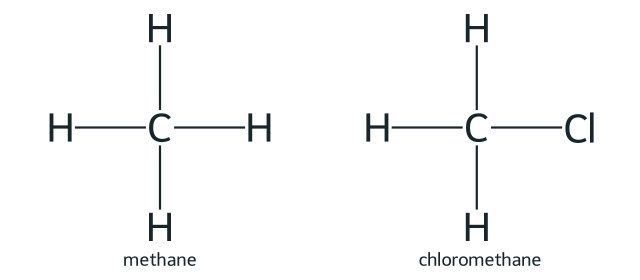
View figure data
| Molecule | Molecular formula | Atoms bonded to carbon |
|---|---|---|
| methane | CH₄ | 4 H |
| chloromethane | CH₃Cl | 3 H and 1 Cl |
Check your understanding 1 Track what is replaced in substitution
For the first reaction of methane with chlorine, choose the condition and what happens to a hydrogen atom. Then identify the second product alongside chloromethane.
Show answer
CH₄ + Cl₂ → (UV light) CH₃Cl + HCl. One chlorine replaces one methane hydrogen; the other chlorine forms hydrogen chloride with the removed hydrogen. All atoms balance, and carbon still has four single bonds.
Check your understanding 2 Balance methane’s complete combustion
For one methane molecule, complete the coefficients in CH₄ + ? O₂ → ? CO₂ + ? H₂O. The oxygen supply is plentiful.
Show answer
CH₄ + 2O₂ → CO₂ + 2H₂O. Carbon and hydrogen enter carbon dioxide and water. The next activity asks for the full equation and comparison with substitution.
Check your understanding 3 Burning methane
Write a balanced equation for methane burning in plenty of oxygen. Explain how the products differ from those in its first substitution with chlorine.
Work on paper or in the optional notes. Compare the full balanced combustion equation with both first-substitution products and how their atoms are rearranged.
Show answer
CH₄ + 2O₂ → CO₂ + 2H₂O. Complete combustion forms carbon dioxide and water; all carbon and hydrogen enter these products. The first chlorine substitution instead replaces one hydrogen and forms chloromethane and hydrogen chloride.
Cracking changes molecules
Cracking breaks large alkane molecules into smaller ones. The large molecules are heated and passed over a catalyst. The products are smaller alkanes and alkenes, and sometimes hydrogen:
C₁₀H₂₂ → C₈H₁₈ + C₂H₄ C₂H₆ → C₂H₄ + H₂
Every carbon and hydrogen atom in the large molecule ends up in a product, so the atoms balance on each side.
Crude oil gives more large molecules than people need, and fewer small molecules than people need. These illustrative shares compare supply and demand for the same total amount:
| Fractions | Share of crude oil supplied / % | Share of demand / % |
|---|---|---|
| small molecules (refinery gas, petrol, naphtha) | 25 | 45 |
| medium molecules (kerosene, diesel) | 35 | 35 |
| large molecules (fuel oil, bitumen) | 40 | 20 |
Cracking turns some of the surplus large molecules into the smaller molecules that are in demand. It is also how alkenes such as ethene are manufactured, and ethene is the starting material for many plastics. This is why cracking is essential to a refinery.
Check your understanding 4 Read the supply and demand before choosing the process
Use the illustrative supply/demand table above. Find demand minus supply for small-molecule fractions, and supply minus demand for large-molecule fractions. Enter both differences in percentage points, then choose the process that can change large molecules into smaller hydrocarbons.
Show answer
Small fractions have a shortfall of 20 percentage points; large fractions have a surplus of 20 percentage points. Cracking can turn some surplus large molecules into smaller ones, including useful alkenes. The table describes shares of a common total; it does not specify one exact cracking equation or industrial product mixture.
Complete a cracking equation
In a model equation, cracking gives an alkene and one other product. Use the supplied formulae to account for the carbon and hydrogen atoms. An atom balance checks the proposed products; it does not predict the full product mixture from an industrial cracker.
Guided practice 1
Find the missing alkene
Problem
Account for both elements
Hints
Hint 1
Carbon atoms
There are nine carbon atoms before the reaction. Six are in the known product.Hint 2
Hydrogen atoms
Do the same subtraction for hydrogen. Check that the formula fits an alkene.Show solution step by step
Account for carbon
Method
Three carbon atoms remain for Y.Reason
Each atom must appear in one of the products.Working
Answer
9 − 6 = 3 carbon atoms.Account for hydrogen
Method
Six hydrogen atoms remain for Y.Reason
The known product uses fourteen of the twenty hydrogen atoms.Working
Answer
20 − 14 = 6 hydrogen atoms, so Y is C₃H₆: propene.Check both elements
Method
The equation balances.Reason
C₃H₆ fits the formula of the three-carbon alkene.Working
Answer
C₉H₂₀ → C₆H₁₄ + C₃H₆. Carbon: 9 = 6 + 3. Hydrogen: 20 = 14 + 6.
Quick check
Check your understanding 5 Construct and check the complete cracking equation
For C₉H₂₀ → C₆H₁₄ + Y, construct the complete equation with Y’s formula. Name Y and show that both atom totals balance. Work on paper or in optional notes.
Show answer
C₉H₂₀ → C₆H₁₄ + C₃H₆. Y is propene. Carbon: 9 = 6 + 3. Hydrogen: 20 = 14 + 6. Both elements balance and the remaining C₃H₆ fits the alkene specified. An atom balance validates this proposed equation; it does not identify the full industrial cracking mixture.
Check your understanding 6 Find the second missing product independently
For the model equation C₁₂H₂₆ → C₁₀H₂₂ + ?, find the carbon and hydrogen counts in the missing molecule and name it.
Show answer
The missing molecule is ethene, C₂H₄. Now write the complete equation, check both totals and explain a use of the product.
Check your understanding 7 Crack a C₁₂ alkane
Complete the model cracking equation C₁₂H₂₆ → C₁₀H₂₂ + ?. Name the missing product, check both atom totals and explain one use of the product.
Work on paper or in the optional notes. Compare the full equation, both atom totals and how ethene can be used to make a plastic.
Show answer
The atoms left over are 12-10 = 2 C and 26-22 = 4 H, so the product is ethene, C₂H₄. The equation is C₁₂H₂₆ → C₁₀H₂₂ + C₂H₄: 12 C and 26 H on each side. Ethene makes plastics such as poly(ethene).
Distillation or cracking?
A learner says: “The refinery needs more small molecules, so it should make its fractionating column cooler to break the large molecules.” Cooling can condense a vapour, but it does not break hydrocarbon molecules into smaller ones. Fractional distillation separates existing molecules; cracking changes them.
Check your understanding 8 Correct the refinery’s proposed solution
A refinery needs more small molecules than the crude oil supplies. A learner suggests cooling the fractionating column more to break the large molecules. Explain the effect of cooling, the process needed to change the molecules and why that helps the refinery. Work on paper or in optional notes.
Show answer
Cooling condenses vapour and can affect where existing fractions are collected, but does not break hydrocarbon molecules into smaller ones. Fractional distillation is physical separation by boiling range. Cracking uses heat and a catalyst to break large alkane molecules into smaller alkanes and alkenes. It can use surplus large fractions to supply more small molecules, and its alkenes provide feedstock for plastics. Every atom remains in a product; exact products depend on the reaction, not on the supply table alone.
Spotted an error? Report a correction
Syllabus and review details
- SEC G2 Science Chemistry component 2027 · 2027
Chemistry content structure and subject content, PDF pages 25–33
Last reviewed: