Planning a Chemistry Investigation (Paper 3)
Planning (Paper 3): identify IV/DV/control variables, write a fair-test method, include safety, and state what results/data to record.
Continue where you stopped
The core idea
On this page
Learning objectives
- plan investigations, select techniques, apparatus and materials;
Planning questions are scored using a checklist: identify variables, write a clear method, keep a fair test, and state how you will record results safely and accurately.
1. Definition
Planning is designing an investigation that is a fair test: you change one variable, measure the effect, and keep other factors constant.
2. Key Ideas
- Independent variable (IV): what you change.
- Dependent variable (DV): what you measure.
- Control variables: what you keep constant to make it a fair test.
- Plan repeat readings and calculate a mean to improve reliability.
- Write methods with measurements (amounts, times, volumes) and apparatus (what you will use).
3. Detailed Explanations
- Fair test / validity: only the IV changes; controls are kept constant with a stated method.
- Reliability: repeat each IV value and calculate a mean (mention anomalies).
- DV must be measurable: name the apparatus and the unit (e.g., “volume of gas / cm³ using a gas syringe”).
A. Variables (What Examiners Want to See)
| Term | What it means | Example (rate of reaction) |
|---|---|---|
| IV | what you deliberately change | concentration of acid |
| DV | what you measure | volume of gas in 60 s |
| Control variable | what you keep constant | mass of marble, temperature, surface area |
B. A Mark-Scheme Method Template
Write your plan like this:
- Set up apparatus (name it).
- State exact amounts (mass, volume, concentration).
- Start timing when you mix/reactants.
- Measure DV (what readings, how often, units).
- Repeat and calculate mean (mention anomalies).
- Change IV in a sensible range (at least 5 values if possible).
- Safety hazards + precautions.
“Keep temperature constant” is incomplete. Write how: e.g., “use a water bath at 25°C for every trial”.
C. Choosing What to Measure (DV)
Common Paper 3 choices:
| What you measure | Typical experiment | Comment |
|---|---|---|
| volume of gas vs time | acid + carbonate / magnesium + acid | good for graphs and rate |
| mass loss vs time | gas escapes from reaction | must prevent splashing |
| time for a fixed change | cloudiness / cross disappears | define the end-point clearly |
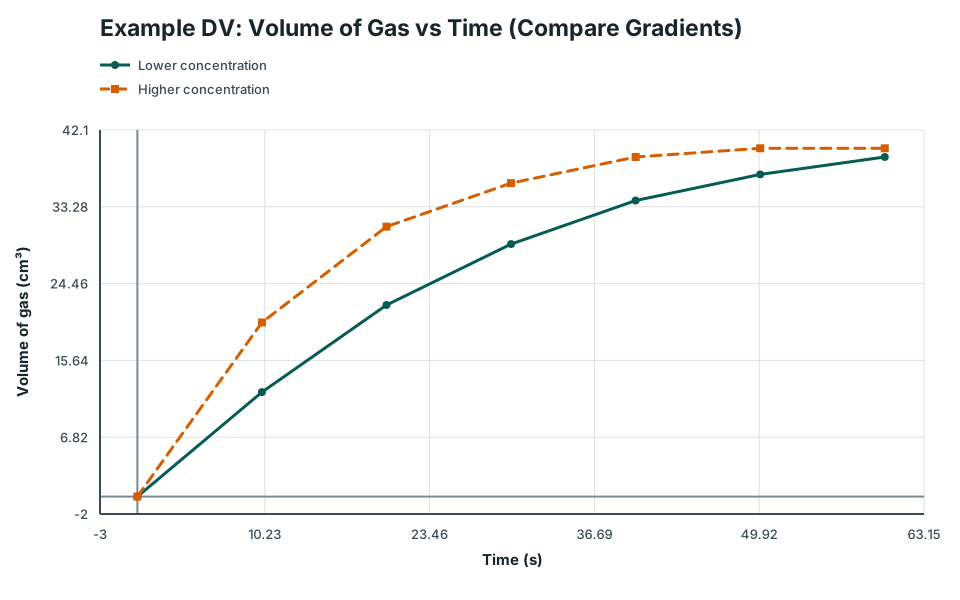
Example: “volume of gas vs time” is a high-scoring DV because you can compare gradients (rate):
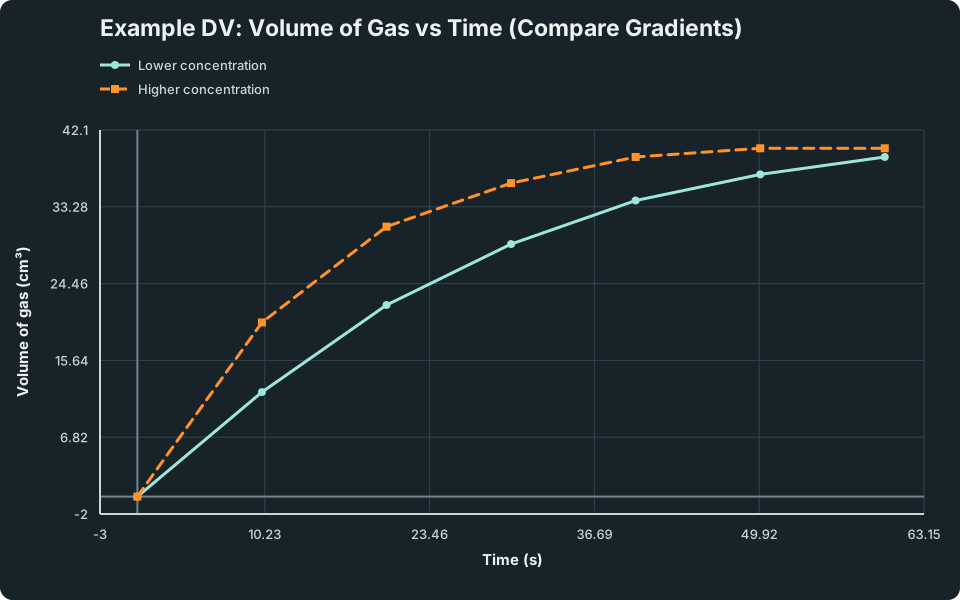
Example DV: Volume of Gas vs Time (Compare Gradients)
Example curves showing how changing conditions affects the gradient (rate) while reaching a similar final volume.
Scroll across the graph to read all labels.
View figure data
| Time (s) | Lower concentration | Higher concentration |
|---|---|---|
| 0 | 0 | 0 |
| 10 | 12 | 20 |
| 20 | 22 | 31 |
| 30 | 29 | 36 |
| 40 | 34 | 39 |
| 50 | 37 | 40 |
| 60 | 39 | 40 |
4. Common Mistakes
- Changing more than one variable at once (not a fair test).
- Writing “measure the results” with no unit / no apparatus.
- No repeats (or no mean) when repeats are expected.
- Control variables listed but not controlled (no “how”).
- Unclear end-point (e.g., “until it changes” with no definition).
5. Exam Tips
“Keep the mass of marble constant by using 2.00 g each time.”
“Keep the temperature constant using a water bath at 25°C.”
“Keep total volume constant by adding water to make 50.0 cm³ each time.”
6. Worked Examples
Modelled example 1
Plan Concentration Against Reaction Rate
Problem
Study the worked solution
Define IV and measurable DV
Method
Change only the concentration of HCl(aq) and measure the volume of CO₂(g) at regular time intervals using a gas syringe.Reason
Repeated volume readings produce a gas-volume–time graph whose gradient represents rate.Working
IV: acid concentration. DV: gas volume / cm³ at stated times / s.Operationalise the controls
Method
Use 2.00 g of marble from the same size range, the same total solution volume, and the same water-bath temperature for every trial.Reason
Marble mass and surface area, total solution volume and temperature can otherwise influence the measured rate.Working
For example, make each mixture to 50.0 cm³ and equilibrate it in a 25°C water bath.Write a repeatable method
Method
Connect a conical flask to a gas syringe, add the measured acid to the marble, fit the bung promptly, start timing and record gas volume every 10 s for 60 s.Reason
Named apparatus, amounts and timings allow another person to repeat the investigation consistently.Working
Repeat across at least five sensible concentrations.Add reliability and safety
Method
Repeat every concentration, investigate anomalies and calculate means; wear eye protection and avoid contact with the acid.Reason
Repeats expose random variation, while the precaution addresses the labelled irritant or corrosive hazard.Working
Plot mean gas volume against time for each concentration and compare initial gradients.
Guided practice 2
Choose a Useful Dependent Variable
Problem
Try this before viewing the solution
Hints
Hint 1: more than one reading
Hint 2: graph feature
View solution step by step
Choose the measurement
Method
Record gas volume at regular time intervals.Reason
Multiple readings show how quickly product forms throughout the reaction rather than giving one isolated result.Working
Plot gas volume / cm³ against time / s.Use the graph
Method
Compare gradients over the same part of each curve, normally the initial gradients.Reason
A steeper gradient means a greater change in gas volume per unit time and therefore a faster rate.Working
Greater gradient → faster reaction.
Common misconception 3
“Keep It Constant” Is Incomplete
Learner plan
Try this before viewing the solution
View solution step by step
Operationalise temperature
Method
Use the same water bath at a stated temperature and allow reactants to reach that temperature before mixing.Reason
Room temperature can drift, and writing “constant” does not describe a control procedure.Working
For example: use a water bath at 25°C for every trial.Operationalise surface area
Method
Use marble chips selected from the same defined size range in each trial.Reason
Equal mass alone does not guarantee equal exposed surface area.Working
Keep both total mass and chip-size range fixed.
Examiner practice 4
Evaluate a Flawed Rate Plan
Examination question
Try this before viewing the solution
View solution step by step
Remove the volume confound
2 marksMethod
Identify that total acid volume changes with concentration, then keep total solution volume constant by adding measured water.Reason
Otherwise concentration and reactant amount or solution volume change together.Working
Use, for example, 50.0 cm³ total solution in every trial.Replace the endpoint
2 marksMethod
Measure gas volume at regular times with a gas syringe instead of timing until bubbling appears to stop.Reason
The visual endpoint is subjective and may reflect total reactant amount rather than a well-defined rate comparison.Working
Plot volume against time and compare initial gradients.Control another rate factor
2 marksMethod
Keep temperature with a stated water bath and/or keep chip surface area using the same size range.Reason
Either factor can change collision frequency and rate independently.Working
State the apparatus or selection method, not just the word “constant”.
Self-mark with the mark scheme
Compare your response with each mark point. Select a point only when your response contains that evidence.
Award one mark for each valid weakness and one for its matched specific improvement.
Challenge 5
Transfer the Plan to Temperature and Magnesium
Problem
Try this before viewing the solution
Hints
Hint 1: change only temperature
Hint 2: synchronise
View solution step by step
Define the measurements
Method
Use water baths to set at least five sensible temperatures and collect hydrogen in a gas syringe at regular times.Reason
Gas volume against time gives a quantitative rate curve for each temperature.Working
IV: temperature / °C; DV: hydrogen volume / cm³ against time / s.Control and synchronise
Method
Use the same acid concentration and volume, equal lengths of consistently cleaned magnesium ribbon, and the same apparatus; equilibrate reactants before mixing.Reason
These controls prevent reactant amount, surface condition or measurement setup from changing with temperature.Working
Add the acid, fit the bung promptly and start timing at the same event each time.Make the result dependable
Method
Repeat each temperature, investigate anomalies, calculate means and compare initial gradients.Reason
Repeats improve reliability and initial gradients give like-for-like rate evidence.Working
Wear eye protection for the acid and keep hydrogen away from ignition sources.
7. Mind Stretchers
Mind stretcher 1: Fix the Control Variable ProblemExtension
Question: A student writes: “Keep the surface area constant.” What is a better answer?
Show Answer
Answer: “Keep surface area constant by using marble chips of the same size range (or use the same length of magnesium ribbon) in every trial.”
Mind stretcher 2: Planning for ReliabilityExtension
Question: Your repeats give 24.20 cm³, 24.15 cm³, and 22.90 cm³ for the same trial. What should you do and why?
Show Answer
Answer: Treat 22.90 cm³ as an anomalous result (far from the other two), repeat the trial, and calculate a mean using concordant values.
Reason: Anomalies reduce reliability and can be caused by leaks, timing errors, or inconsistent mixing.
8. Quiz
Ready to check your understanding? Try the interactive quiz, then review any questions you missed.