Ethanol Reactions and Oxidation
Distinguish ethanol combustion from oxidation to ethanoic acid, conserve oxygen atoms, and interpret acidified manganate(VII) observations.
On this page
Burning ethanol and making vinegar both involve oxidation, but their carbon-containing products are different. Follow the carbon skeleton and count every oxygen source before choosing an equation.
Combustion
Complete combustion of ethanol in sufficient oxygen produces carbon dioxide and water:
Water is shown as a liquid after cooling; it is vapour in the hot flame. The products contain seven oxygen atoms. Ethanol already supplies one, so three oxygen molecules supply the other six. Do not balance it as though ethanol were a hydrocarbon with no oxygen.
Oxidation to ethanoic acid
The required example is ethanol to ethanoic acid. The two-carbon skeleton remains while the end functional group changes:
Keep both carbons, change the functional group
In ethanol the second carbon bonds to two hydrogens and OH. In ethanoic acid it has a double bond to oxygen and a single bond to OH. The two-carbon skeleton remains.
Scroll across the graph to read all labels.
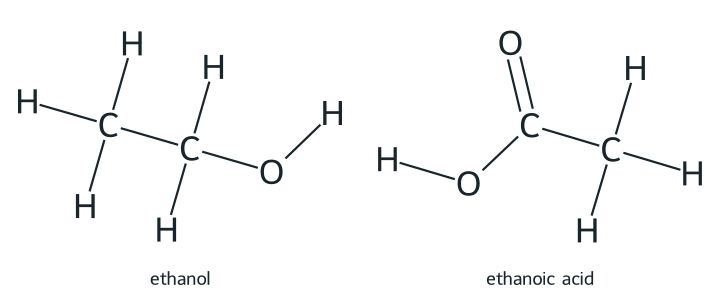
View figure data
| Molecule | Molecular formula | Functional group | Atoms on the second carbon |
|---|---|---|---|
| ethanol | C2H6O | -OH | 2 H and -OH |
| ethanoic acid | C2H4O2 | -CO2H | =O and -OH |
Atmospheric oxygen is the oxidant in vinegar production, where bacteria catalyse the conversion:
Exposure to air does not mean every bottle of ethanol instantly becomes an acid. The oxygen participates in an oxidation process under suitable conditions.
Acidified potassium manganate(VII) also oxidises ethanol to ethanoic acid. When a small amount of its purple solution reacts with sufficient ethanol, the purple colour disappears as the manganate(VII) is reduced. Unused excess reagent can leave the solution purple.
Using [O] to represent oxygen supplied by the oxidising agent:
This is a balanced shorthand for the organic change, not a full equation containing every species from the acidified reagent. The OH position affects alcohol oxidation; do not assume that all the alternative alcohol structures give carboxylic acids in this way.
Balance and explain the changes
Common misconception 1
Combustion equation
Learner equation
Count oxygen on both sides, including ethanol
View solution step by step
Balance carbon and hydrogen
Method
Use two carbon dioxide and three water molecules.Reason
Ethanol contains two C atoms and six H atoms.Working
C₂H₅OH + O₂ → 2CO₂ + 3H₂O.Count every oxygen source
Method
Use three O₂ molecules.Reason
The products contain seven O atoms; ethanol already supplies one, so O₂ must supply the remaining six.Working
C₂H₅OH(l) + 3O₂(g) → 2CO₂(g) + 3H₂O(l).
Guided practice 2
Two routes to ethanoic acid
Guided reaction comparison
Connect both routes to the same product
Hints
Hint 1: two oxidants
Hint 2: organic change
View solution step by step
State the atmospheric route
Method
Use atmospheric oxygen, with bacteria catalysing the process.Reason
In vinegar production, bacteria catalyse the oxidation of ethanol using oxygen from air.Working
C₂H₅OH + O₂ → CH₃COOH + H₂O.State the reagent route
Method
Use acidified potassium manganate(VII) and record purple to colourless.Reason
The reagent is reduced while oxidising ethanol to the same organic product.Working
C₂H₅OH + 2[O] → CH₃COOH + H₂O; product: ethanoic acid.
Try without prompts
Mind stretcher 1: Follow the reactions through a processExtension
Glucose solution is fermented with yeast in a warm vessel fitted with an airlock. The ethanol-rich product is later exposed to oxygen with the bacteria used in vinegar production. Identify the organic product at each step and explain why the air conditions differ. In a separate test, a small amount of acidified purple potassium manganate(VII) remains purple: does that observation alone prove there is no ethanol? Explain.
Show answer
First, fermentation makes ethanol and carbon dioxide; the airlock limits incoming oxygen while CO2 escapes. Second, bacteria use oxygen to oxidise ethanol into ethanoic acid, so oxygen is now a reactant. The conditions suit different processes.
A remaining purple colour alone is not proof that ethanol was absent. Some reagent may remain unreacted, for example because it was in excess or the reaction was incomplete. Interpret the observation with the quantities and reaction conditions. When the small amount of reagent is fully used up in the prescribed ethanol oxidation test, purple changes to colourless.
Bring the reactions together
Complete combustion produces carbon dioxide and water; the studied oxidation to ethanoic acid keeps ethanol’s two-carbon skeleton. The oxygen already in ethanol counts in both cases. Use the reacting substances and conditions to interpret a colour change; an observation alone does not identify every possible product.
Practise and check
Use the Organic Chemistry topic check to practise and check your understanding.
Syllabus and review details
- SEC G3 Pure Chemistry 2027 · 2027
Content structure and subject content, PDF pages 9–24
Last reviewed: