Speed of Reaction
Rate of reaction: define change per unit time, choose a measurable quantity, calculate rates with units and interpret reaction graphs.
Continue where you stopped
The core idea
On this page
Learning objectives
- interpret data obtained from experiments concerned with rate of reaction.
Reaction rate is measurable: state what changes, divide by the time taken, and include a rate unit.
1. Definition
A. Speed (Rate) of Reaction
The speed of reaction (rate of reaction) is the change in amount of reactant used up or product formed per unit time.
B. Reactants and Products
- Reactants: starting substances used up in a reaction.
- Products: new substances formed in a reaction.
2. Key Ideas
- As a reaction proceeds, reactants decrease and products increase.
- Rate is always “change per time”, so it must have units (e.g., cm³/s, g/min, mol dm⁻³/s).
- You can find rate by measuring an observable change (mass, gas volume, colour, pH, precipitate, etc.).
- A reaction can be fast but produce very little product if the amount of reactant is small. Do not confuse rate with amount.
| Representation | What it tells you |
|---|---|
| Macroscopic | an observable quantity changes, such as gas volume increasing or mass decreasing |
| Particle | reactant particles are converted into product particles during effective collisions |
| Symbolic | rate is expressed as a change divided by a time interval, with a unit such as cm³ s⁻¹ |
Rate of reaction = amount of reactant used up or product formed per unit time.
3. Detailed Explanations
- Rate of reaction = amount of reactant used up or product formed per unit time.
- Average rate = change/time and your unit must include “per time” (e.g. cm³/s, g/min).
- Choose an observable change (gas volume, mass loss, colour/pH change, precipitate forming) to measure rate.
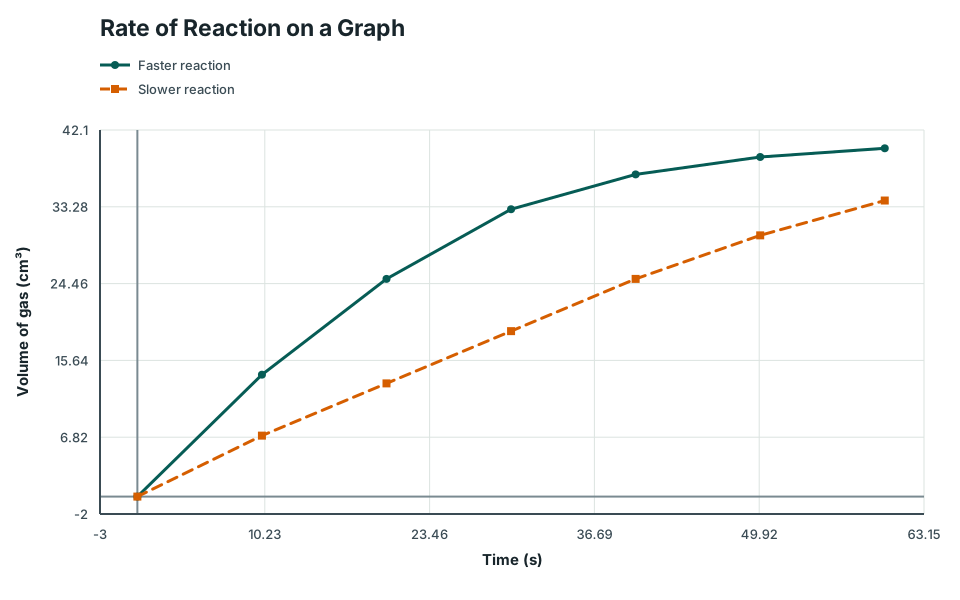
- On a change–time graph, a steeper gradient means a faster rate.
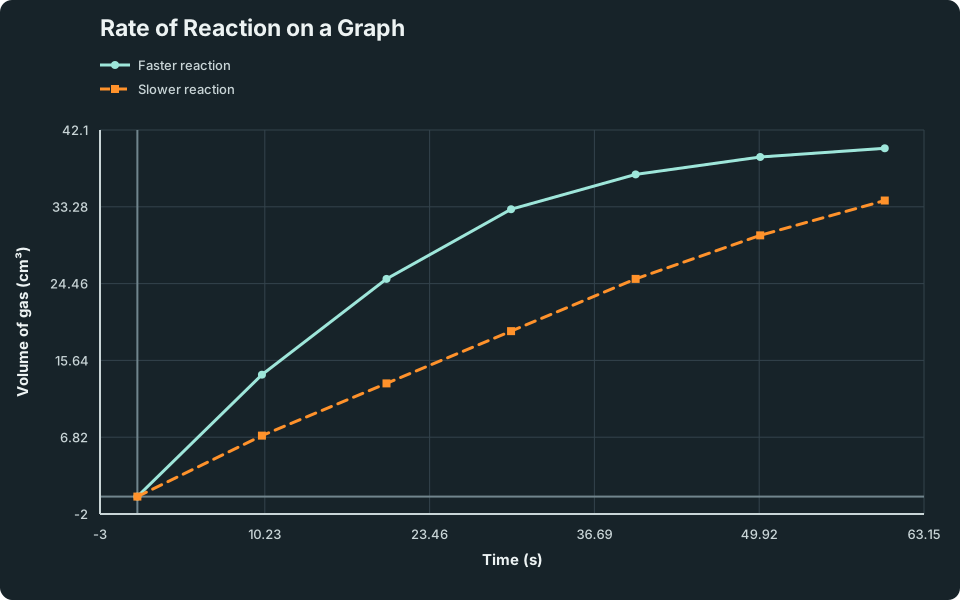
Rate of Reaction on a Graph
Two volume-of-gas vs time curves showing a faster reaction with a steeper gradient reaching the final volume sooner.
Scroll across the graph to read all labels.
View figure data
| Time (s) | Faster reaction | Slower reaction |
|---|---|---|
| 0 | 0 | 0 |
| 10 | 14 | 7 |
| 20 | 25 | 13 |
| 30 | 33 | 19 |
| 40 | 37 | 25 |
| 50 | 39 | 30 |
| 60 | 40 | 34 |
A. What “Per Unit Time” Means
If you measure how much product forms in 40 seconds, you can calculate the average rate:
Examples of “change” that examiners accept:
| What changes? | What you actually measure | Typical unit |
|---|---|---|
| Gas produced | volume of gas | cm³ s⁻¹ |
| Gas escapes | mass decreases | g min⁻¹ |
| Solution concentration | concentration changes | mol dm⁻³ s⁻¹ |
| Precipitate forms | time until a mark disappears | seconds (then rate is “faster” = shorter time) |
B. Try this next
This page is the “what” (definition and what can be measured). The “how” is next:
4. Common Mistakes
- Writing “rate is how fast a reaction happens” without stating the measurable change per unit time.
- Forgetting “per unit time” (you lose the definition mark).
- Confusing rate with time taken: shorter time usually means faster rate, but you must state the condition (same amount of reactant/product).
- Measuring the wrong thing (e.g., measuring “volume of air” instead of gas produced).
- Not stating units.
5. Exam Tips
Rate must have “per time” units. If your answer has no time unit, it is wrong.
- If given data in a table, rate is often “change in volume/mass/concentration ÷ time”.
- If asked for a method, write what you measure (e.g., “measure volume of gas every 10 s using a gas syringe”).
- When comparing two reactions, make sure the comparison is fair (same conditions, same amount measured).
6. Worked Examples
Modelled example 1
Calculate an Average Rate (Gas Volume)
Problem
Study the worked solution
Identify the measurable change
Method
Use the 48 cm³ increase in gas volume.Reason
Average rate compares the amount of product formed with the elapsed time.Working
Change = 48 cm³; time = 60 s.Divide change by time
Method
Calculate volume formed per second.Reason
“Per unit time” means divide the measured change by the time interval.Working
rate = 48/60 = 0.80 cm³ s⁻¹.Report the rate
Method
Include the volume-per-time unit and two significant figures.Reason
The unit states what changed and the time basis; 0.80 matches the two significant figures in 48.Working
0.80 cm³ s⁻¹.
Guided practice 2
Calculate an Average Rate (Mass Loss)
Problem
Complete the change-per-time calculation
Hints
Hint 1: definition
Hint 2: unit
View solution step by step
Divide mass loss by time
Method
Divide 1.6 g by 4.0 min.Reason
The escaping gas causes a measurable mass decrease per unit time.Working
rate = 1.6/4.0 = 0.40.Attach the rate unit
Method
Report grams per minute.Reason
The numerator is mass change and the denominator is time in minutes.Working
0.40 g min⁻¹.
Common misconception 3
Spot the Bad Definition
Learner definition
Separate rate from completion time
View solution step by step
Identify the vague quantity
Method
Reject “how quickly” without a measurable change.Reason
A reaction can finish sooner because less reactant was present, even if its rate was not higher.Working
Completion time alone mixes rate with amount.Give the measurable definition
Method
State change in reactant or product per unit time.Reason
This identifies both what changes and the time denominator.Working
Rate of reaction is the amount of reactant used up or product formed per unit time.
Challenge 4
Choose a Suitable Observable Change
Method transfer
Connect reaction evidence to a rate
Hints
Hint 1: read the equation
View solution step by step
Choose a product-linked observable
Method
Measure hydrogen volume as it forms.Reason
Hydrogen is a gaseous product, so its increasing volume tracks product formation.Working
Collect H₂ with a gas syringe at regular times.Define the rate quantity
Method
Calculate hydrogen volume formed per unit time.Reason
The unit must identify both the measured change and the time basis.Working
For example, rate in cm³ s⁻¹.
7. Mind Stretchers
Mind stretcher 1: Same Total Gas, Different RateExtension
Two experiments both produce 60 cm³ of gas in total. Experiment A reaches 60 cm³ in 30 s, Experiment B reaches 60 cm³ in 90 s. Which has the higher average rate? Explain.
Show Answer
Experiment A. For the same change (60 cm³), it takes less time, so rate is higher: 60/30 = 2.0 cm³/s vs 60/90 = 0.67 cm³/s.
Mind stretcher 2: “Fast” Does Not Mean “More”Extension
Experiment X is fast but produces only 10 cm³ of gas. Experiment Y is slower but produces 80 cm³. What does this tell you about confusing rate with amount?
Show Answer
Rate is about how quickly change happens; amount is how much change happens. A fast reaction can still produce a small amount if there is little reactant.
8. Quiz
The shared K324 / 6092 practice includes definitions, units and measurement choices from this lesson.
K324 / 6092 Practice