Solution Concentration and Dilution
Use n = cV and the dilution rule, converting volume units correctly.
On this page
Most stoichiometry questions use solutions somewhere, such as in titrations, ionic equations or solution preparation. Start by converting V to dm³, then use n = cV. Use c₁V₁ = c₂V₂ only for dilution, when no reaction occurs.
Build on the mole and Avogadro constant, using your course’s Stoichiometry topic navigation to review them when needed. Keep unit conversions and mole ratios together in your working.
What this page is really testing
- Can you choose the right equation for the scenario (n = cV vs c₁V₁ = c₂V₂)?
- Can you keep units consistent, especially cm³ to dm³?
- Can you state clearly when a question is dilution-only versus reaction stoichiometry?
Definitions (Must Know)
A. Amount concentration
The amount concentration is:
where c is in mol dm⁻³ and V is in dm³.
Key Ideas (What Earns Marks)
- Always convert volume to dm³: 1000 cm³ = 1 dm³.
- For dilution of the same solute: c₁V₁ = c₂V₂.
- Moles in solution: n = cV.
- V(dm³) = V(cm³)/1000
- n = cV (only if V is in dm³)
- c₁V₁ = c₂V₂ is for dilution only (no reaction)
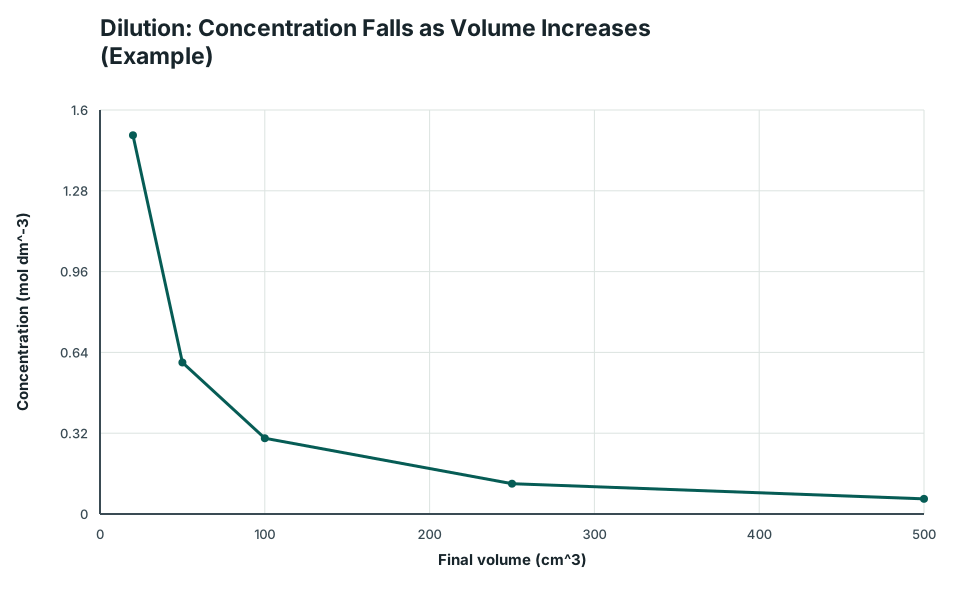
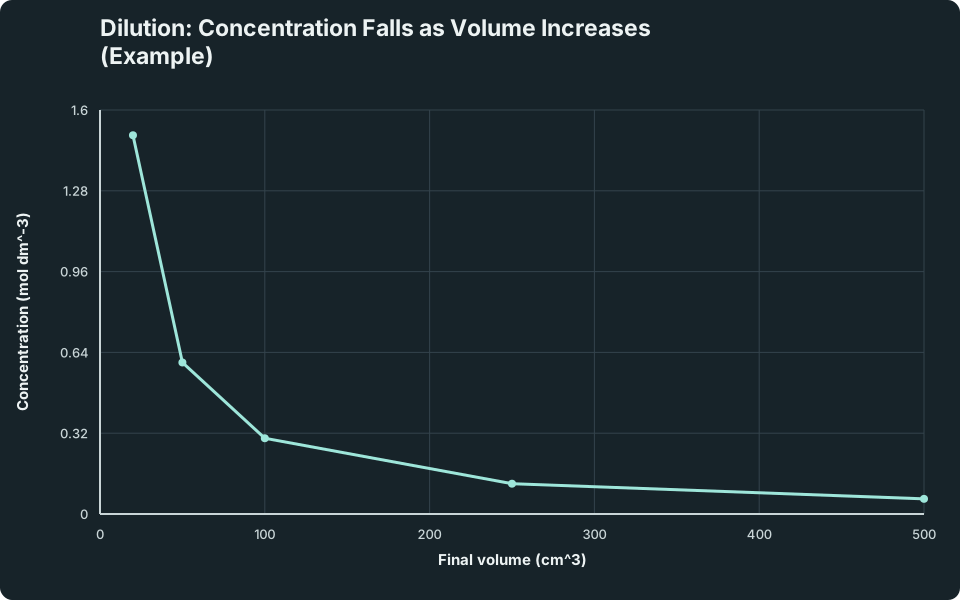
Dilution: Concentration Falls as Volume Increases (Example)
Dilution: Concentration Falls as Volume Increases (Example). c vs V (same moles) plotted as Concentration against Final volume.
Scroll across the graph to read all labels.
View figure data
| Final volume (cm^3) | c vs V (same moles) |
|---|---|
| 20 | 1.5 |
| 50 | 0.6 |
| 100 | 0.3 |
| 250 | 0.12 |
| 500 | 0.06 |
Detailed Explanations
A. Unit discipline
If a volume is given in cm³, convert:
Mini example:
- 25.0 cm³ = 0.0250 dm³
B. Using n = cV (workflow)
- Convert V to dm³.
- Calculate moles: n = cV.
- If needed, rearrange to find c or V.
C. Dilution equation (why it works + workflow)
Because dilution adds water but does not change moles of solute, n₁ = n₂.
Using n = cV: c₁V₁ = c₂V₂
Use c₁V₁ = c₂V₂ only when:
- the solute is the same (no reaction), and
- concentration units match on both sides, and
- volume units match on both sides.
Mini example:
- 20.0 cm³ of 1.50 mol dm⁻³ diluted to 250 cm³ gives c₂ = (1.50 × 20.0)/250 = 0.120 mol dm⁻³.
D. Converting between g dm⁻³ and mol dm⁻³
If a concentration is given in g dm⁻³, convert using molar mass:
Mini example:
- 8.00 g dm⁻³ of NaOH is 8.00/40.0 = 0.200 mol dm⁻³.
E. Worked setup method for dilution prep questions
For “how would you prepare…” prompts, this sequence is fast and mark-safe:
- Calculate the stock volume required using c₁V₁ = c₂V₂.
- Pipette that stock volume into a volumetric flask.
- Add distilled water to the calibration mark.
- Stopper and invert several times to mix thoroughly.
This avoids the common “beaker + top-up” method that loses accuracy marks.
Worked Examples
Modelled example 1
Calculate Amount in a Solution Aliquot
Problem
Study the worked solution
Convert the volume
Method
Divide the volume in cubic centimetres by 1000.Reason
The concentration unit is per cubic decimetre, so V must be expressed in dm ³.
Working
V = 25.0/1000 = 0.0250 dm ³Apply the concentration relationship
Method
Use n = cV.Reason
Concentration multiplied by solution volume gives solute amount.
Working
n = (0.200)(0.0250) = 0.00500 mol
Guided practice 2
Calculate a Diluted Concentration
Problem
Try this before viewing the solution
Hints
Hint 1: identify what is conserved
Dilution adds water but does not change the amount of HCl.
Hint 2: use matching volume units
Because both volumes are in cm ³, use them directly in c₁V₁ = c₂V₂.
View solution step by step
Use the dilution relationship
Method
Set c₁V₁ = c₂V₂.Reason
The solute is unchanged and no reaction occurs.Working
(1.50)(20.0) = c₂(250)Rearrange
Method
Divide by the final volume.Reason
The tenfold-plus volume increase reduces concentration in the same proportion.Working
c₂ = (1.50)(20.0)/250 = 0.120 mol dm⁻³
Common misconception 3
Correct the Cubic-centimetre Error
Learner attempt
For 25.0 cm³ of 0.200 mol dm⁻³ NaOH, a learner writes n = cV = (0.200)(25.0) = 5.00 mol. Identify the first error and correct the amount.
Diagnose before recalculating
View solution step by step
Correct the volume unit
Method
Convert 25.0 cm ³ to 0.0250 dm ³.
Reason
Using cubic centimetres directly makes the result too large by a factor of 1000.
Working
V = 25.0/1000 = 0.0250 dm ³Recalculate
Method
Multiply concentration by the converted volume.Reason
The units now cancel to moles.Working
n = (0.200)(0.0250) = 0.00500 mol
Examiner practice 4
Prepare a Dilution Accurately
Problem
Describe how to prepare 500 cm³ of 0.100 mol dm⁻³ NaCl from 2.00 mol dm⁻³ stock solution. Include the stock volume required. [4 marks]
Try this before viewing the solution
View solution step by step
Calculate stock volume
1 markMethod
Rearrange c₁V₁ = c₂V₂ for V₁.Reason
The amount of sodium chloride transferred from stock equals the amount in the final solution.Working
V₁ = (0.100)(500)/(2.00) = 25.0 cm³Transfer accurately
1 markMethod
Pipette 25.0 cm³ stock into a 500 cm³ volumetric flask.Reason
Volumetric apparatus measures the required aliquot and final volume accurately.Working
Use a volumetric pipette and flask.Dilute to the mark
1 markReason
The calibration mark defines the final 500 cm³ solution volume.Working
Add distilled water to the calibration mark.Mix the solution
1 markMethod
Stopper and invert the flask several times.Reason
Mixing makes the concentration uniform throughout the flask.Working
The prepared solution is 0.100 mol dm⁻³.
Self-mark with the mark scheme
Compare your response with each mark point. Select a point only when your response contains that evidence.
Credit the calculated aliquot and three essential volumetric-preparation actions separately.
Challenge 5
Dilute a Mass-concentration Stock
Problem
A stock solution contains 9.80 g dm⁻³ H₂SO₄. A 25.0 cm³ aliquot is diluted to 250 cm³. Calculate the final concentration in mol dm⁻³. Use M(H₂SO₄) = 98.0 g mol⁻¹.
Try this before viewing the solution
Hints
Hint 1: convert the concentration representation
Divide the mass concentration by molar mass.
Hint 2: identify the dilution factor
The final volume is ten times the aliquot volume.
View solution step by step
Convert to molar concentration
Method
Divide grams per cubic decimetre by grams per mole.Reason
The dilution calculation requires the stock concentration on a molar basis.Working
c₁ = 9.80/98.0 = 0.100 mol dm⁻³Apply the dilution
Method
Use c₂ = c₁V₁/V₂.Reason
The same sulfuric acid amount is spread through ten times the volume.Working
c₂ = (0.100)(25.0)/250 = 0.0100 mol dm⁻³
Common Mistakes
- Plugging V in cm³ directly into n = cV without converting.
- Using c₁V₁ = c₂V₂ when a reaction happens (it is for dilution only).
- Mixing mol dm⁻³ with mol L⁻¹ without stating they are equivalent.
Use the topic check in Practise and check below to practise and check your understanding.
Exam Tips
- Write the conversion line: “25.0 cm³ = 0.0250 dm³”.
- If the question asks for moles first, do n = cV before any ratios.
A. Phrase-level wording reminders
- “Using n = cV with volume in dm³, the amount is … mol.”
- “c₁V₁ = c₂V₂ is valid here because this is dilution of the same solute.”
- “The limiting reagent is …, so its moles are used for the concentration calculation.”
- “Answer to 3 s.f. to match given concentration/volume data.”
Mind Stretchers
Connect This To
- Titration Calculations in your course’s topic navigation for concentration calculations with mole ratios.
- Reacting Masses and Limiting Reagent in your course’s topic navigation for choosing the correct mole basis in mixed questions.
- Further H2 practical study: Data Tables, Graphs, and Uncertainty for preparation-method accuracy language in practical writeups.
Practice Route
- Solve one n = cV and one c₁V₁ = c₂V₂ question back-to-back and compare method lines.
- Complete the topic check in Practise and check below for speed and unit discipline.
- Check command-word phrasing in Exam Skills.
Mind stretcher 1Extension
A student prepares 500 cm³ of 0.100 mol dm⁻³ Na₂CO₃ solution. How many grams of Na₂CO₃ are needed? (M(Na₂CO₃) = 106 g mol⁻¹)
Show Hint
For a dilution, moles of the same solute are unchanged. For a reaction, calculate each reactant amount separately.
Show Answer
Mark scheme:
- V = 500/1000 = 0.500 dm³
- n = cV = 0.100 × 0.500 = 0.0500 mol
- Mass = nM = 0.0500 × 106 = 5.30 g
Mind stretcher 2: Concentration after neutralisationExtension
Question. 25.0 cm³ of 0.200 mol dm⁻³ HCl is mixed with 20.0 cm³ of 0.150 mol dm⁻³ NaOH. Find the concentration of excess H⁺, assuming additive volumes.
Show Hint
Find both amounts, subtract using the 1:1 equation, then divide by the total volume.
Show Answer
n(H⁺) = 0.200(0.0250) = 0.00500 mol and n(OH⁻) = 0.150(0.0200) = 0.00300 mol. Excess H⁺ = 0.00200 mol in 0.0450 dm³, so [H⁺] = 0.0444 mol dm⁻³.
Syllabus and review details
- GCE A-Level H2 Chemistry 9476-2027 · 9476-2027
9476 (2027), complete syllabus
Last reviewed: