Dative Bonding and Common Examples
Explain dative bonding in the ammonium ion and the aluminium chloride dimer.
On this page
A dative bond is an exam favourite because the marks are mostly in the arrow direction. If you can reliably identify the donor (lone pair) and acceptor (electron-deficient), you can pick up easy marks.
Build on atomic structure, then use your course’s Chemical Bonding topic navigation to compare models across the topic.
Definitions (Must Know)
A. Dative covalent (coordinate) bond
A dative covalent bond is a covalent bond where both electrons in the shared pair come from the same atom.
B. Electron-pair donor
An electron-pair donor is a species that donates a lone pair to form a dative bond.
C. Electron-pair acceptor
An electron-pair acceptor is a species that accepts a lone pair to form a dative bond.
Key Ideas (What Earns Marks)
- A dative bond is still a covalent bond (shared pair attraction).
- It forms when one species has a lone pair (donor) and the other has an empty orbital / is electron-deficient (acceptor).
- The arrow shows the direction of electron-pair donation: donor → acceptor.
- Once formed, a dative bond is treated like an ordinary covalent bond (it is not automatically “weaker”).
Required donors and acceptors:
- in ammonium formation, N in NH₃ donates and H⁺ accepts;
- in Al₂Cl₆, a terminal Cl on each AlCl₃ unit donates and the electron-deficient Al in the other unit accepts.
- Donor = has a lone pair available to share. - Acceptor = positive or electron-deficient and has an orbital available for the pair. - Arrow direction is about the electron pair: donor atom → acceptor atom.
Detailed Explanations
A. Donor vs acceptor (how to spot them)
- Donor: has a lone pair on the atom that will bond (often N/O/halide ions).
- Acceptor: electron-deficient or positively charged (can accept a lone pair into an empty orbital).
In NH₃ + H⁺ → NH₄⁺, N has a lone pair (donor) and H⁺ has no electrons (acceptor).
B. How to draw a dative bond (workflow)
- Identify the donor atom (where the lone pair is).
- Identify the acceptor atom (electron-deficient/positive).
- Draw the arrow from donor to acceptor (this arrow shows where the shared pair came from).
- Check overall charge after forming the bond.
For NH₃ + H⁺ → NH₄⁺, draw the arrow from N to H and place the product in brackets with overall charge + 1.
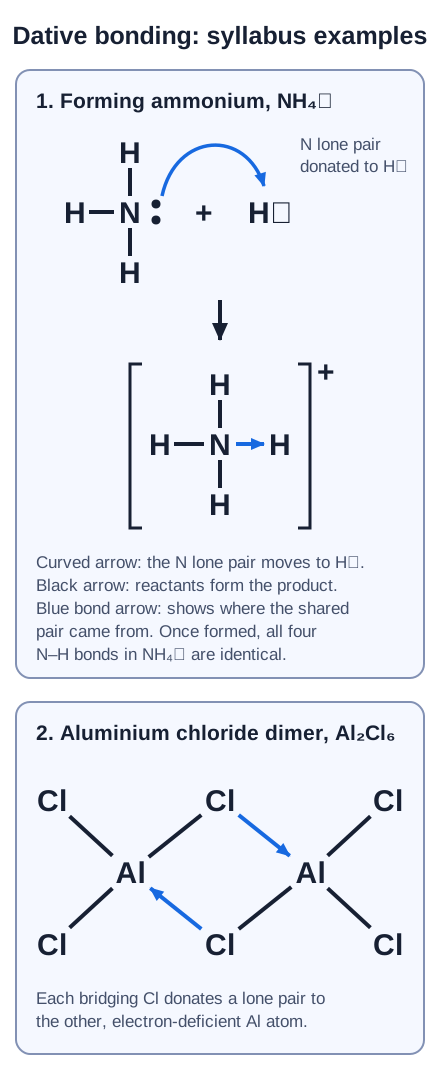
C. Common examples you must recognise
- NH₃ + H⁺ → NH₄ +
- Al₂Cl₆ contains dative bonds from Cl lone pairs to electron-deficient Al centres.
What to say for Al₂Cl₆:
- AlCl₃ is electron-deficient (Al has an incomplete octet).
- One terminal Cl from each AlCl₃ unit donates a lone pair to the Al atom in the other unit.
- The product has two bridging Cl atoms and two dative bonds in total—not four.
Worked Examples
Modelled example 1
Identify the Donor in Ammonium Formation
Problem
In the formation of NH₄ + from NH₃ and H⁺, which species donates the electron pair?
Study the worked solution
Find the available lone pair
Method
Identify the lone pair on nitrogen in NH₃.Reason
A dative-bond donor supplies both electrons in the new shared pair.Working
:NH₃ is the electron-pair donor.Identify the acceptor
Method
Identify H⁺ as electron-deficient.Reason
The proton can accept the nitrogen lone pair.Working
H⁺ is the electron-pair acceptor.State the donation direction
Method
Direct the pair from nitrogen to the proton.Reason
The arrow follows the electron pair from donor to acceptor.Working
NH₃ → H⁺ forms NH₄ +.
Guided practice 2
Complete the Ammonium Formation Diagram
Problem
Describe the three features that a diagram of NH₃ + H⁺ → NH₄ + must show to represent the dative bond unambiguously.
Try this before viewing the solution
Hints
Hint 1: start at the donor
Show the nitrogen lone pair before bond formation.
Hint 2: finish the product
The arrow points to H, and the complete product has an overall + 1 charge.
View solution step by step
Show the donated pair
Method
Draw the lone pair on nitrogen in NH₃.Reason
Both electrons in the new bond originate from nitrogen.Working
:NH₃Direct the arrow
Method
Draw the arrow from N to H⁺.Reason
The arrow records electron-pair donation from donor to acceptor.Working
N → H⁺Show the product charge
Method
Place the ammonium product in brackets with overall charge + 1.Reason
The product contains the incoming proton and remains a cation.Working
[NH₄]⁺
Common misconception 3
Correct a Reversed Dative Arrow
Learner attempt
A learner draws the ammonium-formation arrow from H⁺ towards N because “the proton moves towards ammonia.” Identify the error and correct the arrow direction.
Follow the electron pair
View solution step by step
Identify what the arrow represents
Method
Treat the arrow as electron-pair movement, not nuclear motion.Reason
The donor is defined by supplying both bonding electrons.Working
Nitrogen supplies the lone pair.Correct the direction
Method
Draw the arrow from N to H⁺.Reason
NH₃ is the donor and H⁺ is the acceptor.Working
N → H⁺
Examiner practice 4
Analyse the Aluminium Chloride Dimer
Problem
How many dative bonds and bridging chlorine atoms are present in Al₂Cl₆? State the donor and acceptor. [4 marks]
Try this before viewing the solution
View solution step by step
Count the bridges
1 markMethod
Identify the two chlorine atoms shared between the aluminium centres.
Reason
These are the bridging chlorine atoms in the dimer.Working
Two bridging Cl atoms.Count the dative bonds
1 markMethod
Count one donation across each reciprocal bridge.Reason
Each AlCl₃ unit supplies one donor chlorine to the other unit.
Working
Two dative bonds in total.Identify the donor
1 markMethod
Name chlorine as the electron-pair donor.Reason
A lone pair on a bridging chlorine supplies the shared pair.
Working
Donor: Cl in one AlCl₃ unit.Identify the acceptor
1 markMethod
Name aluminium in the other unit as acceptor.Reason
The aluminium centre is electron-deficient and accepts the lone pair.
Working
Acceptor: Al in the other AlCl₃ unit.
Self-mark with the mark scheme
Compare your response with each mark point. Select a point only when your response contains that evidence.
Credit both counts and both donor–acceptor identifications separately.
Challenge 5
Interpret the Bonds after Ammonium Forms
Problem
A diagram marks one N–H bond in NH₄ + as having formed by lone-pair donation. A learner concludes that this bond remains a different, automatically weaker type of bond than the other three N–H bonds. Evaluate the conclusion.
Try this before viewing the solution
Hints
Hint 1: separate formation from the product
The arrow records where the shared pair originated during formation.
Hint 2: classify the formed bond
Once formed, a dative bond is treated as an ordinary covalent bond.
View solution step by step
Interpret the arrow correctly
Method
Use it to identify the original electron-pair donor.Reason
The arrow is a record of bond formation, not a permanent label of weaker electrons.Working
The marked pair originally came from nitrogen.Evaluate the product bonds
Method
Reject the claim that the donated-pair bond remains automatically weaker or distinct.Reason
After formation it is a covalent N–H bond and is treated like the other N–H bonds in NH₄ +.Working
The four N–H bonds in ammonium are equivalent.
Common Mistakes
- Drawing an arrow from the acceptor to the donor (arrow shows electron-pair donation).
- Forgetting that the overall species charge must match (e.g. NH₄ +).
- Calling a dative bond “weaker”: once formed, it is just a covalent bond.
Use the topic check in Practise and check below to practise and check your understanding.
Exam Tips
- Show the dative bond with an arrow from the lone-pair donor atom to the acceptor atom.
- If asked for donor/acceptor, state both and add “donates/accepts an electron pair”.
- Don’t forget overall charges on complex/ions (common mark loss).
Mind Stretchers
Mind stretcher 1Extension
Explain why AlCl₃ forms Al₂Cl₆ and identify the donor and acceptor in the dative bond.
Show Answer
Mark scheme:
- In AlCl₃, Al is electron-deficient (does not have a full octet).
- A lone pair on Cl can be donated into an empty orbital on Al to form a dative bond.
- Donor: a Cl atom (lone pair). Acceptor: Al in AlCl₃.
- Dimer formation increases the electron count around Al (more stable structure).
Syllabus and review details
- GCE A-Level H2 Chemistry 9476-2027 · 9476-2027
9476 (2027), complete syllabus
Last reviewed: