Planning a chemistry investigation
Planning (Paper 3): identify IV/DV/control variables, write a fair-test method, include safety, and state what results/data to record.
On this page
A useful plan lets another person carry out an investigation and judge what the results show. Define what you will change, what you will measure and how you will control other relevant factors.
What the skill involves
Planning means choosing a method that can answer an investigation question. In a controlled comparison, make it a fair test: change the independent variable, measure its effect and keep other relevant factors constant.
What you need to know
- Independent variable (IV): what you change.
- Dependent variable (DV): what you measure.
- Control variables: what you keep constant to make it a fair test.
- Plan repeat readings and calculate a mean to improve reliability.
- Write methods with measurements (amounts, times, volumes) and apparatus (what you will use).
Putting the skill into practice
- State how each relevant control will be maintained.
- Repeat measurements at each independent-variable value to check agreement. Investigate unusual results before choosing which readings to average.
- Name the measured quantity, apparatus and unit, such as gas volume in cm³ using a gas syringe.
Defining the variables
| Term | What it means | Example (rate of reaction) |
|---|---|---|
| IV | what you deliberately change | concentration of acid |
| DV | what you measure | volume of gas in 60 s |
| Control variable | what you keep constant | mass of marble, temperature, surface area |
Writing a repeatable method
Write your plan like this:
- Set up apparatus (name it).
- State measured amounts (mass, volume, concentration).
- Start timing when you mix the reactants.
- Measure DV (what readings, how often, units).
- Repeat measurements, record their spread, investigate unusual results and calculate appropriate means.
- Change IV across a safe, practical range, with enough values to reveal the trend.
- Safety hazards + precautions.
“Keep temperature constant” is incomplete. Write how: e.g., “use a water bath at 25°C for every trial”.
Choosing what to measure (DV)
Common Paper 3 choices:
| What you measure | Typical experiment | Comment |
|---|---|---|
| volume of gas vs time | acid + carbonate / magnesium + acid | good for graphs and rate |
| mass loss vs time | gas escapes from reaction | must prevent splashing |
| time for a fixed change | cloudiness / cross disappears | define the end-point clearly |
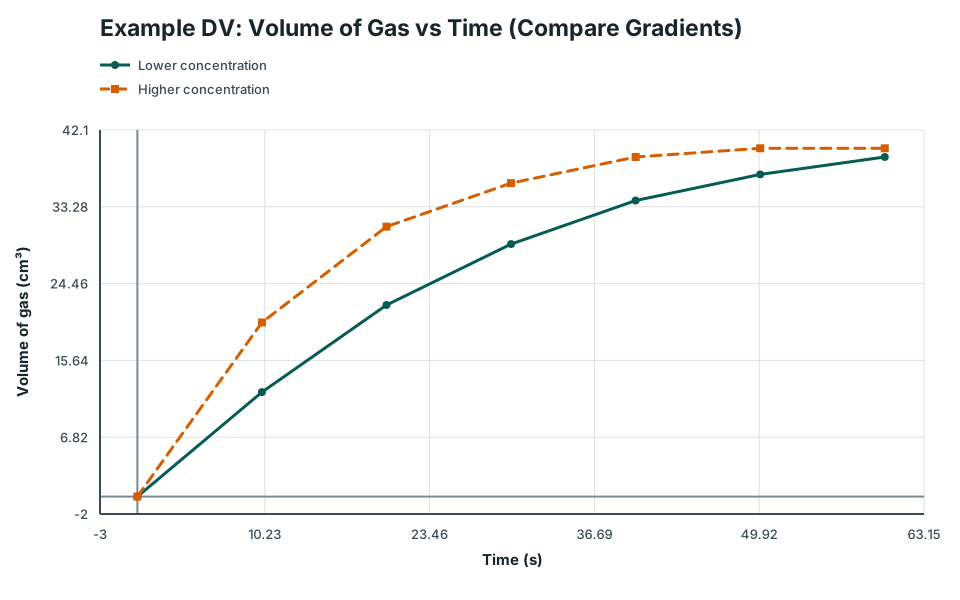
For a gas-producing reaction, gas volume against time lets you compare gradients, which represent the rate of gas collection. Use an airtight setup and a freely moving syringe plunger:
Example DV: Volume of Gas vs Time (Compare Gradients)
Example curves showing how changing conditions affects the gradient (rate) while reaching a similar final volume.
Scroll across the graph to read all labels.
View figure data
| Time (s) | Lower concentration | Higher concentration |
|---|---|---|
| 0 | 0 | 0 |
| 10 | 12 | 20 |
| 20 | 22 | 31 |
| 30 | 29 | 36 |
| 40 | 34 | 39 |
| 50 | 37 | 40 |
| 60 | 39 | 40 |
Avoiding common mistakes
- Changing more than one variable at once (not a fair test).
- Writing “measure the results” with no unit / no apparatus.
- No repeats (or no mean) when repeats are expected.
- Control variables listed without a method for controlling them.
- Unclear end-point (e.g., “until it changes” with no definition).
Explaining your method
“Keep the mass of marble constant by using 0.20 g each time.”
“Keep the temperature constant using a water bath at 25°C.”
“Keep total volume constant by adding water to make 50.0 cm³ each time.”
Worked examples
Modelled example 1
Plan Concentration Against Reaction Rate
Problem
Plan an experiment to investigate how hydrochloric acid concentration affects the rate of reaction with marble chips. Include the variables, method, reliability and safety.
Study the worked solution
Define IV and measurable DV
Method
Change only the concentration of HCl(aq) and measure the volume of CO₂(g) at regular time intervals using a gas syringe.
Reason
Repeated volume readings produce a gas-volume–time graph whose gradient represents rate.
Working
IV: acid concentration. DV: gas volume / cm³ at stated times / s.
Operationalise the controls
Method
Use 0.20 g of marble from the same size range and 50.0 cm³ of acid at each chosen concentration, for example across 0.10–0.20 mol dm⁻³. Bring the reactants to the same measured starting temperature for every trial.
Reason
Marble mass and surface area, total solution volume and temperature can otherwise affect the comparison. Changing concentration at fixed volume changes the amount of acid, so keep acid in excess in every trial if you want the same final amount of carbon dioxide.
Working
For example, make each mixture to 50.0 cm³ and equilibrate it in a 25°C water bath.
Write a repeatable method
Method
Connect the flask to a 100 cm³ gas syringe with the acid and marble initially separated inside it, for example with the acid in a small inner tube. Fit the bung, check that the plunger moves freely, then tilt the flask to mix the reactants and start timing. Record gas volume every 10 s for 60 s; continue longer if needed to observe the plateau.
Reason
Named apparatus, amounts and timings allow another person to repeat the investigation consistently.
Working
Use several concentrations across the chosen range, keeping the same timing schedule for each.
Add reliability and safety
Method
Repeat every concentration, investigate anomalies and calculate means; wear eye protection and avoid contact with the acid.
Reason
Repeats expose random variation, while the precaution addresses the labelled irritant or corrosive hazard.
Working
Plot mean gas volume against time for each concentration and compare initial gradients.
Guided practice 2
Choose a Useful Dependent Variable
Problem
You want to compare reaction rates at different acid concentrations. Which dependent variable gives the most useful graph for analysis, and what feature of the graph represents rate?
Try this before viewing the solution
Hints
Hint 1: more than one reading
Choose a measurement that changes throughout the reaction.
Hint 2: graph feature
Rate is change in gas volume divided by change in time.
View solution step by step
Choose the measurement
Method
Record gas volume at regular time intervals.Reason
Multiple readings show how quickly product forms throughout the reaction rather than giving one isolated result.
Working
Plot gas volume / cm³ against time / s.
Use the graph
Method
Compare gradients over the same part of each curve, normally the initial gradients.
Reason
A steeper gradient means a greater change in gas volume per unit time and therefore a faster rate.
Working
Greater gradient → faster reaction.
Common misconception 3
“Keep It Constant” Is Incomplete
Learner plan
A learner writes, “Keep temperature and marble surface area constant.” Improve both controls so another learner could carry them out.
Try this before viewing the solution
View solution step by step
Operationalise temperature
Method
Use the same water bath at a stated temperature and allow reactants to reach that temperature before mixing.
Reason
Room temperature can drift, and writing “constant” does not describe a control procedure.
Working
For example: use a water bath at 25°C for every trial.
Operationalise surface area
Method
Use marble chips selected from the same defined size range in each trial.
Reason
Equal mass alone does not guarantee equal exposed surface area.
Working
Keep both total mass and chip-size range fixed.
Examiner practice 4
Evaluate a Flawed Rate Plan
Examination question
A learner mixes 10, 20 or 30 cm³ of 0.50 mol dm⁻³ hydrochloric acid with 10 cm³ of water each time. Each mixture reacts with 0.20 g of marble chips. The learner records the time until bubbling stops, without controlling temperature or chip size. Identify three weaknesses and give a specific improvement for each. [6 marks]
Try this before viewing the solution
View solution step by step
Remove the volume confound
2 marksMethod
Identify that total acid volume changes with concentration, then keep total solution volume constant by adding measured water.
Reason
The mixtures have different concentrations and different total volumes. Make each up to the same total volume, while still using different measured volumes of stock acid; acid remains in excess for the stated marble mass.
Working
Use, for example, 50.0 cm³ total solution in every trial.
Replace the endpoint
2 marksMethod
Measure gas volume at regular times with a gas syringe instead of timing until bubbling appears to stop.
Reason
The visual endpoint is subjective and may reflect total reactant amount rather than a well-defined rate comparison.
Working
Plot volume against time and compare initial gradients.
Control another rate factor
2 marksMethod
Keep temperature with a stated water bath and/or keep chip surface area using the same size range.
Reason
Either factor can change collision frequency and rate independently.
Working
State the apparatus or selection method, not just the word “constant”.
Self-mark with the mark scheme
Compare your response with each mark point. Select a point only when your response contains that evidence.
Award one mark for each valid weakness and one for its matched specific improvement.
Challenge 5
Transfer the Plan to Temperature and Magnesium
Problem
Plan how to investigate the effect of temperature on the rate of reaction between magnesium ribbon and dilute hydrochloric acid. State a measurable dependent variable, operational controls, the timing method, reliability and one relevant safety precaution.
Try this before viewing the solution
Hints
Hint 1: change only temperature
Use water baths; keep acid concentration and volume and magnesium amount/surface condition fixed.
Hint 2: synchronise
Allow reactants to reach the selected temperature. Seal the apparatus while they are separated, then mix them and start timing together.
View solution step by step
Define the measurements
Method
Use water baths to set several safe, practical temperatures and collect hydrogen in a gas syringe at regular times.
Reason
Gas volume against time gives a quantitative rate curve for each temperature.
Working
IV: temperature / °C; DV: hydrogen volume / cm³ against time / s.
Control and synchronise
Method
Use the same acid concentration and volume, equal lengths of consistently cleaned magnesium ribbon, and the same apparatus. Use acid in excess and a syringe large enough for the expected hydrogen volume; equilibrate reactants before mixing.
Reason
These controls prevent reactant amount, surface condition or measurement setup from changing with temperature.
Working
Keep the reactants separated inside the sealed gas-collection apparatus, then mix and start timing together. Check the actual starting temperature for each trial.
Make the result dependable
Method
Repeat each temperature, investigate anomalies, calculate means and compare initial gradients.
Reason
Repeats improve reliability and initial gradients give like-for-like rate evidence.
Working
Wear eye protection for the acid and keep hydrogen away from ignition sources.
Try it independently
Mind stretcher 1: Fix the Control Variable ProblemExtension
Question: A student writes: “Keep the surface area constant.” What is a better answer?
Show Answer
Answer: “Keep surface area constant by using marble chips of the same size range and total mass (or use equal lengths from the same magnesium ribbon, cleaned in the same way) in every trial.”
Mind stretcher 2: Planning for ReliabilityExtension
Question: Your repeats give 24.20 cm³, 24.15 cm³, and 22.90 cm³ for the same trial. What should you do and why?
Show Answer
Answer: Flag the unexpected 22.90 cm³ reading, retain it in the record, check for a leak, a timing mistake or inconsistent mixing, and repeat the trial under the same conditions. If an identified fault justifies excluding a trial, record that reason. Being far from the other readings alone is not permission to discard it.
Reason: Repeats help you judge the spread and investigate the unexpected result. Selecting only close readings without justification can bias the reported mean.
Practise and check
See what you know across this topic, then go back to anything you got wrong.
Syllabus and review details
- SEC G3 Pure Chemistry 2027 · 2027
Content structure and subject content, PDF pages 9–24
Last reviewed: