Addition Reactions of Alkenes
Follow ethene through hydrogenation, bromination, hydration and polymerisation, and explain hydrogenation of vegetable oils.
On this page
What changes when atoms add to a double bond? Follow the same pair of carbon atoms through ethene’s reactions, then use the idea to explain polymer formation and the manufacture of margarine.
Follow the double-bond carbons
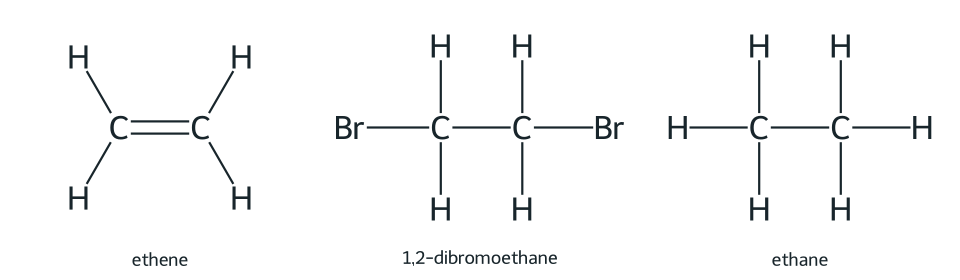
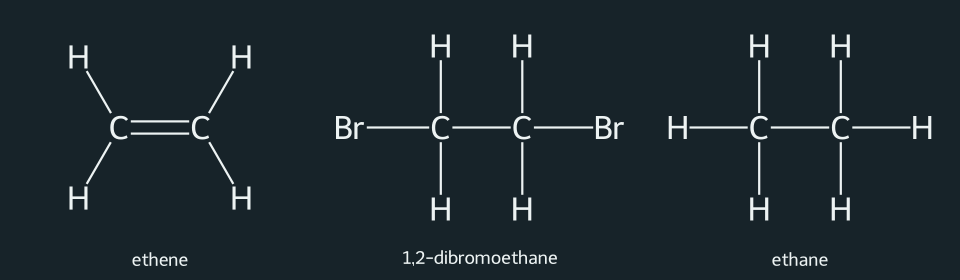
In an addition reaction, atoms from another reactant add across C = C. The carbon–carbon double bond becomes a single bond; a new bond forms at each of those two carbons. They remain connected. For these simple additions to ethene, all atoms of both reactants end up in one product.
Keep the carbon connection and add new atoms
Ethene has a C=C double bond. Each addition product has a single carbon–carbon bond. Bromination adds one Br to each carbon; hydrogenation adds one H to each carbon.
Scroll across the graph to read all labels.
View figure data
| Molecule | Molecular formula | Carbon–carbon bond | Atoms on each carbon |
|---|---|---|---|
| ethene | C2H4 | double | 2 H |
| 1,2-dibromoethane | C2H4Br2 | single | 2 H and 1 Br |
| ethane | C2H6 | single | 3 H |
Hydrogenation
Hydrogen adds across ethene’s double bond to form ethane:
Use a nickel catalyst and heat. Each carbon gains one hydrogen, and the product has no C = C bond. It is saturated. For a molecule with several double bonds, adding one molecule of hydrogen removes only one double bond.
Bromine addition
In the simplified bromine-addition model, one Br atom bonds to each carbon of ethene’s double bond:
The product shown is 1,2-dibromoethane, C₂H₄Br₂. It contains all the atoms of ethene and bromine. It has a carbon–carbon single bond and is no longer a hydrocarbon, because it contains bromine.
Aqueous bromine is also used as the test for unsaturation: its red-brown colour disappears as an alkene reacts. This equation shows the simple addition model; it does not label the organic product as an aqueous solution.
Hydration
Hydration adds the components of water across C = C. One carbon gains H and the other gains OH. Ethene reacts with steam at high temperature and pressure, using a phosphoric(V) acid catalyst, H₃PO₄:
The product is ethanol, not ethane. The equation shows gases in the hot reactor. Ethanol is collected as a liquid after the mixture is cooled. The reaction is reversible; industrial conditions balance reaction rate and useful conversion. Exact temperature and pressure values are not required here.
Addition polymerisation
Many alkene molecules, called monomers, join into a long-chain polymer. For ethene, C = C becomes C-C, and new carbon–carbon bonds connect neighbouring units. No small molecule is eliminated:
A repeating unit is the section repeated along the chain. The outward bonds show that the chain continues; they are bonds, not negative charges. Study displayed repeating units and unfamiliar monomers in Polymers.
Vegetable oils and margarine
Vegetable oils contain molecules with long hydrocarbon chains that can include C = C bonds. The oil molecules also contain other groups, so vegetable oil is not simply a pure alkene.
Polyunsaturated means there is more than one carbon–carbon double bond in a molecule’s hydrocarbon chains. During the hydrogenation used in margarine manufacture, hydrogen adds across some of these double bonds with a nickel catalyst. The chains become more saturated, and the product is more solid at room temperature. Treat this as a change in molecular structure and physical properties, not a claim that hydrogenation removes carbon or adds oxygen.
Combustion is a different reaction
Ethene is also a fuel. Complete combustion in sufficient oxygen gives carbon dioxide and water:
Water is shown as a liquid after cooling; it is vapour in the hot flame. Combustion is not addition across C = C: the carbon skeleton is converted into different small molecules. Limited oxygen or poor mixing can give carbon monoxide or soot as well as water, as in Alkane Reactions.
Explain the conditions and structure
Examiner practice 1
Hydration conditions (ethene → ethanol)
Examination question
Give the complete industrial conditions
View solution step by step
State the reagent
1 markMethod
Use steam, H₂O(g).Reason
Hydration adds the components of water across C = C.Working
Reagent: steam.State temperature
1 markMethod
Use a high temperature.Reason
High temperature is the required level of detail; an exact value is not required.Working
Condition: high temperature.State pressure
1 markMethod
Use high pressure.Reason
The industrial hydration process operates at elevated pressure.Working
Condition: high pressure.State the catalyst
1 markMethod
Use phosphoric(V) acid, H₃PO₄.Reason
It catalyses the addition of steam to ethene.Working
Steam at high temperature and pressure with a H₃PO₄ catalyst.
Self-mark with the mark scheme
Compare your response with each mark point. Select a point only when your response contains that evidence.
Self-mark the reagent, essential conditions and catalyst.
Common misconception 2
Polymerisation (repeating unit)
Learner structure
Track the alkene bond
View solution step by step
Change the double bond to a single bond
Method
Replace the C = C in each ethene monomer with a C-C bond.Reason
The additional bonding capacity joins each monomer to its neighbours in the growing chain.Working
CH₂ = CH₂ monomer → single-bonded carbon atoms in the polymer.Write the repeating unit
Method
Show an outward bond at both ends of -CH₂-CH₂-.Reason
Those bonds indicate continuation of the polymer chain.Working
Repeating unit: -CH₂-CH₂-.
Try without prompts
Mind stretcher 1: Which atoms have been added?Extension
Each route starts with ethene, C₂H₄. The products are A: C₂H₆, B: C₂H₆O and C: C₂H₄Br₂. Identify the added reactant in each route and describe what attaches to each carbon. Give the essential conditions for A and B. Why can C not be called a saturated hydrocarbon?
Show answer
A adds H₂: one H joins each carbon, giving ethane, using heat and a nickel catalyst. B adds H₂O as steam: H joins one carbon and OH the other, giving ethanol, using high temperature and pressure with a phosphoric(V) acid catalyst. C adds Br₂: one Br joins each carbon in the simplified bromine-addition model. C has no carbon–carbon multiple bond, but it contains bromine, so it is not a hydrocarbon.
Mind stretcher 2: One addition is not always enoughExtension
A molecule has three carbon–carbon double bonds. Assuming only hydrogenation occurs, how many molecules of hydrogen are needed to remove all three? If only one is added, is the product saturated? Explain without calling the oil an alkane.
Show answer
Three H₂ molecules are needed per starting molecule: one for each double bond. Adding one removes one C = C but leaves two, so the product is still unsaturated. Other functional groups in an oil molecule remain; reducing its double bonds does not turn the whole molecule into an alkane.
Bring the reactions together
Follow the two double-bond carbons. Hydrogen adds H and H; bromine adds Br and Br; steam adds H and OH. Polymerisation connects many monomers without eliminating a small molecule. In each case, count four bonds at every carbon and conserve the atoms.
Practise and check
Use the Organic Chemistry topic check to practise and check your understanding.
Syllabus and review details
- SEC G3 Pure Chemistry 2027 · 2027
Content structure and subject content, PDF pages 9–24
Last reviewed: