Alcohols and fermentation
Key idea: Alcohols contain a covalently bonded OH group. Yeast enzymes ferment glucose into ethanol and carbon dioxide in warm conditions with air excluded but gas able to escape.
Offline pages
Saved on this device only. Connect at least once every 30 days to confirm Premium. Sign-out or a change of account removes saved copies.
Loading guide controls…
Guided lessons · coming soon
Guided lesson
Guided steps
- Use bonding rules to identify an alcohol group.
- Count every ethanol atom and oxygen’s covalent bonds.
- Draw ethanol and explain its covalently bonded alcohol group.
- Connect fermentation conditions with yeast enzymes and gas escape.
- Read the mole ratio and check carbon, hydrogen and oxygen.
- Choose fermentation conditions, gas and a safe escape route.
- Compare a bonded alcohol group with a hydroxide ion.
- Explain ethanol’s oxygen and hydrogen counts.
- Name the alcohol and count C–H and total bonds.
- Convert glucose mass through the mole ratio to ethanol mass.
- Calculate each amount and the final mass with units.
- Explain the complete calculation and yeast’s catalyst role.
- Choose how to let gas escape while excluding air.
- Explain both faulty setups and how an airlock helps.
On this page
You stopped at:
ContinueAlcohols are a homologous series of compounds containing the -OH group. Ethanol, the most familiar, is made by fermenting glucose with yeast. Carbon forms four bonds, hydrogen one and oxygen two, which is enough to draw any of the alcohols in this course.
Build and name alcohol structures
The simple alcohols studied here contain an -OH group bonded to a carbon that has only single bonds. The alcohols form a homologous series: they have the same -OH group, so they have similar chemical properties, and each member differs from the next by CH₂. Their names end in -ol.
To build an alcohol, take the alkane with the same number of carbons and replace one hydrogen with -O-H. The oxygen uses one bond to the carbon and one to its hydrogen.
Methanol, ethanol and propanol
Methanol is one carbon with three hydrogens and an O-H group. Ethanol is two carbons joined by a single bond; one carbon has three hydrogens and the other has two hydrogens and the O-H group. Propanol is a chain of three carbons joined by single bonds, with the O-H group on an end carbon.
Scroll across the figure to read all labels.
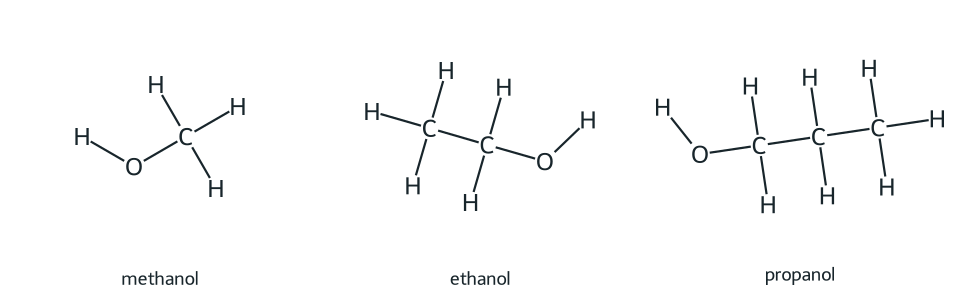
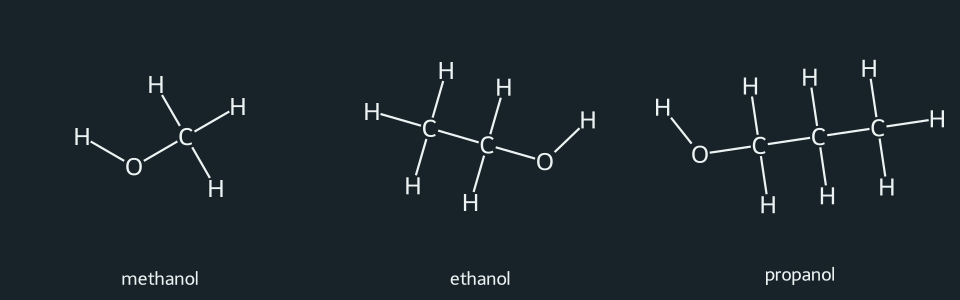
View figure data
| Alcohol | Molecular formula | Carbon atoms | Position of -OH |
|---|---|---|---|
| methanol | CH₄O | 1 | on the carbon |
| ethanol | C₂H₆O | 2 | on an end carbon |
| propanol | C₃H₈O | 3 | on an end carbon |
| Carbon atoms | Name | Molecular formula | Condensed formula |
|---|---|---|---|
| 1 | methanol | CH₄O | CH₃OH |
| 2 | ethanol | C₂H₆O | CH₃CH₂OH or C₂H₅OH |
| 3 | propanol | C₃H₈O | CH₃CH₂CH₂OH |
Here, propanol means the end-group structure CH₃CH₂CH₂OH, more precisely named propan-1-ol.
The -OH group in an alcohol is covalently bonded to carbon. It is not a hydroxide ion, OH⁻; the presence of this group does not make a substance an alkali.
Check your understanding 1 Count the alcohol’s atoms and bonds
For ethanol, CH₃CH₂OH, count all carbon, hydrogen and oxygen atoms. Count the covalent bonds formed by its oxygen. Include the hydrogen in the alcohol group.
Show answer
Ethanol has molecular formula C₂H₆O. Its oxygen forms two covalent bonds, C–O and O–H. The bonded alcohol group is not a separate hydroxide ion. Now construct the complete structure and explain the bonding.
Check your understanding 2 Construct and explain ethanol’s bonding
Draw every atom and bond in ethanol on paper, describe the bonding and name its functional group. You need not transcribe the drawing.
Work on paper or in the optional notes. Compare a complete paper drawing with every C–H bond, the C–C bond, C–O–H and the covalent hydroxyl group.
Show answer
The two carbons share a single bond. One has three hydrogens; the other has two hydrogens and a bond to oxygen. Oxygen also bonds to one hydrogen. Each carbon has four bonds and oxygen has two. The functional group is -OH (hydroxyl).
Make ethanol by fermentation
Yeast converts glucose into ethanol and carbon dioxide. Enzymes in the yeast catalyse the reaction.
| Condition | Why it is needed |
|---|---|
| glucose dissolved in water, with yeast | yeast enzymes act on dissolved glucose |
| warm, about 30–35 °C | cold slows the enzymes; too hot destroys (denatures) them and fermentation stops |
| no air (anaerobic) | fermentation does not use oxygen; limiting air reduces competing aerobic respiration and helps protect the ethanol from oxidation |
Keep air out while allowing carbon dioxide to escape, for example through a suitable fermentation airlock. Do not seal a gas-producing fermentation in a rigid, airtight bottle. Carbon dioxide would build up pressure. Excluding air helps produce and preserve ethanol; it does not mean yeast can never form any ethanol when oxygen is present.
Worked example 1
Read the fermentation equation
Problem
One mole of glucose ferments completely. Use the balanced equation to state the amounts of ethanol and carbon dioxide formed, and check that the equation balances.
Show solution step by step
Read the coefficients
Method
Use the numbers in front of each formula.Reason
The coefficients give the ratio of amounts in moles.
Working
Answer
glucose : ethanol : carbon dioxide = 1 : 2 : 2
Check the atoms balance
Method
Count each element on both sides.Reason
A balanced equation conserves every atom.Working
Answer
Carbon: 6 = 2(2) + 2(1). Hydrogen: 12 = 2(6). Oxygen: 6 = 2(1) + 2(2).
Answer
Working
Answer
1 mol of glucose forms 2 mol of ethanol and 2 mol of carbon dioxide.
Quick check
The equation describes ethanol and carbon dioxide formation without consuming oxygen. In this setup, keep air out and let the carbon dioxide escape.
Guided practice 2
Set up a fermentation
Problem
A student wants to make ethanol from glucose solution and yeast. Choose the conditions, identify the gas and choose how it can escape safely.
Choose each condition
Hints
Hint 1
enzymes
Yeast contains enzymes.
Hint 2
equation
Look at the products in the fermentation equation.
Show full solution
Conditions
Working
Answer
Keep the mixture warm, at about 35 °C, and keep air out. Carbon dioxide bubbles off as the glucose ferments.
Quick check
Each condition protects the yeast or the ethanol it makes.
Check the structure before naming it
A learner calls ethanol an alkali because it contains -OH. The mistake is treating a covalently bonded group as a separate ion. The alcohol group is part of an uncharged molecule; an alkali produces OH⁻ ions in water.
Check your understanding 3 Explain the missing oxygen and the bonded group
What is wrong with giving ethanol the formula C₂H₆?
Work on paper or in the optional notes. Compare ethane with ethanol, total hydrogens and the oxygen introduced in C–O–H; compare a covalent group with a hydroxide ion.
Show answer
That is ethane’s formula. Replacing one C–H bond with C–O–H adds one oxygen while keeping the same total number of hydrogens. Ethanol has molecular formula C₂H₆O, often written C₂H₅OH to show the alcohol group.
Check your understanding 4 Name and count the complete propanol molecule
Name CH₃CH₂CH₂OH. How many covalent bonds does one molecule contain, and how many of them are C–H bonds?
Show answer
It is propanol (propan-1-ol). There are 2 C–C bonds, 7 C–H bonds (3 + 2 + 2), 1 C–O bond and 1 O–H bond: 11 covalent bonds, 7 of them C–H. Check from the bonding rules: three carbons with four bonds, eight hydrogens with one and one oxygen with two give (12 + 8 + 2)/2 = 11 bonds, since each bond joins two atoms.
Worked example 3
Convert a mass through the fermentation ratio
Problem
Show solution step by step
Convert glucose mass to amount
Method
Use n = m/M, where n is amount in moles, m mass and M molar mass.Reason
The equation relates amounts in moles, not masses in grams.Working
Answer
n(C₆H₁₂O₆) = 18.0/180 = 0.100 mol.Apply the coefficient ratio
Method
Multiply by the ethanol-to-glucose ratio 2/1.Reason
One mole of glucose forms two moles of ethanol.Working
Answer
n(C₂H₅OH) = 0.100(2) = 0.200 mol.Convert ethanol amount to mass
Method
Use m = nM with ethanol’s molar mass.Reason
The target is a mass, not an amount.Working
Answer
m(C₂H₅OH) = 0.200(46.0) = 9.20 g.
Quick check
Check your understanding 5 Convert, apply the ratio and convert back
Glucose of mass 90.0 g ferments completely. Use M(C₆H₁₂O₆) = 180 g mol⁻¹ and M(C₂H₅OH) = 46.0 g mol⁻¹. Find the glucose amount, apply the 1:2 glucose-to-ethanol mole ratio, then find the ethanol mass.
Show the steps Optional working
Show answer
The amounts are 0.500 mol glucose and 1.00 mol ethanol, giving 46.0 g ethanol. Now show the complete method and explain yeast’s role in the next activity.
Check your understanding 6 Explain the complete mass method and yeast’s role
90.0 g of glucose ferments completely. Calculate the mass of ethanol formed, and explain the role of yeast. Use M(C₆H₁₂O₆) = 180 g mol⁻¹ and M(C₂H₅OH) = 46.0 g mol⁻¹.
Work on paper or in the optional notes. Compare the mass–mole conversion, coefficient ratio, ethanol mass and yeast enzymes as catalysts.
Show answer
n(C₆H₁₂O₆) = 90.0/180 = 0.500 mol. The 1:2 glucose-to-ethanol ratio in C₆H₁₂O₆ → 2C₂H₅OH + 2CO₂ gives 1.00 mol ethanol, so the mass is 1.00(46.0) = 46.0 g. Enzymes in yeast catalyse the conversion of glucose to ethanol and carbon dioxide.
Check your understanding 7 Separate excluding air from trapping gas
A fermentation produces carbon dioxide. Choose what the setup should do with that gas and with incoming air.
Show answer
A suitable airlock lets carbon dioxide out while keeping air out. Explain the problems with both the capped and open alternatives in the next activity.
Check your understanding 8 Explain both faulty fermentation setups
One student ferments glucose solution with yeast in a glass bottle with the cap screwed on tight. Another leaves the flask open to the air for a week. Predict a problem with each setup, and suggest a better one.
Work on paper or in the optional notes. Compare gas pressure in the tightly capped bottle, incoming oxygen in the open flask and the airlock’s two functions.
Show answer
In the capped bottle, carbon dioxide cannot escape, so pressure builds up and the bottle could burst. In the open flask, air gets in: aerobic respiration competes with fermentation, and the ethanol that forms can be oxidised. An airlock lets carbon dioxide out while keeping air out.
Common mistakes
- Drawing the -OH group as a hydroxide ion, or as OH⁻.
- Counting the carbons wrongly when naming, such as calling CH₃CH₂OH methanol.
- Leaving out a fermentation condition: yeast, no oxygen and a warm temperature.
- Writing the fermentation equation without carbon dioxide as a product.
Spotted an error? Report a correction
Syllabus and review details
- SEC G3 Combined Science Chemistry component 2027 · 2027
Chemistry content structure and subject content, PDF pages 26–36
Last reviewed: