Ethanol reactions and ethanoic acid
Key idea: Complete combustion turns ethanol into carbon dioxide and water. Oxidation to ethanoic acid keeps the two-carbon chain and changes the alcohol group into a carboxylic-acid group.
Offline pages
Saved on this device only. Connect at least once every 30 days to confirm Premium. Sign-out or a change of account removes saved copies.
Loading guide controls…
Guided lessons · coming soon
Guided lesson
Guided steps
- Follow every atom of ethanol into the combustion products.
- Read how ethanol is oxidised to ethanoic acid.
- Choose the colour change and the product.
- Write the oxidation equation and explain the colour change.
- Read how making ethanol differs from turning it into ethanoic acid.
- Name both reactions and their products.
- Explain both reactions, then compare your answer.
- Explain why waiting alone does not turn the wine sour.
- Read where the carbon goes in each reaction.
- Balance carbon and hydrogen, then the oxygen.
- Count the products and the oxygen needed for one propanol.
- Double the equation to make whole numbers.
- Write the whole equation and check every atom balances.
- Explain both methods and what you would see.
- Name the group and how it differs from an alcohol.
- Choose the carbon product of complete combustion.
- Explain why the conditions decide the product.
On this page
You stopped at:
ContinueEthanol burns completely to carbon dioxide and water, but an oxidising agent turns it into ethanoic acid while keeping its two-carbon chain. Following the carbon atoms tells the two reactions apart.
Complete combustion
Alcohols burn in plenty of oxygen to form carbon dioxide and water. This is why ethanol, including bioethanol from sugarcane, is used as a fuel.
Oxidation to ethanoic acid
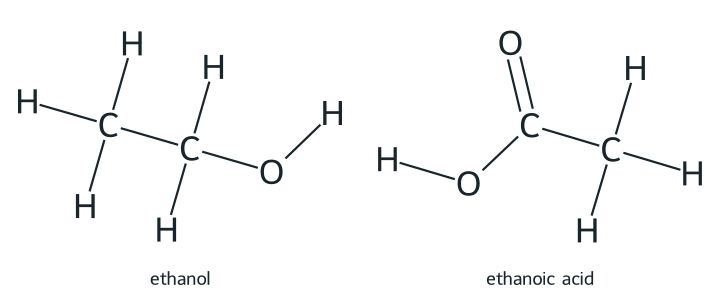
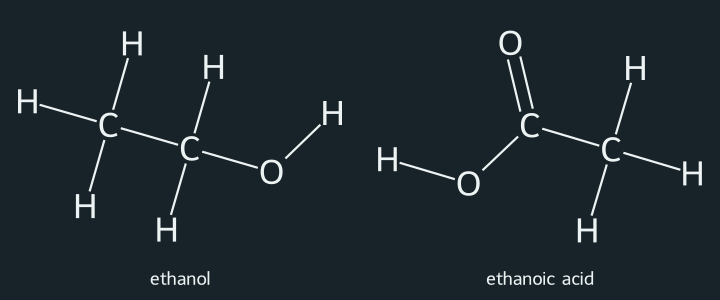
Ethanol can be oxidised to a carboxylic acid. The carboxylic acids form another homologous series: successive members differ by CH₂ and have similar chemical properties because they share the same functional group. Each contains the -CO₂H group (also written -COOH): a carbon with a double bond to one oxygen and a single bond to an -O-H group. Oxidising ethanol gives ethanoic acid, CH₃COOH, the acid in vinegar.
Ethanol and ethanoic acid
Ethanol is two carbons joined by a single bond; one carbon has three hydrogens and the other has two hydrogens and an O-H group. Ethanoic acid is two carbons joined by a single bond; one carbon has three hydrogens and the other has a double bond to an oxygen and a single bond to an O-H group.
Scroll across the figure to read all labels.
View figure data
| Molecule | Molecular formula | Functional group | Atoms on the second carbon |
|---|---|---|---|
| ethanol | C₂H₆O | -OH | 2 H and -OH |
| ethanoic acid | C₂H₄O₂ | -CO₂H | =O and -OH |
Use these two methods to oxidise ethanol to ethanoic acid. The alcohols shown in the previous lesson have their -OH group on an end carbon; do not extend their carboxylic-acid product rule to every possible alcohol structure.
| Oxidising agent | What happens | Observation |
|---|---|---|
| oxygen in the air | slow biological oxidation: bacteria use oxygen to convert ethanol in wine or beer into ethanoic acid | vinegar-like smell develops as ethanoic acid forms |
| acidified potassium manganate(VII), warmed | faster | purple manganate(VII) is decolourised as it reacts |
C₂H₅OH + O₂ → CH₃COOH + H₂O CH₃CH₂OH + 2[O] → CH₃COOH + H₂O
Air provides the oxygen, but suitable bacteria catalyse vinegar formation. Leaving clean ethanol open to the air does not, on its own, turn it into vinegar quickly.
In the second equation, [O] stands for oxygen provided by the oxidising agent. Water forms as well as ethanoic acid in both. Purple manganate(VII) is decolourised as it reacts; a large excess of the reagent can leave the final mixture purple.
Guided practice 1
Explain an oxidation observation
Problem
Ethanol is warmed with a small portion of acidified potassium manganate(VII), allowing the added reagent to react completely. State the colour change, the organic product and the homologous series it belongs to.
Observation, then product
Hints
Hint 1
reagent
The colour belongs to the reagent, not to the ethanol.
Hint 2
product
The -CH₂OH end becomes -CO₂H.
Show solution step by step
Observation
Method
Describe the colour of the reagent.Reason
The manganate(VII) ions are purple; they are used up as they oxidise the ethanol.
Working
Answer
The solution changes from purple to colourless.
Product
Working
Answer
Ethanol is oxidised to ethanoic acid, CH₃COOH, a carboxylic acid; water also forms.
Quick check
Purple to colourless is the manganate(VII) test result. Orange-brown to colourless is the bromine test for a carbon–carbon double bond.
Check your understanding 1 Connect the observation to the full oxidation
Draw ethanoic acid on paper, showing its two-carbon chain and the whole carboxylic-acid group. Write ethanol’s oxidation equation using [O] for oxygen provided by the oxidising agent. Explain which substance loses its purple colour when a small portion of acidified manganate(VII) reacts completely. Use optional comparison notes without transcribing the drawing.
Show answer
The product is ethanoic acid, CH₃COOH. Its methyl carbon joins a carbon that has a double bond to one O and a single bond to an O–H group. Keep the two-carbon chain; compare the displayed structure above. CH₃CH₂OH + 2[O] → CH₃COOH + H₂O. The purple colour belongs to the manganate(VII) reagent, not ethanol or the acid. It is decolourised as it reacts; the stated small portion is used up, whereas a large excess can leave the mixture purple.
Keep fermentation and oxidation separate
Check your understanding 2 Name each step before explaining the air conditions
Glucose in grape juice first reacts with yeast; later, suitable bacteria use air to change the ethanol. Choose each reaction and its main organic product.
Show answer
First fermentation makes ethanol; then oxidation makes ethanoic acid. Explain both reactions, their products and the different air conditions in the next activity.
Check your understanding 3 From grape juice to vinegar
Grape juice containing glucose is fermented with yeast in a vessel fitted with an airlock. Later, bacteria oxidise the ethanol using oxygen from the air. Name the reaction and organic product at each step, and explain why the air conditions differ.
Work on paper or in the optional notes. Compare the two reactions and organic products, fermentation’s gas escape and oxidation’s oxygen/bacterial requirements.
Show answer
First, fermentation converts glucose into ethanol and carbon dioxide. Keep air out for this setup, while allowing carbon dioxide to escape. Second, oxidation converts ethanol into ethanoic acid: oxygen is a reactant and bacteria catalyse the change. Ethanol is an alcohol; ethanoic acid is a carboxylic acid.
Check your understanding 4 Explain why time alone does not make vinegar
After fermentation, a learner removes the yeast and seals the ethanol in a clean flask with no oxygen or other oxidising agent. They predict that it will turn into vinegar if left long enough. Explain what is missing from their proposed reaction.
Work on paper or in the optional notes. Compare the missing oxidising agent and biological catalyst with the fermentation that already made ethanol.
Show answer
Making ethanoic acid from ethanol requires oxidation. The sealed flask has no oxygen or other oxidising agent to supply that change, so time alone does not make vinegar. For biological vinegar formation, oxygen and suitable bacteria are needed; fermentation has already produced ethanol and is a different reaction.
Compare the products and observations
| Process | What happens to the carbon? | Products to name |
|---|---|---|
| Fermentation of glucose | the six-carbon glucose molecule forms smaller products | ethanol and carbon dioxide |
| Complete combustion of ethanol | both ethanol carbon atoms form carbon dioxide | carbon dioxide and water |
| Oxidation of ethanol to ethanoic acid | the two-carbon chain remains | ethanoic acid and water |
The purple-to-colourless observation belongs to acidified potassium manganate(VII) being reduced. It is not the colour of ethanol or ethanoic acid, and it is different from the orange-brown bromine test for a carbon–carbon double bond.
Worked example 2
Count fuel oxygen before finding air oxygen
Problem
Show solution step by step
Balance carbon and hydrogen
Method
Make two carbon dioxide and three water molecules.Reason
The ethanol contains two C and six H atoms.Working
Answer
2CO₂ and 3H₂O contain 4 + 3 = 7 oxygen atoms.Account for oxygen already in the fuel
Method
Subtract the one O atom in ethanol, then divide the remainder by two.Reason
Not every product oxygen comes from O₂; each oxygen molecule supplies two atoms.Working
Answer
Air supplies 7-1 = 6 O atoms, so 6/2 = 3 oxygen molecules.Check the complete equation
Working
Answer
C₂H₅OH + 3O₂ → 2CO₂ + 3H₂O. Each side has 2 C, 6 H and 7 O atoms.
Check your understanding 5 Balance products and account for the fuel oxygen
For one molecule of propanol, C₃H₇OH, find the number of carbon dioxide and water molecules formed in complete combustion. Then count the oxygen atoms that must come from air after allowing for the oxygen already in propanol.
Show answer
One propanol forms three carbon dioxide and four water molecules. The products need ten oxygen atoms, one from the alcohol and nine from air. That is 4.5 oxygen molecules per propanol; double all amounts to obtain the smallest whole-number equation.
Check your understanding 6 Use the smallest whole-number coefficients
Complete the smallest whole-number coefficients in ? C₃H₇OH + ? O₂ → ? CO₂ + ? H₂O. Doubling the one-propanol result removes the fractional oxygen coefficient.
Show answer
2C₃H₇OH + 9O₂ → 6CO₂ + 8H₂O. Now construct the complete equation and compare every atom total.
Check your understanding 7 Construct and check propanol’s complete combustion
Write and check the balanced equation for complete combustion of propanol, C₃H₇OH, in excess oxygen.
Work on paper or in the optional notes. Compare the complete equation, smallest whole-number coefficients and 6 C, 16 H and 20 O atoms on each side.
Show answer
2C₃H₇OH + 9O₂ → 6CO₂ + 8H₂O. Each propanol molecule’s three carbons give three carbon dioxide molecules, and its eight hydrogens give four water molecules. Those products need ten oxygen atoms per propanol, one of which is already in the propanol, so nine oxygen atoms (41/2 O₂) must come from the air; doubling gives whole numbers. Check: there are 20 oxygen atoms on each side.
Check your understanding 8 Explain biological and laboratory oxidation
An open bottle of wine starts to smell of vinegar after a few weeks. Name the organic product and explain what happened in the bottle. Then describe a faster way to make the same product from ethanol in the laboratory, with the observation you would expect.
Work on paper or in the optional notes. Compare product identity, oxygen and bacteria in wine with the warmed acidified reagent, colour observation and excess-reagent limit.
Show answer
The product is ethanoic acid. Bacteria used oxygen from the air to oxidise the ethanol in the wine slowly. In the laboratory, warm ethanol with a small portion of acidified potassium manganate(VII): the purple reagent is decolourised as it oxidises the ethanol. A large excess of reagent could leave the mixture purple.
Check your understanding 9 Explain the whole carboxylic-acid group
A carbon is double-bonded to one oxygen and single-bonded to an -OH oxygen. Identify the whole functional group and explain why it is not an alcohol group.
Work on paper or in the optional notes. Compare the double-bonded oxygen and O–H oxygen together, and how the carbon’s bonding differs from an alcohol.
Show answer
Together the bonds form -CO₂H (or -COOH), the carboxylic-acid group. The alcohol group has its oxygen bonded to a carbon with only single bonds; here that carbon also has a C = O bond.
Check your understanding 10 Use the actual reaction conditions
Ethanol burns completely in plenty of oxygen. Choose the carbon-containing product and whether the ethanol’s two-carbon chain remains intact.
Show answer
Both ethanol carbon atoms enter carbon dioxide in complete combustion. The next activity asks why the word “oxidation” on its own does not tell you the product is ethanoic acid.
Check your understanding 11 Correct the conclusion using products and conditions
A student burns ethanol completely and says it must form ethanoic acid because ethanol is being oxidised. Correct the conclusion.
Work on paper or in the optional notes. Compare combustion’s carbon fate with chain-retaining oxidation and explain why both can be oxidation reactions with different products.
Show answer
Complete combustion is oxidation, but it forms carbon dioxide and water: both carbon atoms enter carbon dioxide. Oxidation to ethanoic acid keeps the two-carbon chain. The reaction conditions determine the products; the word “oxidation” alone does not.
Common mistakes
- Writing combustion products for an oxidation, or the reverse.
- Drawing ethanoic acid without the -COOH group.
- Confusing fermentation, which makes ethanol, with oxidation, which uses it up.
- Saying the oxidising agent changed colour because the ethanol did.
Spotted an error? Report a correction
Syllabus and review details
- SEC G3 Combined Science Chemistry component 2027 · 2027
Chemistry content structure and subject content, PDF pages 26–36
Last reviewed: