Alkanes, alkenes and their structures
Key idea: Carbon forms four bonds and hydrogen one. Alkanes have only single carbon-carbon bonds; alkenes have a carbon-carbon double bond and are unsaturated.
Offline pages
Saved on this device only. Connect at least once every 30 days to confirm Premium. Sign-out or a change of account removes saved copies.
Loading guide controls…
Guided lessons · coming soon
Guided lesson
Guided steps
- Build the carbon chain and give every carbon four bonds.
- Count the bonds before adding hydrogen to each carbon.
- Compare the atom counts and single bonds in alkanes.
- Compare double-bonded alkenes with saturated chains.
- Count the hydrogens needed on each carbon.
- Draw the complete molecule and explain why it is unsaturated.
- Connect homologous-series bonding with chemical and physical properties.
- Test both formulae before naming this open-chain molecule.
- Identify the family, saturation and name, then count the atoms.
- Count all bonds around each carbon, including the double bond.
- Correct the drawing and explain why its formula was insufficient.
- Decide whether C₃H₈ can contain a carbon–carbon double bond.
- Draw ethene and explain why a one-carbon alkene cannot exist.
On this page
You stopped at:
ContinueMethane, ethane and propane are alkanes; ethene and propene are alkenes. Every structure in this lesson follows from two bonding rules: in a covalent molecule, carbon forms four bonds and hydrogen forms one. A double bond is two shared pairs, so it counts as two of carbon’s four bonds.
This lesson uses open-chain hydrocarbons: the carbon atoms form a chain, not a ring. When a question gives a structure, check the bonds as well as counting atoms.
Build a structure from bonding rules
A displayed structure (displayed formula) shows every atom and every bond as a line. You can build one without memorising it:
- Join the carbon atoms in a chain.
- Count the bonds each carbon already has.
- Give each carbon hydrogen atoms until it has four bonds.
- Count the atoms to get the molecular formula.
Worked example 1
Build the structure of propane
Problem
Propane is a hydrocarbon with a chain of three carbon atoms joined by single bonds. Build its displayed structure and find its molecular formula.
Show solution step by step
Count bonds already used
Method
Draw C–C–C and count each carbon’s bonds.Reason
Each carbon needs four bonds in total.Working
Answer
End carbons: 1 bond each. Middle carbon: 2 bonds.
Add hydrogen atoms
Method
Fill each carbon up to four bonds with hydrogen.
Reason
Each hydrogen forms one bond.Working
Answer
End carbons: 3 H each. Middle carbon: 2 H. Total: 3 + 2 + 3 = 8 H.
Write the formulae
Working
Answer
Molecular formula C₃H₈; condensed formula CH₃CH₂CH₃. The displayed structure is the third one in the figure below.
Quick check
Check with the alkane formula: for 3 carbons, 2(3) + 2 = 8 hydrogens.
Alkanes: only single bonds
An alkane is a hydrocarbon in which every carbon–carbon bond is a single bond. Each carbon holds as many hydrogen atoms as it can, so alkanes are saturated. The alkanes follow the general formula CₙH₂ₙ₊₂, where n is the number of carbon atoms. Their names end in -ane; the start of the name counts the carbons: meth- (1), eth- (2), prop- (3).
Methane, ethane and propane
Methane is one carbon with four hydrogens. Ethane is two carbons joined by a single bond with three hydrogens on each carbon. Propane is a chain of three carbons joined by single bonds, with three hydrogens on each end carbon and two on the middle carbon.
Scroll across the figure to read all labels.
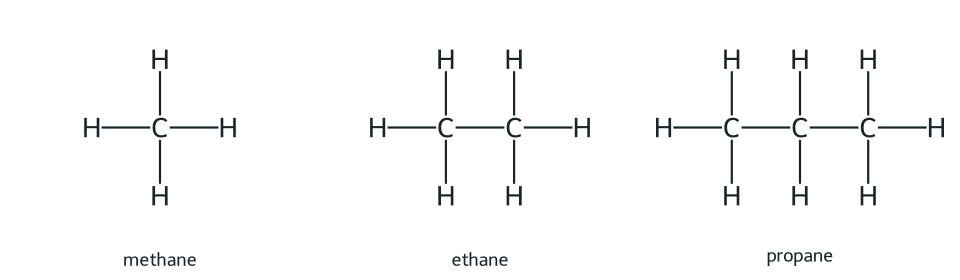
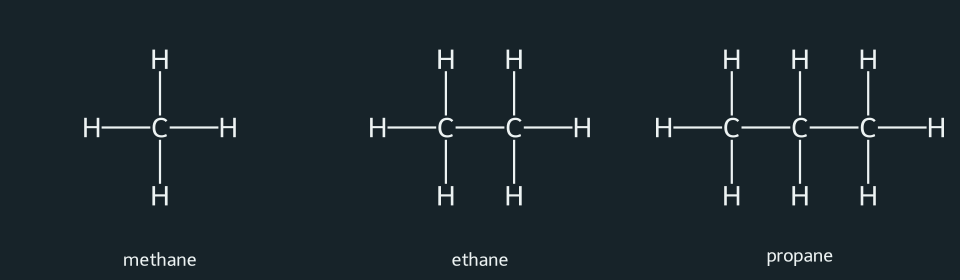
View figure data
| Alkane | Molecular formula | Carbon–carbon bonds | Hydrogen atoms |
|---|---|---|---|
| methane | CH₄ | none | 4 |
| ethane | C₂H₆ | 1 single | 6 |
| propane | C₃H₈ | 2 single | 8 |
| Carbon atoms | Name | Molecular formula | Condensed formula |
|---|---|---|---|
| 1 | methane | CH₄ | CH₄ |
| 2 | ethane | C₂H₆ | CH₃CH₃ |
| 3 | propane | C₃H₈ | CH₃CH₂CH₃ |
Alkenes: one carbon–carbon double bond
The alkenes studied here are open-chain hydrocarbons containing one carbon–carbon double bond, C = C. The double bond uses two of each carbon’s four bonds, so those carbons hold fewer hydrogen atoms. Alkenes are unsaturated. They follow the general formula CₙH₂ₙ and their names end in -ene.
There is no one-carbon alkene: a double bond between carbon atoms needs at least two carbons. The first two alkenes are ethene and propene.
Ethene and propene
Ethene is two carbons joined by a double bond, with two hydrogens on each carbon. Propene is a chain of three carbons. A double bond joins an end carbon carrying two hydrogens to the middle carbon, which carries one hydrogen; a single bond joins the middle carbon to the other end carbon, which carries three hydrogens.
Scroll across the figure to read all labels.
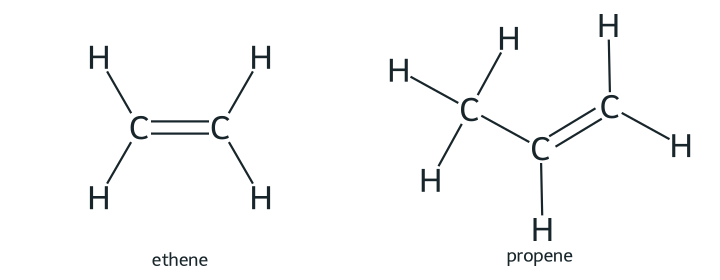
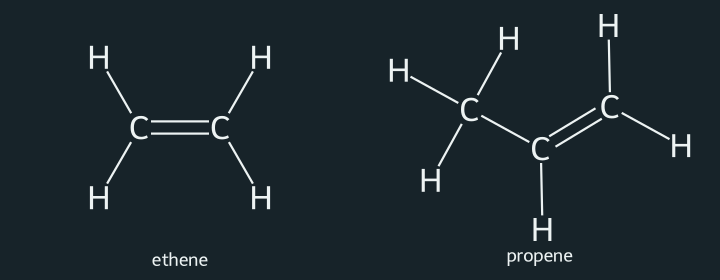
View figure data
| Alkene | Molecular formula | Carbon–carbon bonds | Hydrogen atoms |
|---|---|---|---|
| ethene | C₂H₄ | 1 double | 4 |
| propene | C₃H₆ | 1 double, 1 single | 6 |
| Carbon atoms | Name | Molecular formula | Condensed formula |
|---|---|---|---|
| 1 | none | — | — |
| 2 | ethene | C₂H₄ | CH₂ = CH₂ |
| 3 | propene | C₃H₆ | CH₂ = CHCH₃ |
Check your understanding 1 Fill each carbon to four bonds
A propene chain is C=C–C. Count the hydrogen atoms needed on the first, middle and last carbon. A double bond counts as two bonds.
Show answer
The hydrogen counts are 2, 1 and 3. Together they give C₃H₆. A count alone is not a displayed structure: draw every atom and bond in the next activity.
Check your understanding 2 Draw the complete propene structure
On paper, draw every atom and bond in propene from the C=C–C chain. Then give its molecular formula and explain why it is unsaturated. You can keep the drawing on paper and use optional notes for comparison.
Show answer
Your drawing should show two H on the first carbon, one H on the middle carbon and three H on the last carbon, each joined by a single bond. Retain the double bond between the first two carbons and the single bond between the last two. Every C has four bonds and every H one. There are three C and six H: C₃H₆. The C=C bond makes it unsaturated. CH₂ = CHCH₃ summarises the connections but is a condensed formula; a displayed structure draws every hydrogen and bond. Compare your paper drawing with the propene figure above.
Homologous series
The alkanes form one homologous series and the alkenes form another. A homologous series is a family of compounds that:
- share one general formula, so each member differs from the next by CH₂;
- have similar chemical properties, because they have the same kind of bonding (for alkenes, the C = C bond);
- show a gradual change in physical properties as the molecules get larger and heavier.
| Alkane | Boiling point / °C | Alkene | Boiling point / °C |
|---|---|---|---|
| methane | −162 | — | — |
| ethane | −89 | ethene | −104 |
| propane | −42 | propene | −48 |
Boiling point rises down each series. Larger molecules attract one another more strongly, so more energy is needed to separate them. Viscosity also generally increases for comparable liquid hydrocarbons at the same temperature: the larger-molecule fractions of crude oil flow less readily. Melting points do not increase smoothly for every successive member; how molecules pack in a solid also matters.
Worked example 2
Classify a molecular formula
Problem
Show full solution
Test both general formulae
Method
Substitute n = 3 into each general formula.Reason
For the open-chain molecules considered here, the hydrogen count tells you which series fits.Working
Answer
Alkane: C₃H₈. Alkene: C₃H₆.Classify and name
Working
Answer
C₃H₆ matches CₙH₂ₙ, so it is an alkene with a C = C bond: propene.
Quick check
Guided practice 3
Read a structure before naming it
Problem
Use the bond and the carbon count
Hints
Hint 1
bond
Look for a double bond first.Hint 2
formula
Choose the general formula for the series you identified.Show solution step by step
Identify the series
Method
Inspect the carbon–carbon bond.Reason
It is single, and every carbon has its full complement of hydrogens.Working
Answer
Alkane; saturated.Name it and check the formula
Method
Count carbons, then hydrogens.Reason
Two carbons give eth-; for n = 2, CₙH₂ₙ₊₂ gives six hydrogens.Working
Answer
Ethane, C₂H₆.
Quick check
Spot the mistake 4
A propene drawing with too many hydrogens
Learner working
A learner draws propene as a chain C=C–C and puts two hydrogens on each of the three carbons, then writes the formula C₃H₆. The formula is right but the drawing is wrong. First count each carbon’s bonds. Then correct the complete displayed structure in the next activity.
Count the bonds on each carbon
Show solution step by step
Count bonds carbon by carbon
Method
Add the double bond, the single bond and the hydrogens on each carbon.
Reason
Every carbon must have exactly four bonds.Working
Answer
First carbon: 2 (double bond) + 2 H = 4. Middle carbon: 2 (double bond)
- 1 (single bond) + 2 H = 5. Third carbon: 1 + 2 H = 3.
Correct the drawing
Working
Answer
The middle carbon has five bonds and the end carbon only three. Give the middle carbon one hydrogen and the end carbon three: (CH₂ = CH - CH₃).
Common mistake
A correct molecular formula does not check the structure. Count the four bonds on every carbon, remembering that a double bond counts as two.
Check your understanding 3 Correct the drawing and its bonds
A C=C–C chain was drawn with two hydrogens on every carbon. Correct the displayed drawing on paper and explain why the right total formula did not check each carbon’s bonds. Use optional notes if helpful.
Show answer
The middle carbon has five bonds while the last has only three. Move one hydrogen from the middle to the last carbon: the counts become 2, 1 and 3. Draw each C–H bond so every carbon has four bonds. The condensed structure is CH₂ = CHCH₃ and the molecular formula remains C₃H₆. Counting six hydrogens in total did not check which carbon they were joined to; both the formula and the local bonding must be right.
Check your understanding 4 Can this molecule have a double bond?
A learner draws a hydrocarbon with formula C₃H₈ and includes one (C = C) bond. Use the bonding rules to decide whether this is possible.
Work on paper or in the optional notes. Compare the carbon-by-carbon bond limits, hydrogen total and saturated/unsaturated conclusion.
Show answer
It is not possible. With a C = C bond in a three-carbon chain, the carbons have room for only 6 hydrogens in total, giving C₃H₆ (propene). Eight hydrogens need every carbon–carbon bond to be single, so C₃H₈ must be the saturated alkane propane.
Check your understanding 5 Build a second structure independently
Draw the displayed structure of ethene on paper, showing every atom and bond. Give its molecular formula and explain why there is no one-carbon alkene. Use optional notes for your comparison.
Show answer
Ethene has two carbons joined by a double bond. Each carbon carries two hydrogens, with every C–H bond drawn: C₂H₄. Every carbon has four bonds and every hydrogen one. There is no one-carbon alkene because the defining carbon–carbon double bond requires two carbon atoms. The ethene figure above provides the complete displayed model for comparison.
Common mistakes
- Drawing a carbon atom with three or five bonds.
- Writing “methene”. There is no one-carbon alkene.
- Using the -ene ending for a molecule with only single bonds.
- Using “saturated” to mean “dissolved”. Here it means having only single carbon–carbon bonds.
Spotted an error? Report a correction
Syllabus and review details
- SEC G3 Combined Science Chemistry component 2027 · 2027
Chemistry content structure and subject content, PDF pages 26–36
Last reviewed: