Biofuels and the carbon dioxide balance
Key idea: Bioethanol releases carbon dioxide when burned, but recent plant growth takes some from the air. Its net addition also depends on farming, processing, transport and land use.
Offline pages
Saved on this device only. Connect at least once every 30 days to confirm Premium. Sign-out or a change of account removes saved copies.
Loading guide controls…
Guided lessons · coming soon
Guided lesson
Guided steps
- Compare source replacement with carbon released on burning.
- Follow recent crop carbon and count other emissions.
- Add releases, subtract uptake once and compare the same journey.
- Read net addition as other emissions change.
- Find the break-even point and compare the higher-emission case.
- Explain how lower production emissions change the net addition.
- Separate ethanol combustion from crop carbon uptake.
- Correct the claim that bioethanol releases no carbon dioxide.
- Compare regrowing a crop with forming new crude oil.
- Add both releases, then subtract uptake once.
- Explain why one uptake cannot cancel every release.
- Calculate both net additions and their difference.
- Explain what forest clearance adds to the comparison.
On this page
You stopped at:
ContinueA fuel can be renewable and still release carbon dioxide. In this lesson you explain how plant growth offsets carbon dioxide from burning bioethanol, then compare the emissions from supplying and using two fuels. Start with the meaning of non-renewable in Fossil fuels and crude oil fractions.
Why bioethanol is renewable
A biofuel is made from recent biological material, such as crops or organic waste. Bioethanol can be made from sugarcane: sugar is fermented to make ethanol, C₂H₅OH. A new crop can grow within a human timescale to replace the one used, so this is a renewable source. Crude oil and natural gas take millions of years to form; using them does not bring about a similar replacement.
Renewable describes replacement of the source. It does not mean that burning the fuel releases no carbon dioxide:
Recent uptake and the burning emission
- Growing sugarcane takes in carbon dioxide by photosynthesis.
- Some of that carbon becomes the ethanol in the fuel.
- Complete combustion returns that carbon to the air as carbon dioxide.
The uptake associated with the fuel can offset its burning emission. A fossil fuel has no corresponding recent crop uptake: burning it returns carbon that was stored away for millions of years. This recent uptake is the carbon dioxide advantage you must be able to explain.
For the full comparison, also count emissions from farming, fertiliser production, processing and transport. Changes in land use matter too: clearing a forest can release stored carbon. Bioethanol can have a smaller net addition than a fossil fuel, but the full emission balance decides the result. The IPCC explanation of bioenergy describes why production and land use affect the climate comparison.
Compare fuels for the same useful output, such as the same journey. Use the same stages for both: include fuel supply as well as burning. This lesson’s numerical model counts carbon dioxide; other greenhouse gases and environmental effects also matter in a wider evaluation.
A carbon dioxide budget
Net addition = releases − recent uptake associated with the fuel. A positive result means that this use adds carbon dioxide overall.
Worked example 1
Compare the carbon dioxide from two fuels
Problem
A car makes the same journey twice. Using petrol, burning releases 2.3 kg of carbon dioxide, and fuel extraction, processing and transport release another 0.4 kg. Using bioethanol, burning the fuel releases 2.2 kg of carbon dioxide; the recent sugarcane uptake associated with that fuel was 2.2 kg; farming, processing and transport released 0.8 kg. Assume no change in carbon stored in the land. These figures are illustrative and include the stated supply stages for both fuels. Compare their net carbon dioxide additions for the same journey.
Show solution step by step
Start with the carbon dioxide released
Method
List every release for each fuel.Reason
Both fuels contain carbon, so both release carbon dioxide when they burn.
Working
Answer
Petrol: 2.3 kg + 0.4 kg = 2.7 kg. Bioethanol: 2.2 kg + 0.8 kg = 3.0 kg.
Subtract the uptake during growth
Method
Take away the carbon dioxide the crop removed from the air.
Reason
Only the biofuel has a recent crop that took in carbon dioxide; petrol has none.
Working
Answer
Bioethanol: 3.0 kg − 2.2 kg = 0.8 kg. Petrol: 2.7 kg − 0 kg = 2.7 kg.
Compare
Working
Answer
Bioethanol adds 0.8 kg of carbon dioxide to the air and petrol adds 2.7 kg. Bioethanol adds less, but not zero, because the other stages still release carbon dioxide.
Quick check
The uptake during growth cancels only the carbon dioxide from burning the bioethanol itself. It does not cancel the emissions from farming, processing and transport.
When other emissions change the result
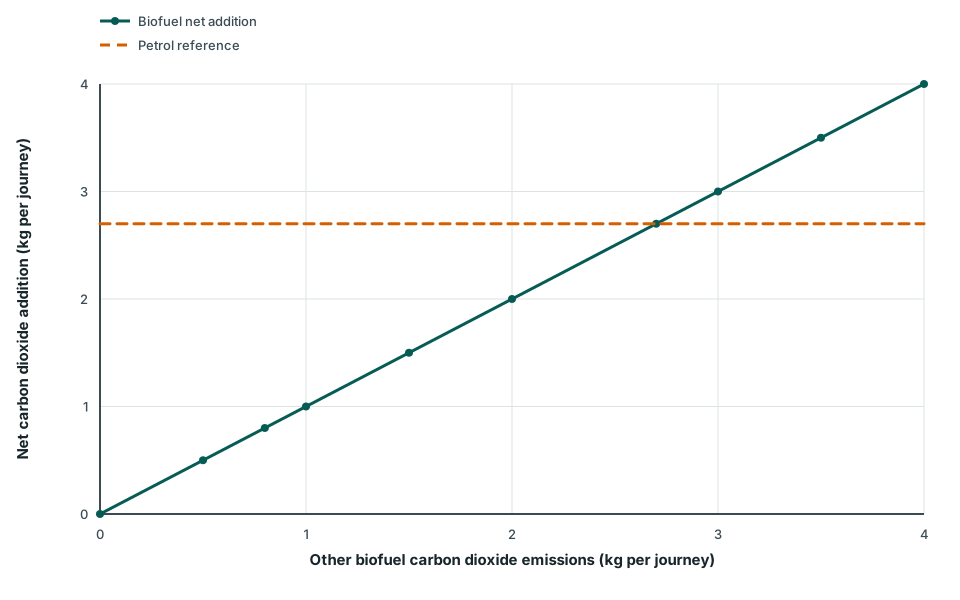
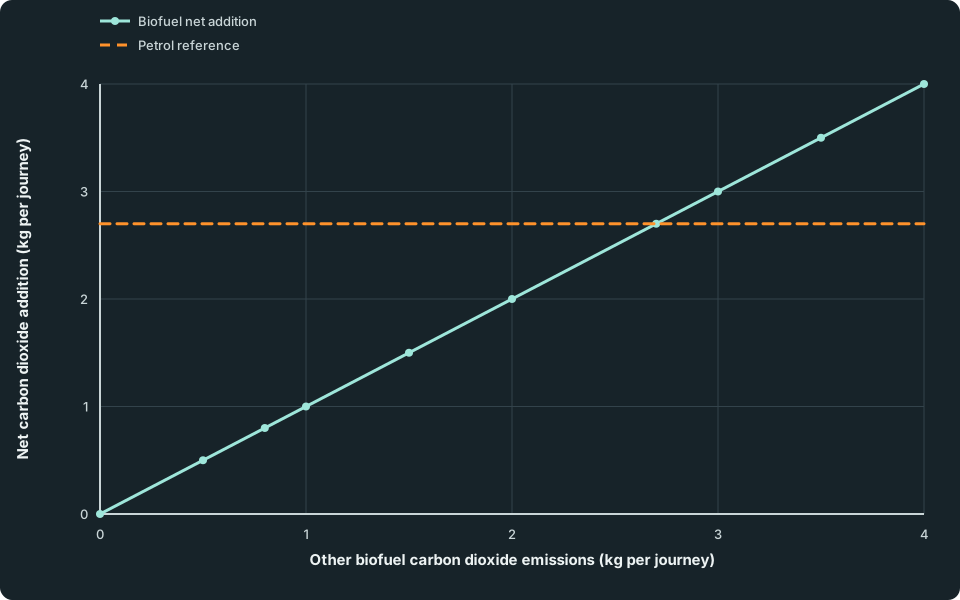
The graph keeps the worked example’s 2.2 kg burning emission and 2.2 kg recent uptake equal. It varies only the other biofuel emissions, including production and transport. Petrol’s stated total stays at 2.7 kg for the same journey.
Other emissions can change the biofuel comparison
Other biofuel carbon dioxide emissions on the horizontal axis and net carbon dioxide addition on the vertical axis, both in kilograms per journey. The biofuel line rises from zero to four kilograms; the petrol reference stays at 2.7 kilograms. Below 2.7 kilograms the biofuel net addition is smaller; above 2.7 it is larger.
Scroll across the figure to read all labels.
View figure data
| Other biofuel carbon dioxide emissions (kg per journey) | Biofuel net addition | Petrol reference |
|---|---|---|
| 0.0 | 0.0 | 2.7 |
| 0.5 | 0.5 | 2.7 |
| 0.8 | 0.8 | 2.7 |
| 1.0 | 1.0 | 2.7 |
| 1.5 | 1.5 | 2.7 |
| 2.0 | 2.0 | 2.7 |
| 2.7 | 2.7 | 2.7 |
| 3.0 | 3.0 | 2.7 |
| 3.5 | 3.5 | 2.7 |
| 4.0 | 4.0 | 2.7 |
Read the net addition, rather than deciding from the fuel’s name:
- Other biofuel emissions of 0.8 kg give a net addition of 0.8 kg: less than petrol’s 2.7 kg.
- At 2.7 kg, the net additions are equal in this model.
- At 3.5 kg, bioethanol adds more carbon dioxide than petrol, despite being renewable.
Check your understanding 1 Find the break-even point in this model
The graph keeps bioethanol’s 2.2 kg burning release and 2.2 kg recent uptake equal. Petrol’s net addition stays at 2.7 kg for the same journey. What other biofuel emissions give equal net additions? If the other emissions rise to 3.5 kg, which fuel has the larger net addition?
Show answer
At 2.7 kg of other emissions the net additions are equal. At 3.5 kg, bioethanol adds 0.8 kg more than petrol in this model. The equality between burning and uptake was given for this comparison; renewable alone tells you neither that those amounts are equal nor which net addition is smaller.
Check your understanding 2 Explain a change to production emissions
What would happen to the biofuel result if making the fuel used less fossil-fuel energy?
Work on paper or in the optional notes. Keep burning and uptake fixed while comparing the production release and the net result on the graph.
Show answer
Its production emissions would decrease. With the same burning emission and crop uptake, its net carbon dioxide addition would decrease too. This moves its result down the rising line.
Correct a common explanation
Check your understanding 3 Separate the release from the offset
Before correcting the claim below, decide whether complete combustion of ethanol releases carbon dioxide and identify the process responsible for the recent crop uptake.
Show answer
Ethanol combustion releases carbon dioxide. Recent crop photosynthesis takes some carbon dioxide from the air; the uptake associated with this fuel can offset some releases. Explain the full balance and its limits in the next activity.
Spot the mistake 2
“Bioethanol gives off no carbon dioxide”
Learner claim
Correct the explanation
Show solution step by step
Find the error
Method
Check the equation for burning ethanol.Reason
Ethanol contains carbon, so burning it must form carbon dioxide.Working
Answer
C₂H₅OH + 3O₂ → 2CO₂ + 3H₂OGive the real reason
Working
Answer
Bioethanol does release carbon dioxide when it burns. The carbon in the ethanol was taken from the air during recent plant growth, so the uptake allocated to that fuel can offset its burning emission. A fossil fuel has no such recent uptake. Farming, processing, transport and changes in land use can add emissions. Compare the complete stated carbon dioxide balance before concluding that a biofuel has the smaller net addition.
Common mistake
Check your understanding
Check your understanding 4 Explain replacement on the relevant timescale
A farmer plants a replacement sugarcane crop after harvesting a crop for bioethanol. A petrol supplier plans to leave an exhausted oil field unused for five years. Which plan can replace its fuel source within a human timescale? Explain.
Work on paper or in the optional notes. Compare a replacement crop with oil-field formation, rather than treating a short pause in use as renewal.
Show answer
The sugarcane plan can replace the harvested crop as a new crop grows. Five years cannot replace an oil field: crude oil takes millions of years to form. Regrowing a source makes the biofuel renewable; leaving a fossil-fuel store unused briefly does not renew it.
Check your understanding 5 Add releases before subtracting uptake
A batch releases 1.8 kg of carbon dioxide on burning and another 0.4 kg during supply. Its associated recent crop uptake is 1.1 kg. Find the total release, then the net addition. Count the given uptake once.
Show the steps Optional working
Show answer
Total release is 2.2 kg; net addition is 1.1 kg. The same 1.1 kg uptake cannot be subtracted again from another part of the release. Explain the complete balance in the next activity.
Check your understanding 6 Explain why the uptake does not cancel every release
A batch of bioethanol releases 1.8 kg of carbon dioxide when burned. Its associated recent crop uptake is 1.1 kg, and supplying the fuel releases another 0.4 kg. Calculate the net addition and explain why the crop uptake does not cancel every release.
Work on paper or in the optional notes. Compare the complete calculation, both release stages and the uptake counted once.
Show answer
The net addition is 1.8 + 0.4-1.1 = 1.1 kg of carbon dioxide. The stated uptake offsets only 1.1 kg of the 2.2 kg released; it cannot be counted again against the remaining emissions. Recent uptake can reduce the net addition without making it zero.
Check your understanding 7 Compare net additions for the same journey
For the same journey, a biofuel releases 2.0 kg on burning, has 2.0 kg of associated recent plant uptake and releases 3.2 kg in its other stages. Petrol’s total addition is 2.7 kg. Calculate and compare their net additions. Give the difference as biofuel’s net addition minus petrol’s.
Show the steps Optional working
Show the steps Optional working
Show answer
Biofuel: 2.0 + 3.2 − 2.0 = 3.2 kg. Petrol: 2.7 kg. In this example the biofuel adds 0.5 kg more carbon dioxide. Renewable does not automatically mean a smaller net addition.
Check your understanding 8 Explain the missing land-use release
A crop is grown on land cleared of forest. Explain why considering only plant uptake and fuel burning could give a misleading climate comparison.
Work on paper or in the optional notes. Compare the carbon stored in vegetation and soil with a boundary that counted only the crop and burning.
Show answer
Clearing the forest can release carbon stored in vegetation and soil. Leaving out that change omits part of the carbon dioxide addition. The full comparison must account for it.
Spotted an error? Report a correction
Syllabus and review details
- SEC G3 Combined Science Chemistry component 2027 · 2027
Chemistry content structure and subject content, PDF pages 26–36
Last reviewed: