Alkene reactions and the bromine test
Key idea: Alkenes add atoms across their carbon-carbon double bond. This removes bromine water's colour; adding hydrogen with heated nickel makes an unsaturated oil more saturated.
Offline pages
Saved on this device only. Connect at least once every 30 days to confirm Premium. Sign-out or a change of account removes saved copies.
Loading guide controls…
Guided lessons · coming soon
Guided lesson
Guided steps
- Track the atoms added across the double bond.
- Predict both addition products for propene.
- Count product atoms and choose the carbon–carbon bond.
- Compare the colour change with the conclusion.
- Record both observations and identify the two gases.
- Explain how hydrogenation can make an oil harder.
- Choose the reaction type and product.
- Explain what happens to the atoms and bonds.
- Use the bromine drops to compare hydrogen needed.
- Choose the hydrogenation catalyst and condition.
- Write the balanced equation with its conditions.
- Correct the observation and explain what the test tells you.
- Count the double bonds left and judge saturation.
- Explain oil classification and how hydrogenation changes it.
On this page
You stopped at:
ContinueAn alkene’s carbon–carbon double bond gives it a reaction that alkanes do not readily undergo: addition. This lesson shows how to predict addition products, interpret the bromine test and apply hydrogenation to vegetable oils.
Use hydrocarbon structures to locate a C=C bond and count the bonds around each carbon. In Alkane reactions and cracking, you learn how substitution differs from addition and how cracking supplies alkenes.
What you will learn
Predict the products of ethene and propene reacting with bromine or hydrogen, explain their combustion, and separate what you see from what you conclude in an aqueous-bromine test. Then use the same addition model to explain polyunsaturated oils and making a harder fat for margarine. Addition polymerisation is introduced here and developed in the next lesson.
Alkenes react by addition
The C = C bond makes alkenes much more reactive than alkanes. In an addition reaction, one of the two bonds in C = C breaks and a new atom joins each of the two carbons. For ethene adding bromine or hydrogen, there is one organic product and it is saturated. A molecule with several double bonds may still be unsaturated after one addition. Ethene shows the reactions you need.
| Reaction of ethene | Reactant and condition | Product |
|---|---|---|
| addition of bromine | aqueous bromine, room temperature | 1,2-dibromoethane, C₂H₄Br₂ |
| addition of hydrogen (hydrogenation) | hydrogen, heated with a nickel catalyst | ethane, C₂H₆ |
| polymerisation | many ethene molecules join | poly(ethene), in the polymers lesson |
| combustion | plenty of oxygen | carbon dioxide and water |
C₂H₄ + Br₂ → C₂H₄Br₂ C₂H₄ + H₂ → (Ni, heat) C₂H₆ C₂H₄ + 3O₂ → 2CO₂ + 2H₂O
Ethene and its two addition products
Ethene has a carbon-carbon double bond with two hydrogens on each carbon. In 1,2-dibromoethane the carbons are joined by a single bond and each carbon carries two hydrogens and one bromine. In ethane the carbons are joined by a single bond and each carbon carries three hydrogens.
Scroll across the figure to read all labels.
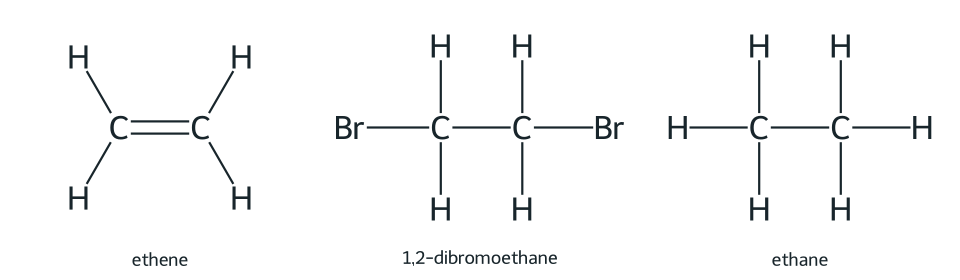
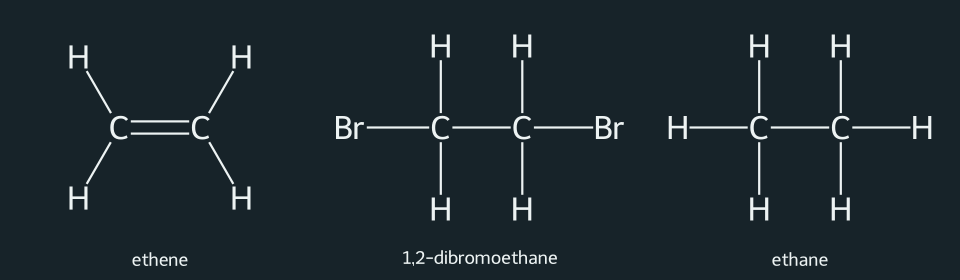
View figure data
| Molecule | Molecular formula | Carbon–carbon bond | Atoms on each carbon |
|---|---|---|---|
| ethene | C₂H₄ | double | 2 H |
| 1,2-dibromoethane | C₂H₄Br₂ | single | 2 H and 1 Br |
| ethane | C₂H₆ | single | 3 H |
Worked example 1
Predict the products for propene
Problem
Show solution step by step
Find the double bond
Method
Locate the two carbons joined by C = C.Reason
Addition happens only at the double bond; the CH₃ group does not change.Working
Answer
CH₂ = CH-CH₃: the first two carbons.Add bromine
Method
Put one bromine atom on each of those carbons.Reason
Both atoms of Br₂ join the molecule; nothing leaves.Working
Answer
C₃H₆ + Br₂ → C₃H₆Br₂, which is CH₂BrCHBrCH₃ (1,2-dibromopropane).Add hydrogen
Working
Answer
C₃H₆ + H₂ → C₃H₈: one hydrogen joins each carbon of the double bond, giving propane.
Quick check
Check your understanding 1 Track atoms across bromine addition
Propene, C₃H₆, adds one Br₂ molecule across its double bond. Enter the carbon, hydrogen and bromine atom counts in the product, then choose the bond between those two carbons. These checks cover the counts and bond; use the full model to inspect the connections.
Show answer
The product is C₃H₆Br₂, with a single bond between the first two carbons. Its condensed structure is CH₂BrCHBrCH₃, not CH₃CH₂CH₂Br: one bromine joins each former double-bond carbon. Count every atom and check four bonds on each carbon against the full model above.
The bromine test: observation, then inference
A saturated hydrocarbon, such as ethane, has only single carbon–carbon bonds. An unsaturated hydrocarbon, such as ethene, has a C = C bond. You can see the difference in their structures, and you can detect it with a test. To compare an alkane with an alkene, use aqueous bromine (bromine water) at room temperature, away from UV light, under supervised laboratory conditions. Shake or bubble the gas through the solution as appropriate. UV light could start an alkane substitution reaction, making this comparison misleading.
| Hydrocarbon | Observation (what you see) | Inference (what it means) |
|---|---|---|
| alkene, such as ethene | orange-brown colour disappears: the solution turns colourless | bromine has added across a C = C bond; the hydrocarbon is unsaturated |
| alkane, such as ethane | stays orange-brown | no C = C bond; the hydrocarbon is saturated |
Keep the two columns apart. An observation is only what you see or measure. An inference is the conclusion you draw from it. For the alkanes and alkenes in this comparison, decolourisation is evidence of a C = C bond; it does not show which alkene you have. Write “colourless”, not “clear”: a clear solution can still be coloured.
Guided practice 2
Identify two unknown gases
Problem
Gases X and Y are propane and propene, in an unknown order. Both have three carbon atoms, and the tests are kept away from UV light. Each is bubbled through aqueous bromine. With X the solution turns colourless. With Y the solution stays orange-brown. Record the evidence and identify each gas.
Separate what you see from what you conclude
Hints
Hint 1
observation
Write only the colour change.
Hint 2
inference
Of the two possible gases, propene adds bromine across C=C at room temperature away from UV light.
Show solution step by step
Record the observations
Method
Write only the colour seen for each gas.Reason
An observation must not contain the conclusion.Working
Answer
X: orange-brown to colourless. Y: no change; stays orange-brown.
Infer and identify
Method
Use the bond each result shows, then the carbon count.
Reason
Only the three-carbon alkene has a (C = C) bond.
Working
Answer
X is unsaturated: propene, C₃H₆. Y is saturated: propane, C₃H₈.
Quick check
The test alone shows only the bond. The “three carbon atoms” information is what lets you name the gas.
Polyunsaturated oils and margarine
Vegetable oils contain molecules with C = C bonds, so they are unsaturated. Polyunsaturated means that the molecules contain more than one carbon–carbon double bond.
One way to make a harder fat for margarine is to add hydrogen to unsaturated vegetable oil, heated with a nickel catalyst. Hydrogen adds across some of the C = C bonds. The product is more saturated and has a higher melting point, so suitable partial hydrogenation can make a fat that is solid or semi-solid at room temperature and can be spread.
Spot the mistake 3
“Hydrogenation is substitution”
Learner claim
Use the reagent and the C=C change
Show solution step by step
Track the double bond
Method
Add one hydrogen atom to each carbon of C = C.Reason
The double bond becomes a single bond and the chain becomes saturated.Working
Answer
C₃H₆ + H₂ → C₃H₈Name the process
Method
Call it addition (hydrogenation).Reason
No atom is removed from propene; both hydrogen atoms are added.Working
Answer
Product: propane. Reaction: addition, with a nickel catalyst.
Common mistake
Check your understanding 2 Explain the correction using atoms and bonds
Propene reacts with hydrogen over heated nickel to form propane. Explain what changes at C=C, what happens to both hydrogen atoms and why the process is addition rather than substitution. Work on paper or in the optional notes.
Show answer
C₃H₆ + H₂ → C₃H₈. The C=C double bond becomes a single bond. One hydrogen atom joins each of those two carbons, and the CH₃ part remains unchanged. No atom is removed from propene; all atoms of both reactants appear in one organic product. This is addition, specifically hydrogenation, with heated nickel as catalyst. Substitution would replace an atom and form a second product such as hydrogen chloride.
Giving UV light as the condition for alkene addition (UV light is for alkane substitution). Writing “clear” for colourless. Saying the bromine test identifies ethene rather than a (C = C) bond. Saying cracking separates crude oil (fractional distillation separates; cracking breaks molecules). Calling every unsaturated oil polyunsaturated.
Compare two oil samples
Check your understanding 3 Which oil sample uses more bromine?
Equal volumes of two vegetable oils are tested with bromine water of the same concentration, equal-sized drops and the same mixing conditions. Assume only addition at C=C uses up the bromine. Oil A decolourises 12 drops of aqueous bromine before the orange-brown colour stays. Oil B decolourises 3 drops. Which sample uses up more bromine, indicating more reactive (C = C) bonds in the tested volume? For the same tested volumes, which would need more hydrogen if all of those double bonds were converted to single bonds? Calculate how many times as much hydrogen oil A would need as oil B.
Show answer
Each drop of bromine is used up by adding across a C = C bond, so the oil that decolourises more bromine has more C = C bonds. Under the stated assumptions, oil A has more reactive double bonds in the tested volume. The test does not tell you how many double bonds are in each molecule. For complete hydrogenation of the same tested volumes, oil A would need four times as much hydrogen: both bromine and hydrogen add one molecule across each double bond.
Practise on your own
Check your understanding 4 Choose the conditions before writing the equation
For hydrogen addition to ethene in this lesson, choose the catalyst and other condition.
Show answer
Use heat and a nickel catalyst. Now construct the complete equation and track the added atoms in the next activity.
Check your understanding 5 Construct the hydrogenation equation
Write the equation for ethene reacting with hydrogen, and state the catalyst and other reaction condition.
Work on paper or in the optional notes. Compare the balanced formulae, heat/nickel conditions and atoms added to each carbon.
Show answer
C₂H₄ + H₂ → (Ni, heat) C₂H₆. Heat with a nickel catalyst. One H joins each double-bond carbon, making ethane; no atom is replaced.
Check your understanding 6 Correct an observation that contains a conclusion
A liquid hydrocarbon is either an alkane or an alkene. Away from UV light at room temperature, aqueous bromine changes from orange-brown to colourless. A learner records “The hydrocarbon is an alkene” as the observation. Separate the observation from the inference and explain whether this test identifies ethene specifically.
Work on paper or in the optional notes. Compare the actual colour change, inference within the stated choices and the limit on naming a particular alkene.
Show answer
Observation: aqueous bromine changed from orange-brown to colourless. Inference within the stated choices: the hydrocarbon contains a C=C bond and is an alkene. The result does not identify ethene specifically; other alkenes also use up bromine by addition.
Check your understanding 7 Check what one hydrogen molecule changes
A molecule has three carbon–carbon double bonds. One molecule of hydrogen adds at one of them. How many double bonds remain, and is the product saturated?
Show answer
Two double bonds remain: one hydrogen molecule changes one C=C to C–C. The remaining double bonds make the product unsaturated.
Check your understanding 8 Explain oil classification and harder-fat formation
An oil’s molecules have one carbon–carbon double bond each. Is “polyunsaturated” justified? Explain what hydrogenation changes when making a harder fat.
Work on paper or in the optional notes. Compare one versus several double bonds, hydrogen addition and the melting-point change.
Show answer
No. Polyunsaturated means more than one C=C bond per molecule. Hydrogenation adds hydrogen across double bonds; heating with nickel can make a more saturated fat with a higher melting point, making it harder at room temperature.
Next, find out how many ethene molecules join in Addition polymer structures and uses.
Spotted an error? Report a correction
Syllabus and review details
- SEC G3 Combined Science Chemistry component 2027 · 2027
Chemistry content structure and subject content, PDF pages 26–36
Last reviewed: